Lines
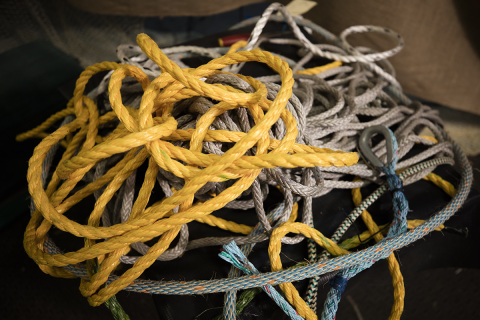
DescriptionLine is the term for a rope used in aquatic applications. A line is a cord made by twisting or braiding together natural or synthetic fibers. Lines can be braided, twisted, twisted composite, and have lead or foam centers. There are many types of lines, each with advantages, disadvantages, appropriate uses, and sometimes safety implications. | ||
Lines OverviewVIDEO LINK: Lines Overview | ||
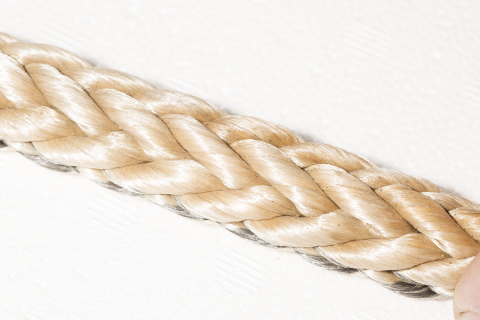
Braided line: made from multiple strands that are woven together | ||
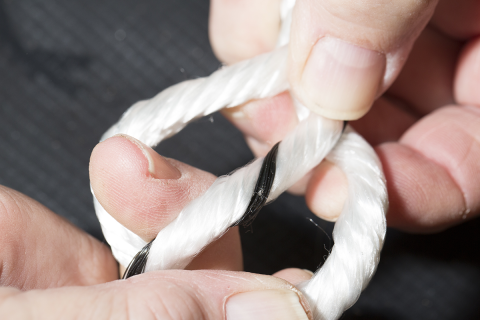
Twisted line: usually made by twisting three strands together to create a spiral pattern. A twisted Polydacron line with black-colored tracer used to identify the manufacturer. | ||
| Back to Top | ||
Nylon LineGenerally not recommended for fishing gears; except for tying boats to docks; do not use as a tow line unless using larger diameter line and/or smaller trawls as typical of hand bow trawling; maybe not good for anchor line; builds up kinetic energy when stretches; line breaks and whips back which is a safety issue. Specific gravity is around 1.14, so nylon line sinks but slowly. VIDEO LINK: Nylon Line | ||
Nylon Line StoryVIDEO LINK: Nylon Line Story | ||
| ||
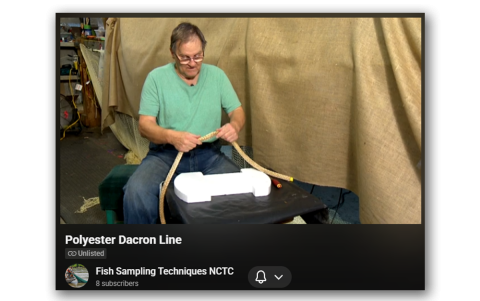
Polyester Line (Dacron)Polyester line is braided and comes in a squarish shape; thus, it is a good line for hauling by hand.It does stretch, less-so than nylon, but can store up significant kinetic energy, break and whip backward endangering crew, particularly if attached to a metal structure. Another braided line type would be preferable safety-wise; do not put polyester line under constant strain.
VIDEO LINK: Polyester Line (Dacron) | ||
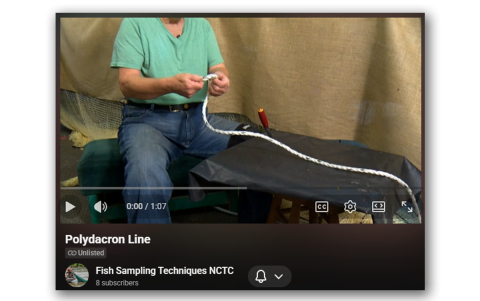
Polydacron LineA combination made of Dacron [= polyester] and polypropylene. The structure is dacron wrapped polypropylene.The black marker is a tracer (identifies the line manufacturer; but beware of tracer imitators that could be inferior quality). Dacron gives the line abrasion resistance; the polypropylene provides strength and keeps the rope from being unraveled. Specific gravity is 1.38 (will sink readily). Polydacron line will stretch about 20% before breakage. Good all-around rope, safely used for some trawls, tow lines, certain seines; there are many manufacturers. VIDEO LINK: Polydacron Line | ||
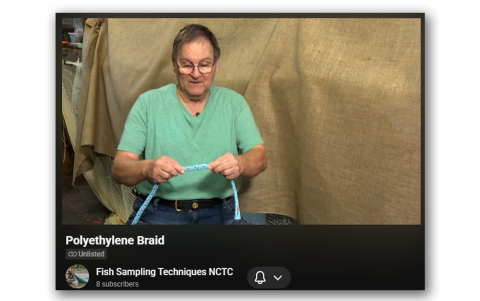
Polyethylene Braided Line
VIDEO LINK: Polyethylene Braided Line | ||
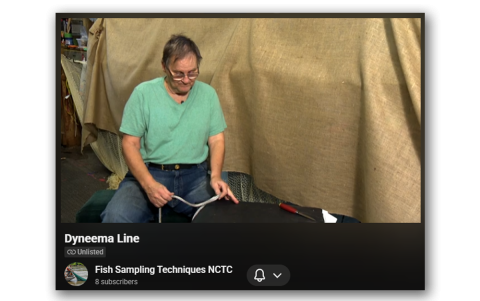
DyneemaThis line is as strong as steel cable.A 5/16” diameter, 8 strand Dyneema line has a minimum pull before breakage 14,000 pounds, can handle 7 tons before line breaks; 1/2” pulls >20 tons; Dyneema is the strongest rope in the world.
VIDEO LINK: Dyneema | ||
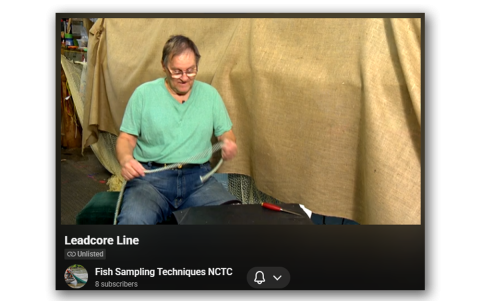
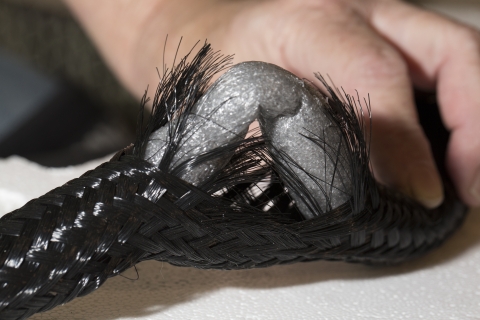
LeadcoreLeadcore contains a chain of lead pellets in the center, usually having a polyester cover or wrapping.This line is somewhat flexible.It is desirable to have a quality line where the polyester cover holds tightly to the lead pellet chain and has some flexibility.Lead pellet leadcore lays flat and has better bottom contact as opposed to line with lead weights (“balls”).
VIDEO LINK: Leadcore | ||
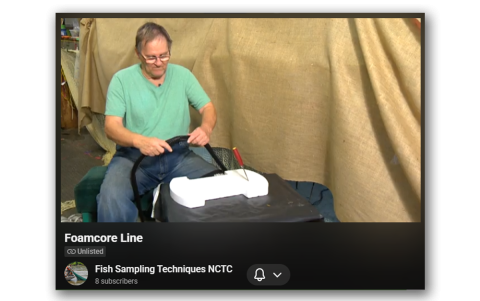
FoamcoreFoam core rope showing floatation material, the foam core. The floatation foam is in the middle. Foamcore takes the place of floats. A significant advantage is that buoyancy is distributed evenly. Disadvantages
Foamcore is not meant to be tugged on. Uses are mostly for nets that sink to the bottom, for holding nets vertical when in contact with the bottom (not for floating entire net at or near water surface). However, foamcore can be used for light weight floating gill and trammel nets. It comes in many sizes, 3/8”, 1/2", 3/4", 1”, etc. | ||
Foamcore LineVIDEO LINK: Foamcore Line | ||
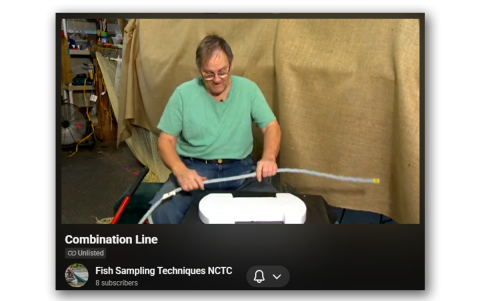
Combination Line | ||
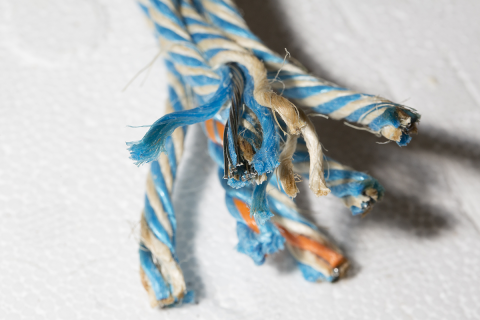
Combination rope showing steel core. “Combination Rope” (rope and steel cable on inside); 6 strands of polyester and polypropylene twine, each strand wrapped around stainless-steel wire; all the polyester/polypropylene/steel strands are wrapped around a very tightly wound single strand of polypropylene line at the very core or center (holds the other six strands in place, gives continuity); example is 1/2”, 5/16” are good sizes for trawls. Danish cable (colored blue and white) high quality (shown in video) Advantages
Disadvantages
Applications Bigger operations. Specifically, for hanging the headropes and footropes of large trawl nets (for the Great Lakes [Yankee trawls], Gulf of America, Atlantic Ocean). | ||
Combination LineVIDEO LINK: Combination Line | ||
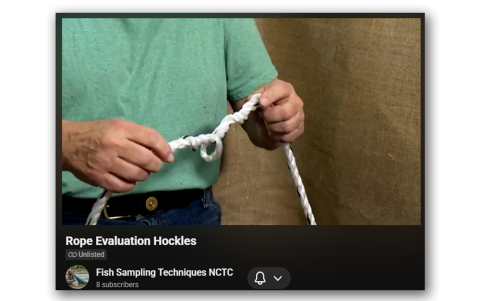
Rope EvaluationVIDEO LINK: Rope Evaluation | ||
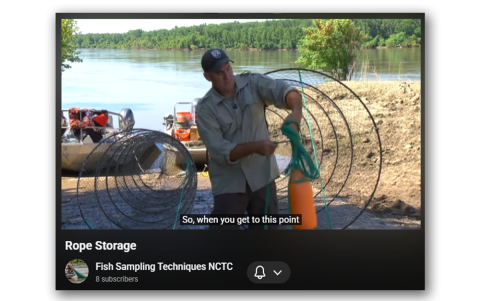
Rope StorageVIDEO LINK: Rope Storage | ||
| Back to Top |