DescriptionElectrofishing is the application of electricity into water to capture or control fish. Electrofishing gear takes several forms, the most common types are backpack, barge, and boat electrofishers. Backpack electrofishing is portable and is typically used in smaller streams. |
| Type | Active | | Habitat deployed | Mid-sized to large streams and rivers. Also, along shorelines of ponds, lakes, and backwaters. | | Target species | Small to mid-sized individuals of a diverse array of warmwater and coldwater species. |
|
Overview |
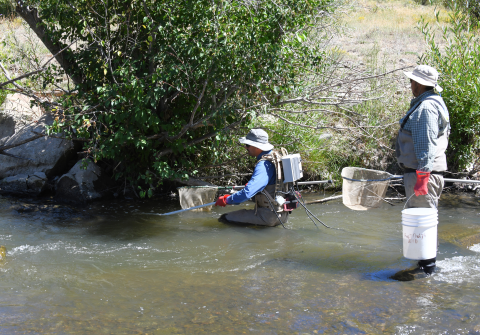
Backpack electrofishers or “shockers” are portable and have relatively low power compared to barge and boat shockers. Average Watts range between 200 – 400 Watts. Units are worn on the back of operators while wading. Crew size varies from two to four members, with primary roles of backpack operator, dip netter, and bucket carrier for captured fishes. The backpack operator also may use a dipnet as well as the bucket carrier. If the stream is wider than what can be effectively sampled by a single backpack crew, side-by-side backpack shocker crews can be added. Common protocols add a backpack shocker crew every 3 or 5 meters of width. Rarely, backpack shockers are placed in canoes or small jon boats to power floating systems. |
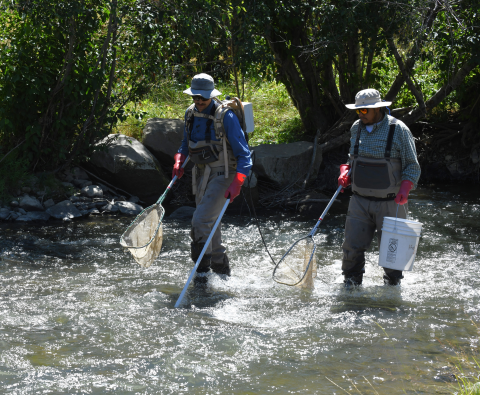
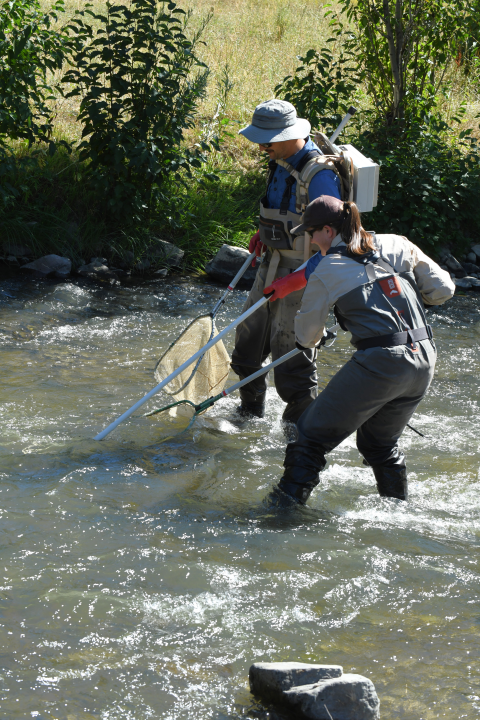
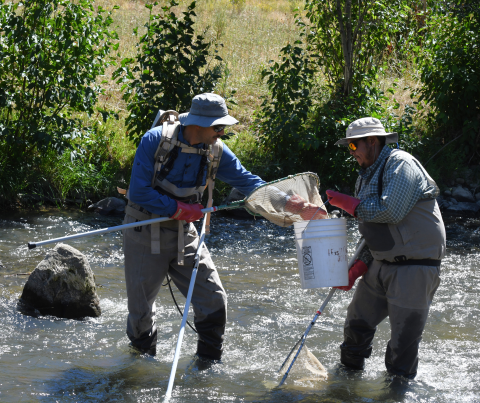
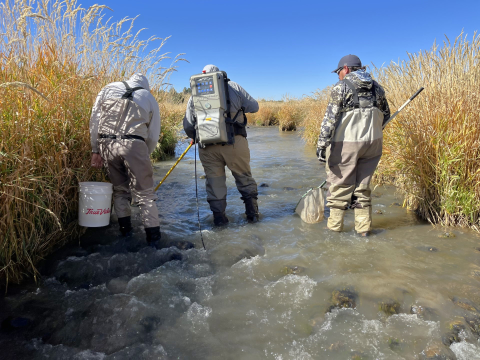
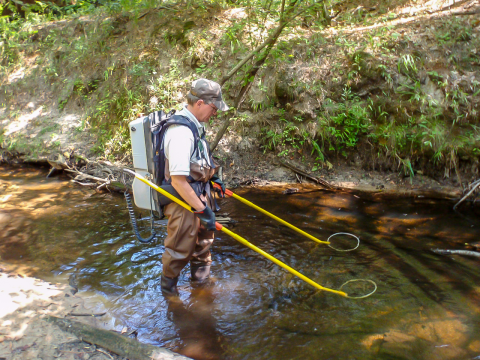
Backpack crews of two with a single hand-held electrode and cable cathode (“rattail”). |
Backpack crews of two with a single hand-held electrode and cable cathode (“rattail”). |
Backpack crews of two with a single hand-held electrode and cable cathode (“rattail”). |
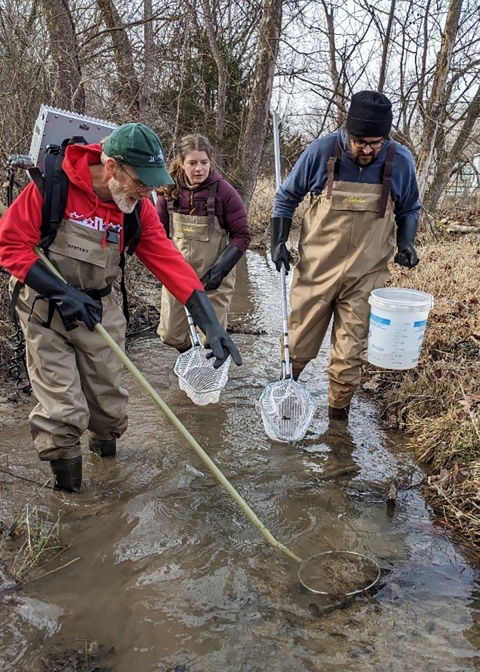
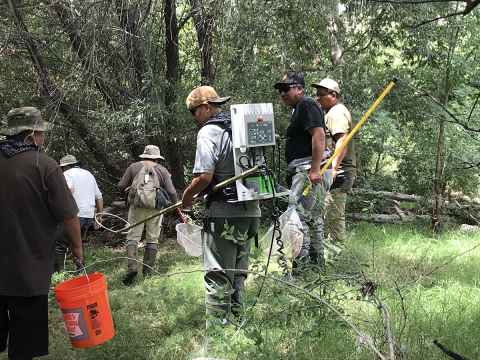
Backpack crew of three with a rattail cathode and bucket for holding captured fishes. |
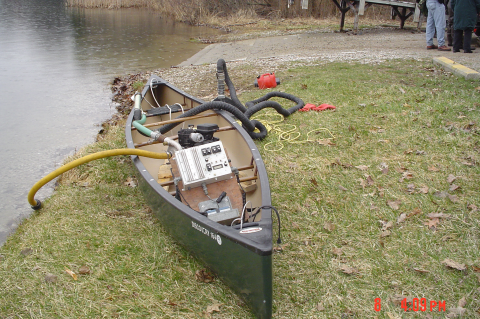
Deep-water larval lamprey canoe system powered by a backpack electrofisher. |
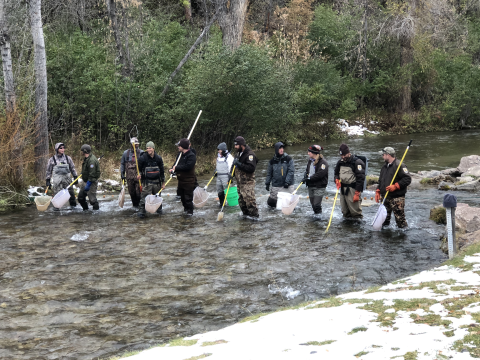
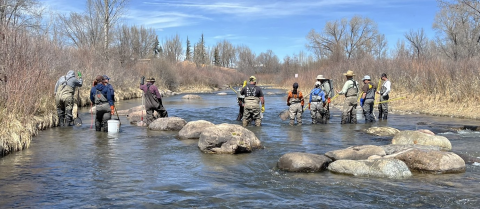
Deployment of side-by-side backpack electrofishers used to cover larger stream widths. |
Deployment of side-by-side backpack electrofishers used to cover larger stream widths. |
| Common protocols add a backpack shocker crew every 3 or 5 meters of width. Note that Barge Electrofishing may be a more efficient approach in wider and wadeable streams, especially when pools ≥ 1 m exist). |
Pros- Portable
- Ease of use
- Small crew size
- Confined areas can be sampled
- Can be very effective in smaller streams
- Some models have fine controls and output metering that permit sampling standardization and reduced fish trauma
- Electrodes can be changed to incorporate two handheld electrodes (anode and cathode), or change the form of the electrodes (diamond or circle, cable or whisked-end cable, etc.), or the size of the electrodes
- Lower power capacity is less of a safety risk to the crew
Cons- Power limitations
- Small electrical field
- Pools over 1 m (3’) can be difficult to effectively sample
- Battery maintenance (less complicated with lithium iron phosphate batteries)
- Can be heavy or tiresome to carry during an entire day
- U.S. backpack models typically range between 6.6 kg – 13.6 kg (15 lb – 30 lb)
- Lithium batteries are much lighter than corresponding lead acid batteries
|
Two-person crew sampling a deeper habitat |
| Back to Top |
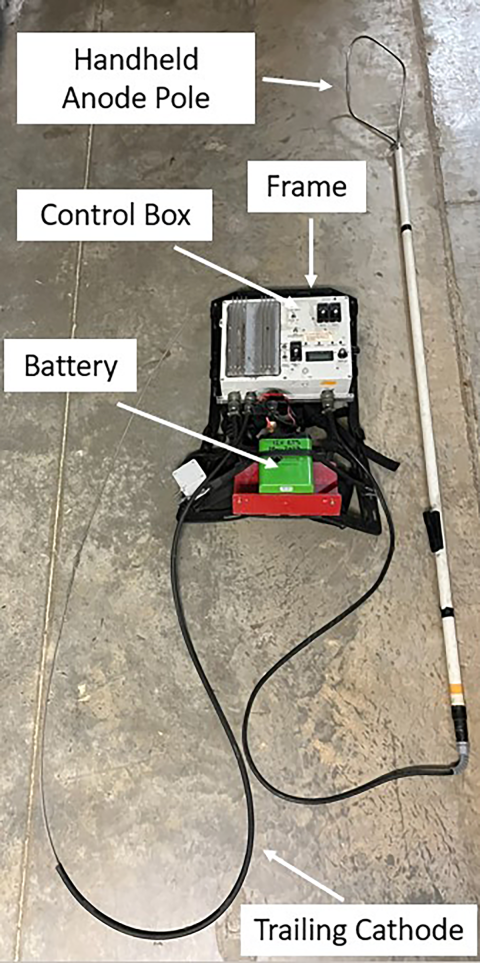
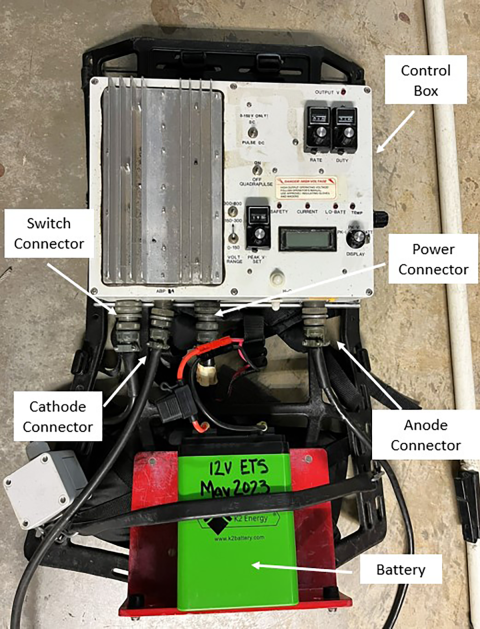
Backpack Electrofishing Anatomy |
Entire backpack with both electrodes and battery |
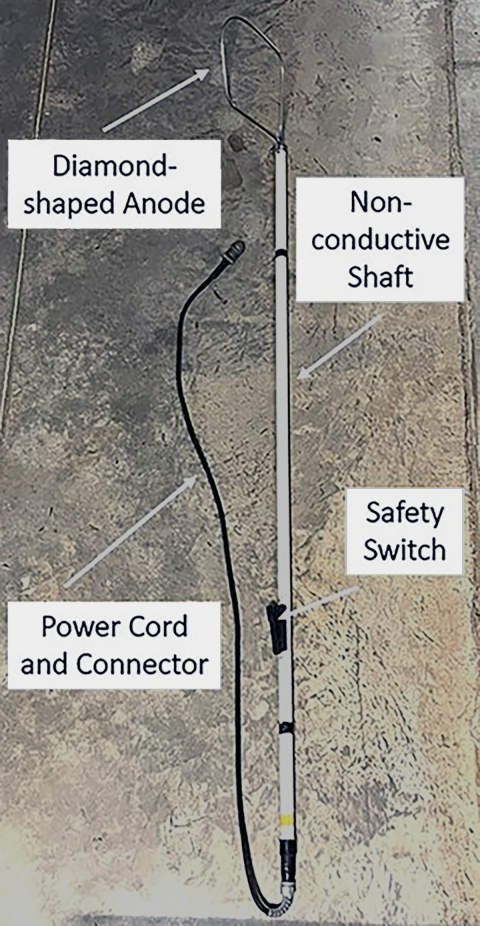
Handheld anode pole |
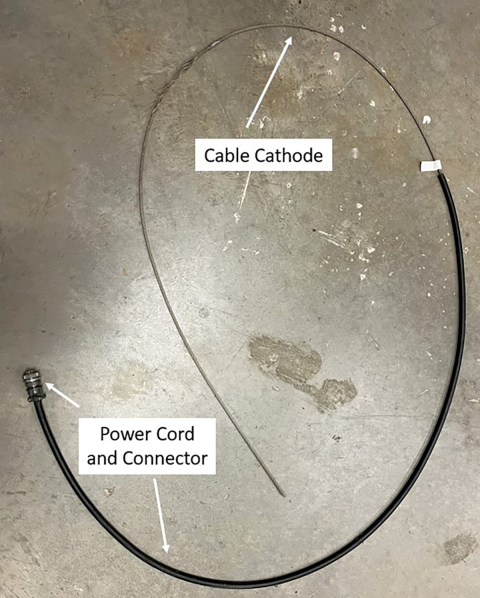
Cable or “Rattail” cathode |
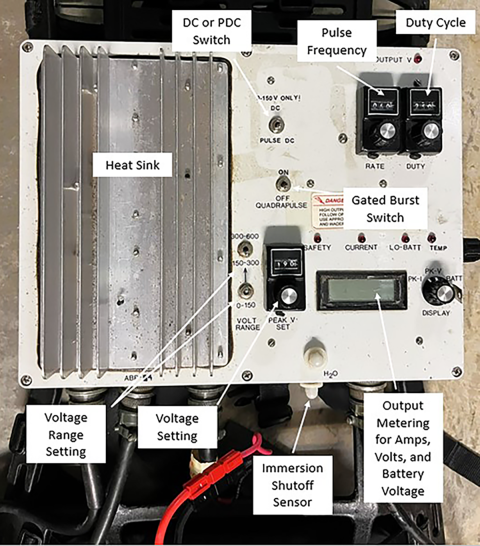
Control box |
Backpack with labeled parts. |
Control box with labeled controls and other features |
Electrode Arrangement |
Backpack shocker with two handheld electrodes. |
Backpack shocker with one handheld electrode and a trailing cable electrode (“rattail”). |
- Electrode configuration consists of either 1) two handheld electrodes or 2) a handheld electrode and a trailing cable electrode
- If using Alternating Current (AC), typically two handheld electrodes are configured.
- If using Direct Current (DC) or Pulsed Direct Current (PDC), either configuration is used.
- If your configuration has a rattail cathode and the operator often reaches back, grabs the rattail, and swings it forward near the anode to increase sampling effectiveness, then consider using two hand-held electrodes (anode and cathode) instead.
- When operating with AC, there is no consistent anode nor cathode.
- When outputting DC or PDC, there is a consistent anode and cathode.
- With DC/PDC electrofishing, the anode is always handheld; if using a trailing cable, that cable is always the cathode.
- The cathode must have a larger surface area than the anode so that more power is allocated to the anode (the electrode doing the “fishing”).
Although not recommended, some operators attach a net to a handheld electrode (usually the anode). There are potential fish welfare and crew safety drawbacks with netting electrodes. |
*For additional instructional videos on related topics as electrical waveforms, measuring water conductivity, standardized sampling, troubleshooting, and safety, see Electrofishing Essentials Course Resources |
| Back to Top |
Operation (Control box settings) |
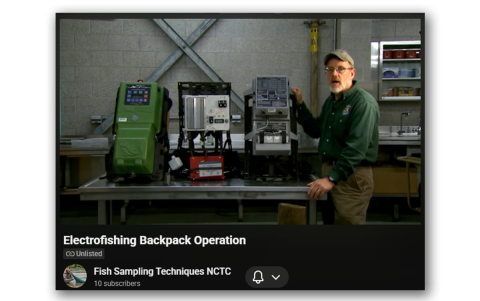
Electrofishing: Backpack OperationSetting the output on 3 different backpack models |
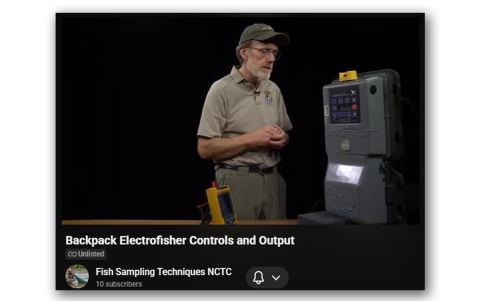
Electrofishing: Backpack Electrofisher Controls and OutputOperation of a backpack electrofisher showing settings and electrical outputs. |
- Backpacks vary in power capacity.
- Backpack controls differ, in adjustment resolution and accuracy.
- Output metering may not exist, only pertain to the battery, or display output Amperage, Voltage, and sometimes Power.
- To facilitate standardized sampling and care when targeting sensitive species, backpacks should have:
- a range of waveforms, especially DC, PDC, and Gated Burst;
- fine setting controls, i.e., small increments (as 1 pulse per second);
- independently controlled outputs (e.g., volts and duty cycle); and
- accurate output metering (Amps, Volts at minimum).
- To maximally extend the range of water conductivity that can be successfully sampled, purchase gear with the highest power capacity and AC output capability.
|
Deployment |
|
- Backpack electrofishing can sample 1) a segment of stream or shoreline, known as a “pass”, or 2) quadrat sample along transects.
- A pass can be made in a variety of ways, such as in a straight line or by zig-zagging.
- Do not rapidly move the hand-held electrode back and forth; instead move the anode deliberately, avoid “jerkiness”.
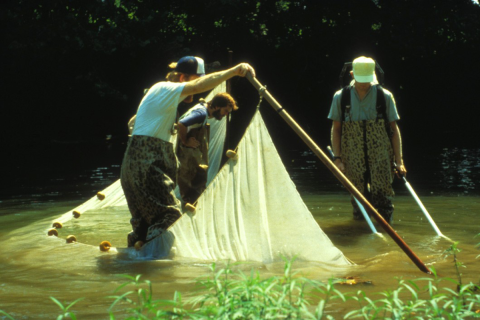
- Quadrat sampling is more effective in current when combined with a seine located just downstream to capture immobilized or escaping fishes.0 average Watts.
Quadrat sampling with a backpack that entails shocking a predefined area just upstream of a set seine. Fishes immobilized or with inhibited swimming flow down into the seine and are captured. In this instance, the backpack electrofisher has two handheld electrodes and is outputting AC. (Although this combination can be effective, employing prepositioned area shockers instead can increase efficiency in similar conditions). |
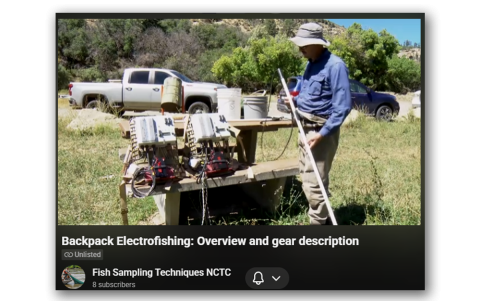
Backpack Electrofishing Overview and Gear Description |
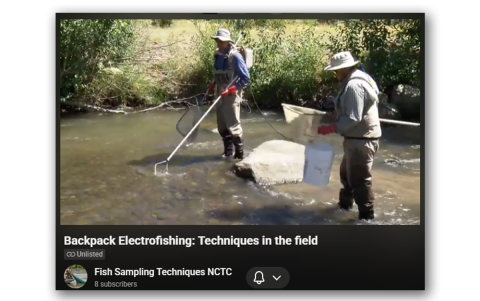
Backpack Electrofishing: Techniques in the Field |
Simple Troubleshooting |
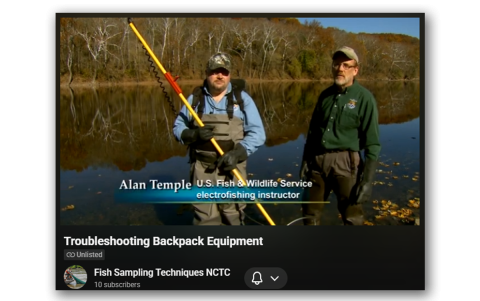
Troubleshooting Backpack Equipment |
Maintenance |
The few but important points are: - Secured transport to prevent impacts to the control box. Backpacks can be transported in plastic or metal cases or secured by seat belts in the vehicle back seat.
- Periodic cleaning of electrode surfaces with roughed pads as Scotch Brite.
- Battery Management
- Sealed Lead Acid (SLA) older technology but less expensive to purchase
- Lithium Iron Phosphate (LiFe) batteries are superior to SLA; if you can afford the initial cost, purchase LiFe batteries instead of SLAs. Less cost in the long run.
- Care of SLA batteries:
- Charge SLA batteries after use, even if lightly used.
- If not on trickle charger, charge in 6 months or 70% state of charge.
- Use a battery charger designed for SLA batteries.
- Often the Ah rate of charging should be around 0.25C or 25% of the rated Ah capacity. For example, a 10 Ah battery would be set to charge at 2.5 Ah.
- Charge using any one of the following methods-
- Constant voltage (most commonly used, although there is an overcharging possibility; important to set initial current charge at ~0.25C)
- Two-step Constant Voltage (for fast charging and maintaining the SLA on a float or trickle charge)
- Care of Lithium Iron Phosphate batteries:
- No memory effect; always charge up after use, even if lightly discharged
- Always charge up just before use (if you can)
- Do not leave charged batteries on the charger
- Batteries in long term storage need to be charged periodically; keeping batteries topped up and cycled regularly is a bigger factor than depth of discharge
- Avoid temperature extremes as those reduce battery life
- Charge using any one of the following methods-
- Best to use chargers made for LiFe that first input constant amperage and then, when close to full, switch to constant voltage to finish charging (Constant Current-Constant Voltage)
- If the LiFe battery has a Battery Management System, you can use SLA battery chargers
- Recommended charging current no greater than 0.5C (set amps at half the Ah rating); no greater than 0.7C (70% of Ah rating)
|
| Back to Top |