Safety
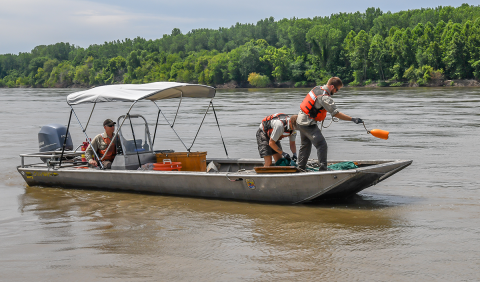
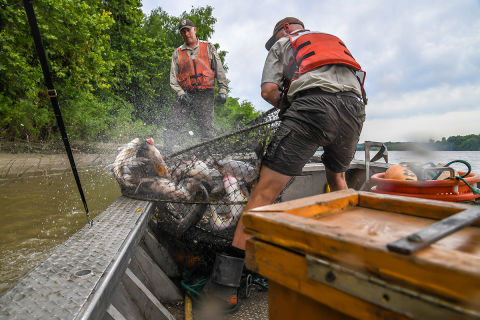
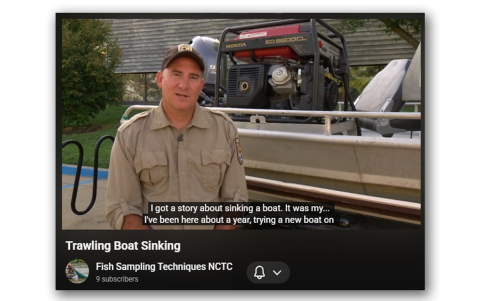
DescriptionThe following videos are interviews with U.S. Fish & Wildlife Service fisheries biologists. The topic is hazards of working in a big river environment. Interviewees were asked to tell “their story” (or stories) and what they learned from those close calls, how to reduce risk. The intent is to highlight the very real perils involved so that others will be motivated to be better informed and capable on technique. These are just a few accounts with lessons learned. There also are included several written stories from a master net maker. Finally, in other modules, there are field method videos with additional safety tips and insights. Enjoy. Many of these risks may be present in smaller streams and lakes as well. | ||||||
Stories on Video | ||||||
| ||||||
Safety Overview on Big Rivers | ||||||
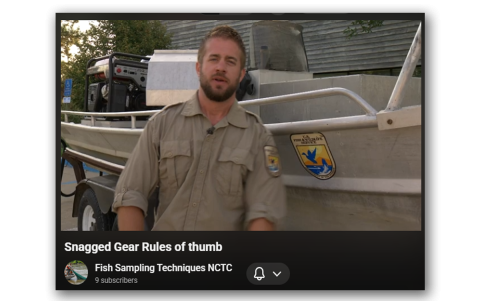
Snagged Gear Rules of ThumbPlanning and solid tricks of the trade. VIDEO LINK: https://youtu.be/rZNBpo1OlRk | ||||||
Written Stories | ||||||
The following stories are a sampling from experiences of master net maker Greg Faulkner of Innovative Net Systems (https://www.fishtrawls.com/). Mr. Faulkner is the instructor of the fisheries sampling techniques videos taken in his Louisiana workshop. As Greg relates “45 years of working and fishing on the water as well as making a living from people who do the same, has taught me some very harsh lessons”. Greg has agreed to allow us to benefit from some of his hard-learned lessons. Some of Greg’s experiences-
Safety Nugget: Accidents and catastrophes happen in seconds…not minutes. Safety Nugget: You either can be prepared to handle it or suffer a possibly unhappy aftermath. Safety Nugget: While some safety issues are obvious, others are more subjective and thus the benefit of using a risk management tool such as the GAR risk assessment. | ||||||
Safety Checks and Fire Extinguishers | ||||||
Case Study My fishing friends and I were a closed group. We didn’t share our fishing or hunting spots with anyone outside of ourselves. Yes, we occasionally took a relative or close friend, but that was only on special occasions. Now it came to pass that a certain relative of my wife’s family, wanted to go Paupier Shrimping one night. He actually had bought an old boat that had a pair of Paupier nets (two big, framed nets on either side of the boat that catch shrimp on the surface at night). Problem was, he had bought the rig but had no knowledge of where to go…he knew I caught shrimp and asked my wife to intervene. And so, I agreed to take him out. My mistake was NOT checking his boat out myself before we left his house. It would prove a near fatal mistake…one of many I have made over a lifetime on the water. I learned from each one. We launched the boat on the bank of a fast-moving bayou. You could see the red eyes of the large white shrimp popping at the water’s surface. It didn’t take long for us to have a 100 pounds in the boat. I was satisfied, he had more than enough for he and his wife. . .let’s call it night…we weren’t commercial fishing. . .only catching enough for his freezer. He pulled in the frames, and I tied them off. He throttled up the engine to head for the landing and suddenly there came a huge explosion from behind us. I felt the heat before I saw the flames. The motor had blown up. . .there was fire all over the stern of the 18’ aluminum hull. I grabbed the fire extinguisher mounted on the gunwale near the stern only to get burned in the process and then to discover to my horror, the extinguisher was rusted and had a hole in it. The relative had never changed it when he bought the old boat. He then hollered back through the smoke that he had found a hole in his gas tank a few days prior, so he had put a wad of chewing gum (that’s right, you can’t make this up) over the hole in the top of the tank. The gum had probably melted from the fumes in the tank and allowed droplets and mist of gasoline to fly all around the back of the boat where the un-enclosed battery set it off. My face was burned as were my hands. The slicker suit protected the rest of me. I grabbed a gallon of homemade root beer (with yeast) out of the ice chest and dumped it over the now blazing fire covering the old Johnson motor…. The cowl was melting away and the fire was now burning from the side of the engine itself. Slowly it went out with more root beer. It shouldn’t have…it should have blown us right out of the boat. With burned face and scorched hands I turned to see the big man standing on the bow of the boat with not only his life jacket, but mine too. He said he was too fat to float with just one life vest. I talked him back off the bow and onto the deck, as the fire slowly withered down to a smoldering mess of fiberglass and metal. We took out the one paddle he had and made our way a mile plus down that bayou, back to the boat launch. Points Taken:
| ||||||
Boat Hooks | ||||||
| No one should ever leave the dock without a boat hook (pike pole, spike pole, gaff). It can be used to test shallow water, it can pick up objects that drop over the side, it can help push your boat out of snags. It can retrieve lost ropes and buoy lines and . . . it can save a life when someone is overboard. | ||||||
Case Study | ||||||
A crew of two was picking up hoop nets in a raging, steaming river. They had no business being out on the river, but they feared that they would lose the 25 nets they had set out 2 days earlier…before that 6” rain and flood. As will happen occasionally, the motor cut out. The narrow 18’ aluminum hull was at the mercy of the river. It spun round and round . . . coming toward the bank then veering away back to the depths. Ahead lay a confluence of this river and a large bayou. They could hear and see the vast eddy twirling logs and other huge debris, round and round. They feared they would capsize. One fisherman grabbed their fluke anchor, a very deep gouging piece of gear guaranteed to stop a boat. Over it went as the ½” Poly line was tied off on the Bow Eye. Big Mistake! The anchor bit hard in the clay river bottom. The boat was yanked to a dead stop… however, the velocity of water pulled on the bow eye and brought the front end under. The boat was now filling with water. A quick hand and the rope was cut…the boat was now back on its course toward the swirling vortex. They grabbed the boat hook, tied a very tight lashing around the middle with a spare line….as they neared the bank they javelin threw the boat hook at the willows along the bank… several more times they heaved that 12’ pole at the tree line until the pole bounced just the right way and turned sideways, lodging itself between two trees. The crew then pulled their skiff (hand over hand on the slim rope) towards the bank and were finally able to make a landing. Point Taken:
| ||||||
Improve Traction on Boat Decks and Take that Boat Hook | ||||||
Case Study | ||||||
We were running a fast-moving Mullet Boat at 30 mph, setting the net out to surround a huge school of fish. My partner slipped on the metal floor, which was covered with water, mud and slime, and then tangled in the streaming gill net . . .Woooosh! He was jerked over the transom and into the Gulf of Mexico. Drowning in the net was one issue, getting him back inside the boat was another. He was well over 6’ and weighed 250 pounds. At that time I was well UNDER 6’ and weighed maybe 150 pounds. He was choking and gagging on salt water. He was semi-unconscious and barely hanging on. He had clipped his head on the transom as he was yanked overboard…. he had a concussion. I struggled and struggled to get his upper body into the boat. It took an hour or better. Finally, he came around enough so he could help himself. It was now sunup. Hundreds of feet of net were tangled in a floating heap…we were both dehydrated and worn out. He was still bleeding from a head wound. Points Taken:
| ||||||
Drag Line or Grappling Hook | ||||||
Case Study | ||||||
My partner’s relative wanted to come trawling with us. We agreed and Friday night found us in Barataria Bay (ancestral home to Jean Lafitte and his pirate crew). The tide was falling nicely, and the moon was almost full. There was a stiff Sud Vent (South Wind) that was strong enough to keep the mosquitoes away. The relative told us that he had been trawling before so don’t worry about him…he could hold up his end. Great! Now shackle the trawl up and let’s get ready to make the first drag. “Latiolais” (Let it Go) I hollered over the engine noise…kick that net off the fantail and let’s catch some shrimp. Well, relative kicked the net in alright. . . 35’ of high-rise Balloon Trawl, worth a month’s pay. . .only the trawl was NOT shackled into the Otter Doors…he had shackled the trawl’s Head Rope and Foot Rope to one another…… relative had only been trawling once before and he had never, ever handled the net. The trawl quickly disappeared in the dark water ……. Being prepared for such awkward events, we hooked up our 20 pound drag line made from drill pipe and re-bar, let out 75’ of rope from the winch and started making ever increasingly wider circles. Circle. . . wider circle. . .wider still. . .really big circles and then tension. . .a lot of tension. We had snagged the trawl. A few minutes of re-rigging and we were back shrimping. Point Taken:
| ||||||
Adequate Boat Flotation | ||||||
Case Study | ||||||
The first boat I swamped was while two of us were trawling for shrimp in really bad weather. WE should NOT have been out in that open water. The third haul-in of the net had well over 200 pounds of mixed catch. We got up on the fantail (portion of the boat that hangs over the water, at the stern). As we tried to heave the bag onto the fantail, a huge roller came in and WHOOOOSH! The boat was full of water… WHOOOOSH again and we were swamped. The boat had adequate floatation, so we drifted at the mercy of wind and current into a shoreline full of oysters. There we spent hours bailing out the boat and trying to re-start. Points Taken:
| ||||||
Bilge Pumps and Backups | ||||||
Case Study | ||||||
I was on an old trawler offshore from the Mouth of the Mississippi River. The weather was ugly and the southwest wind was clocking 25 knots plus . . .I was feeling something was wrong, We were being hit broadside by seven foot rollers. About that time, the captain scrambled into the wheelhouse in a near panic. Two of the cypress planks were coming apart from the tresses….(the side of the boat was un-nailing itself due to rough weather and an unforeseen area of damaged wood). There was enough water in the bilge to knock out the generator and kill the electric water pump and hydraulics. We were stuck in 7-foot seas with no way to bring in the two 40’ trawls running off the outriggers. We were in essence, taking water while stuck with two huge trawl nets, filled with a ton of catch each, that could NOT be raised off the bottom. I woke my 10-year-old son who was still sleeping. I put him in a life jacket, stuck a flashlight in his pants pocket and told him to get ready to abandon ship. Normally, when planking starts coming apart in those old boats, it opens wide enough to sink the vessel in minutes…. once again. . .we were blessed. . .it held together long enough for us to get to shore and run the hull up into the marsh. Points Taken:
Overall, consider this: Think of the worse things that can happen on the water and prepare for them. Simple Rule, but it can get you seriously injured if you DON’T follow it. Accidents and life-threatening situations are happily infrequent while travelling on the water, but when they do occur, accidents and equipment failure can leave you marooned on a wooded bank or marshy shoreline or worse. |