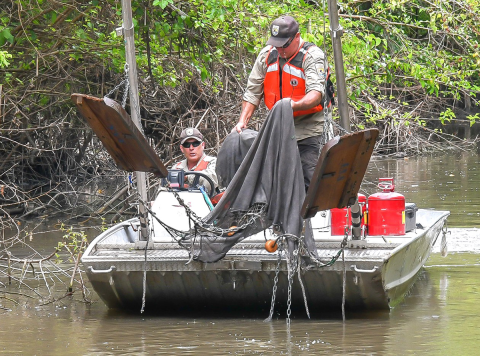
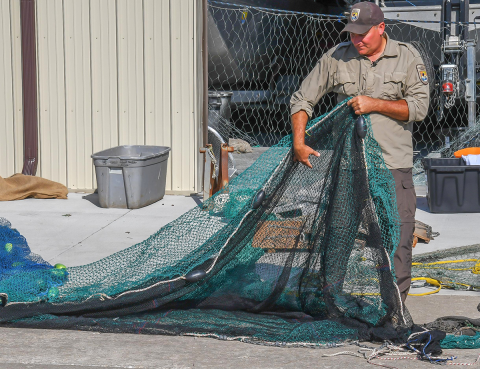
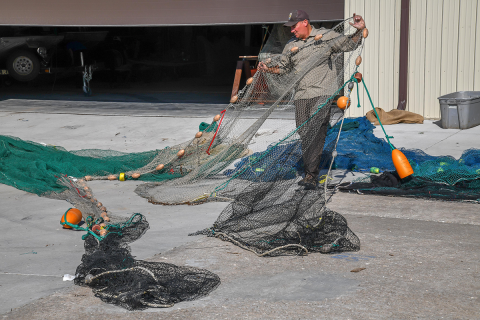
Introduction to Trawls
DescriptionTrawls are tapered (funnel- or cone-shaped) nets moved through the water by a boat or other mechanized means. Trawls may be categorized as otter trawls, beam trawls, and frame trawls. Deployment can be at the water surface or on the bottom, less commonly mid-water in freshwater systems. Minimum water depth for trawling is about 1 meter. | ||||||||
| ||||||||
Some Trawl and Trawling Categories | ||||||||
| ||||||||
Trawl Morphology CategoriesNote: Some of the terms used in these illustrations and instructional videos can be found in the Definitions section. | ||||||||
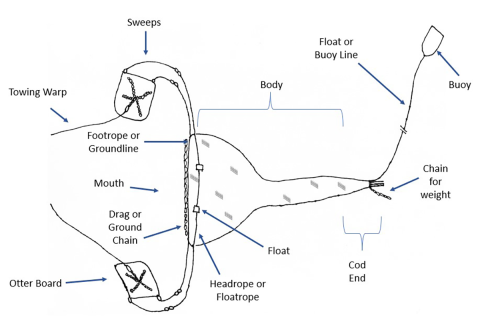
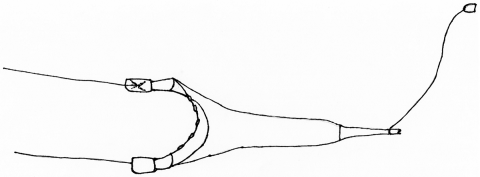
Otter Trawl (Benthic, Surface, or Mid-water trawls)This is an example Otter trawl with major parts labeled. Although this drawing is taken after the benthic trawl used in the bow trawling videos, Otter trawls can be designed as surface trawls or mid-water trawls. Be advised that a trawl component may be called by more than one name. For example, “haul line” or “towing warp”. Notes:
| ||||||||
Deployed in Active Sampling (Benthic, Surface, or Mid-water) | ||||||||
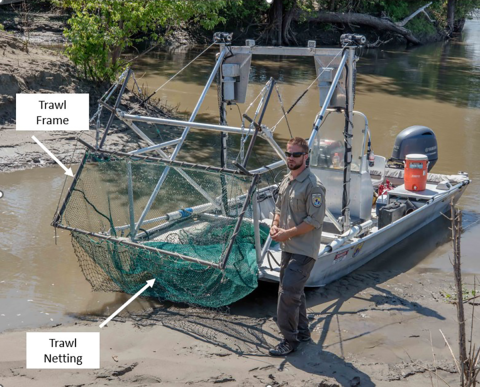
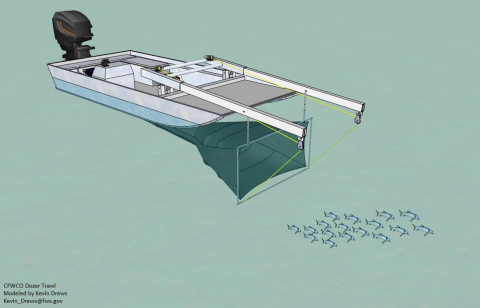
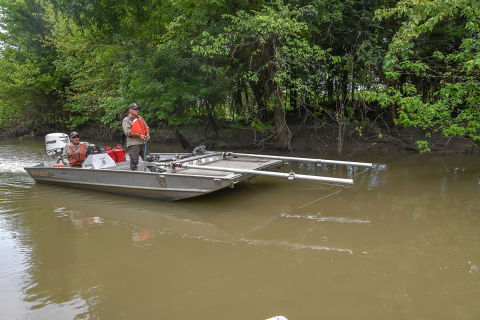
Frame Net (= Surface trawl)In this frame trawl, a trawl net is attached to a rectangular frame. (When sampling, the frame is lowered into the water). There are no Otter boards, floats, or weights as the frame provides structure and form. There are several designs that deploy frame trawls off the bow, side, or stern. If the frame is located off the bow or side, it is further described as a Push Trawl (as depicted in the picture). Although rectangular frames are the most common, frames can have other shapes as circular. | ||||||||
Deployed in Active Sampling | ||||||||
| Back to Top | ||||||||
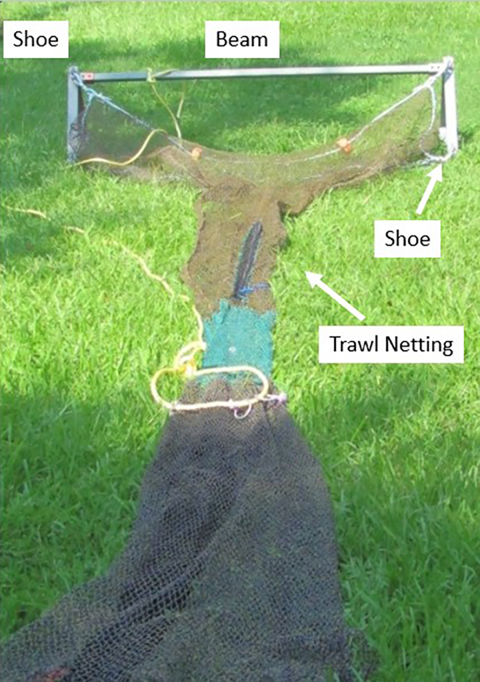
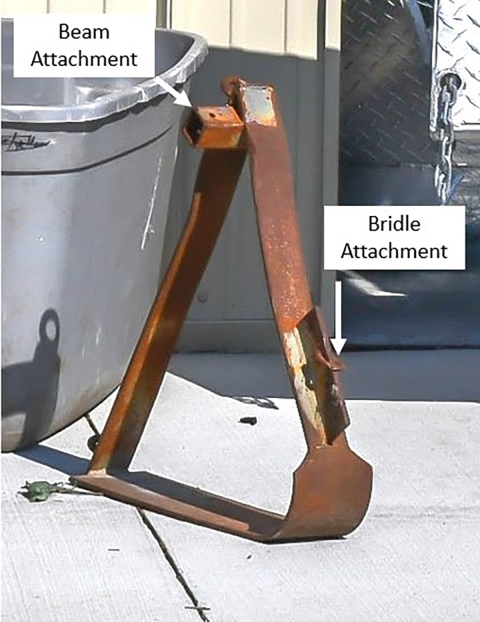
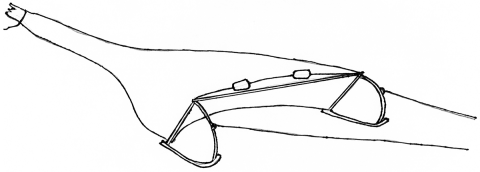
Beam Trawl (usually a Benthic trawl)This is the Mini Misago from Innovative Net Systems. Built for depths from 1m to 100m. Beam trawls are like frame trawls in that the trawl netting is attached to a rigid structure. In the case of beam trawls, the rigid structure is a steel beam with “shoes” on each end. The beam and shoes keep the net open at a consistent sized area. Beam trawls typically are benthic (demersal gear) where the shoes contact the bottom and operate like a sled. However, Beam trawls can be deployed near surface or mid-water, in which case there may not be shoes. There are numerous variations. | ||||||||
Deployed in Active Sampling | ||||||||
Habitat Sampled or Deployment Categories | ||||||||
Benthic, Mid-water, and Surface Trawls | ||||||||
| These terms describe the water column strata sampled by the trawl tow. Benthic or bottom trawling, by far, is the most common technique in North American rivers and small lakes. However, use of surface trawls is increasing. Mid-water trawling is the least used but, due to design and material improvements, is being applied in mid-western reservoirs among other places. Typically, Mid-water trawling is a large lake technique. Otter trawls are the most applied gear in all applications. Frame trawls have been demonstrated to be effective surface trawls in Mid-West rivers. | ||||||||
Bow, Stern, and Push | ||||||||
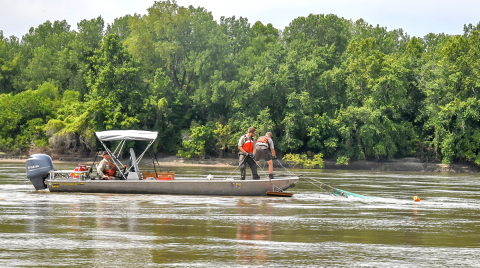
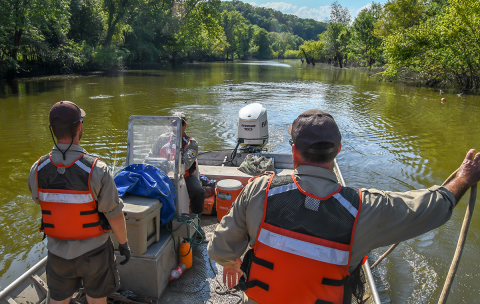
Bow trawling is the most common deployment in rivers. In Bow trailing, the trawl is attached to the bow area and the boat moves in reverse with the water current. The trawl is towed backwards from the crew’s perspective. Bow trawling may be mechanized or worked by hand. This is a bow hand trawling operation. | ||||||||
As with Bow trawling, stern trawling can be mechanized or done by hand. The trawl is towed off the stern of the vessel and the boat moves in the direction of the water current. Otter, beam, and frame trawls can be deployed for stern trawling. A surface trawl is deployed off the stern. | ||||||||
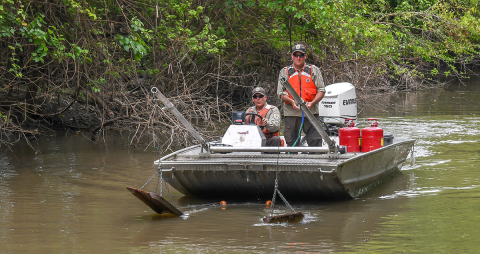
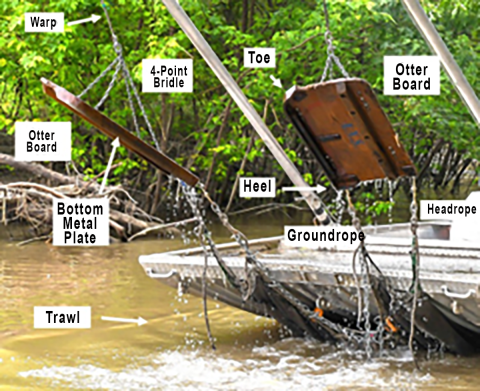
Push trawling pushes, rather than tows, a trawl. The direction of trawling is forward from the crew’s perspective. Push trawls utilize Otter trawls or Frame trawls. Push trawling with Otter trawls is considered benthic whereas using frame trawls is surface trawling. A push trawl operation. The Otter trawl is being lowered into the water for sampling. | ||||||||
The Otter trawl is in sampling position and is being pushed through the water. | ||||||||
| Descriptive trawling categories often are combinations. For example, Bow/Surface/Otter Trawl, Bow/Benthic/Otter Trawl, Stern/Surface/Frame Trawl, Stern/Surface/Otter Trawl, Push/Surface/Frame Trawl, Push/Benthic/Otter Trawl, etc. These categories strictly are not so important as it is for the fish biologist to understand availability, opportunities, disadvantages, and safety specifics with the various general approaches. | ||||||||
| Back to Top | ||||||||
Trawl Overview and the Nitty-Gritty | ||||||||
| ||||||||
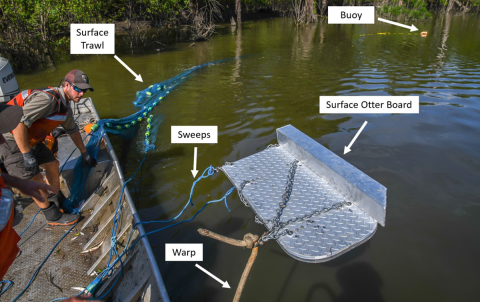
A surface trawl Otter board being deployed. | ||||||||
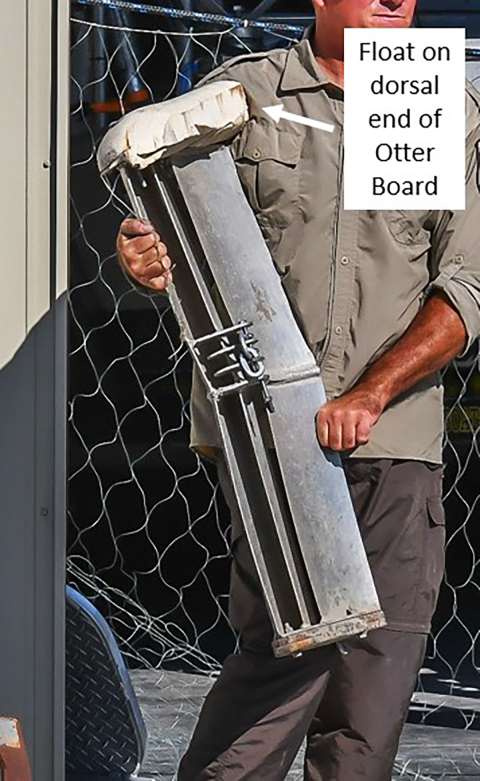
This is a “Hendricksson style” mid-water Otter board converted with the addition of flotation to a surface trawl Otter board. | ||||||||
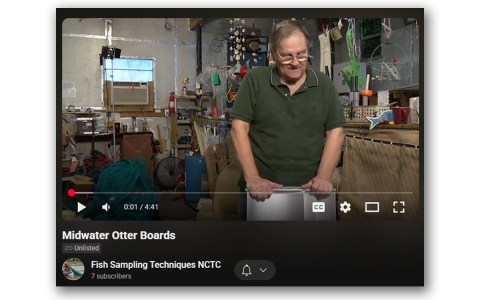
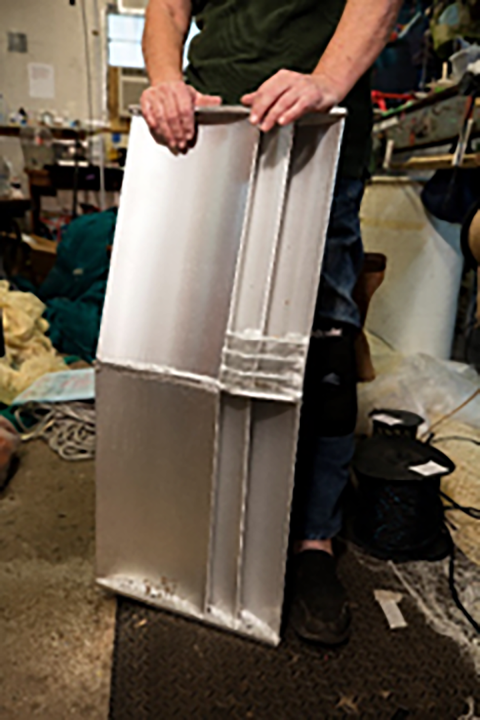
This is a mid-water Otter Board. It has fine adjustments to set sampling depth “Hendricksson” style. | ||||||||
Benthic trawl Otter Boards on a Push Trawl deployment. The Otter Boards and trawl is being raised out of the water after completion of the sampling transect. | ||||||||
| Back to Top | ||||||||
Cods | ||||||||
| ||||||||
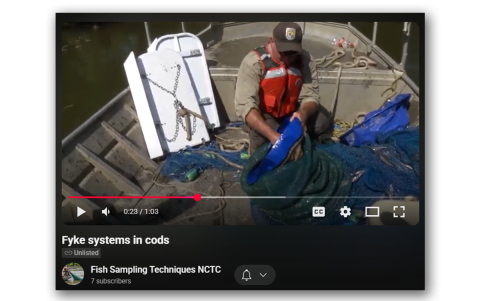
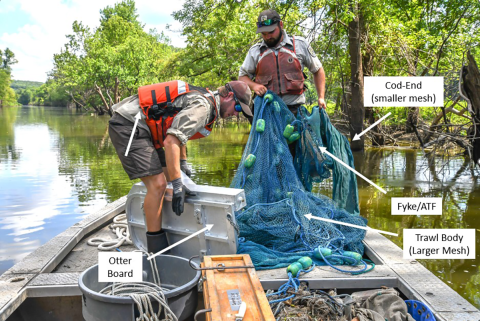
Fyke/ATF installed in a trawl. Also review the ATF and Fyke entries in the Definitions section. | ||||||||
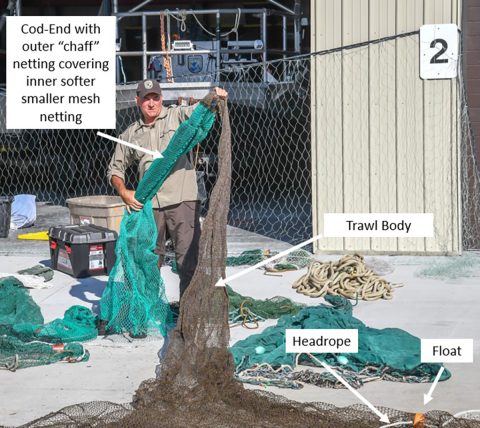
This is a double-mesh dead end Cod. The outer larger mesh netting is more durable and resistant to tearing from snags (“chaff” netting). The outer mesh protects the inner cod netting. | ||||||||
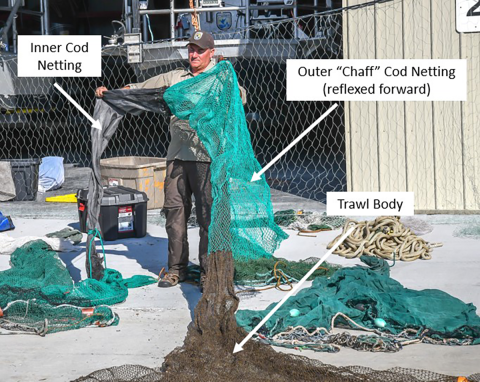
This is the same trawl but with the outer chaff netting reflexed forward to reveal the inner smaller-mesh cod netting. Here, the inner cod mesh is tied shut and thus serves as the cod-end with the outer chaff protective netting. This configuration can be changed to serve as a separator of smaller and larger-size fish. By untying the inner cod netting and then tying shut just the outer chaff netting, all fish pass through the inner cod netting and into the outer cod. Smaller fish pass through the larger mesh and escape whereas larger-size fish or species are retained in the outer netting of the cod. | ||||||||
Knots | ||||||||
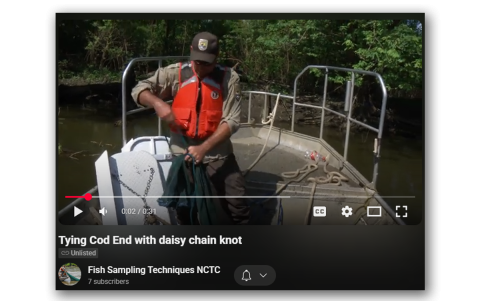
Tying Cod End with Daisy Chain KnotSecuring the Cod-end for sampling | ||||||||
Lines | ||||||||
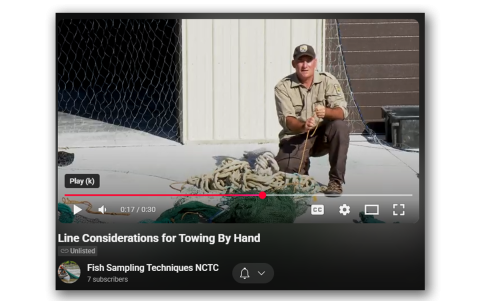
Line Considerations for Towing by HandThe Surface Trawl, Benthic Trawl, and Push Trawl modules contain information on lines. For hand towing, here are some recommendations . | ||||||||
For additional information on netting materials, lines, and floats, refer to modules entitled: | ||||||||
| Back to Top | ||||||||
Important Stuff to Know for Purchasing and Operating Trawls | ||||||||
| ||||||||
Boat Operation and Outfitting | ||||||||
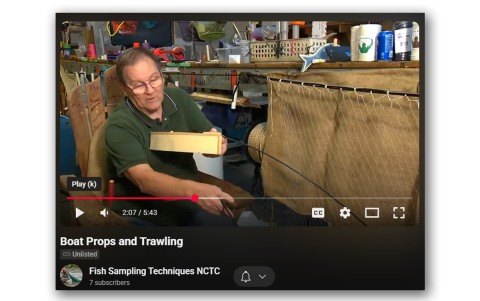
Boat Props and TrawlingDiscussion on 3- vs. 4-blade propellers and methods of boat operation when trawling to minimize disturbance to sampling. | ||||||||
Maintenance and Storage | ||||||||
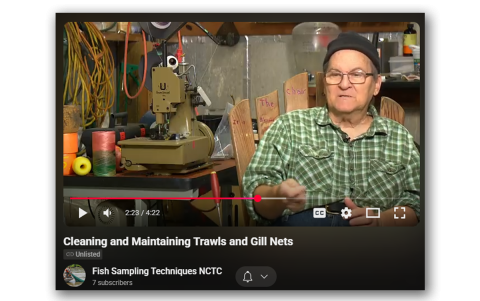
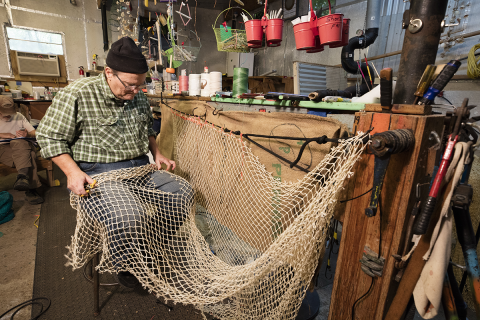
Cleaning and Maintaining Trawls and Gill NetsA Master Net Maker gives pointers on cleaning and storing trawls.(There is some reference to gill nets). There seems to be an inconsistency between Instructors on storing wet nets, but the fisheries biologist is referring to nylon gill nets. | ||||||||
Quick Repairs | ||||||||
Tools, Twines, and Repair Methods: See Repairing Nets Module | ||||||||
This module is introductory. For more detailed treatment of the various trawling approaches in rivers and lakes, please reference these other modules: | ||||||||
Definitions | ||||||||
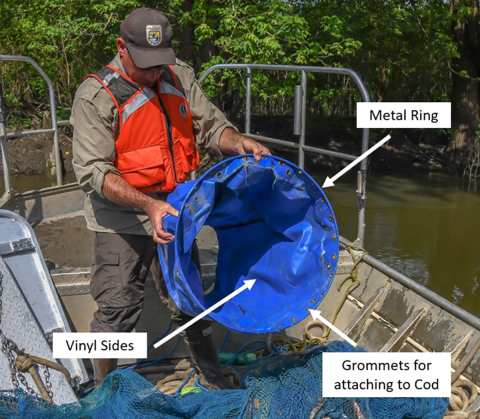
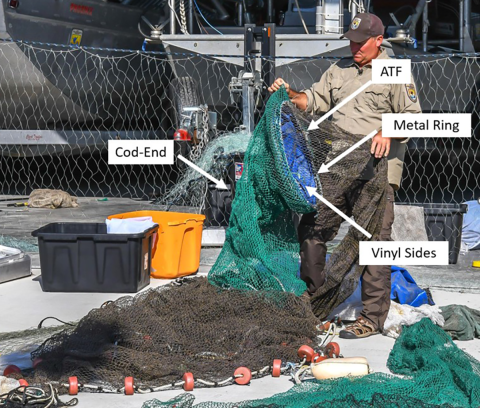
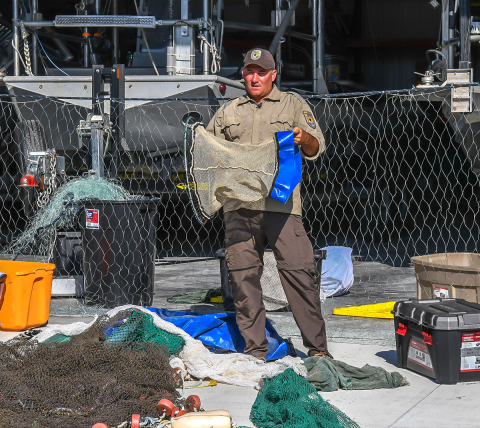
ATF (“Accelerator Transfer Funnel”): A vinyl or part fabric-part vinyl tube attached to a metal ring. The ATF is installed into the trawl cod-end to 1) hold the cod-end open for slow current sampling and 2) increase movement of fish rearward into the cod-end. The ATF also serves as a Fyke wherein the vinyl sides collapse when the trawl slows or stops at the end of a sample run, thus preventing fish escape from the cod-end. This is an uninstalled ATF showing component parts. | ||||||||
An installed ATF in the cod-end of a trawl. | ||||||||
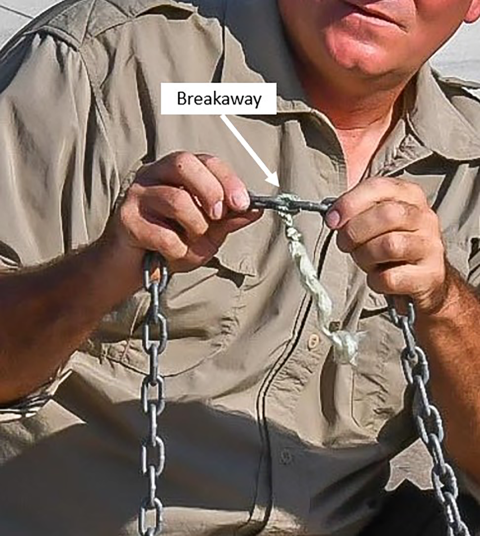
Breakaway: An intentional weak point placed in a line or cable that allows breakage if the trawl encounters a snag at too high a speed or to facilitate trawl retrieval from a snag. The “breakaway” is composed of weaker line. A fiber (line) breakaway in a trawl forward-running chain. | ||||||||
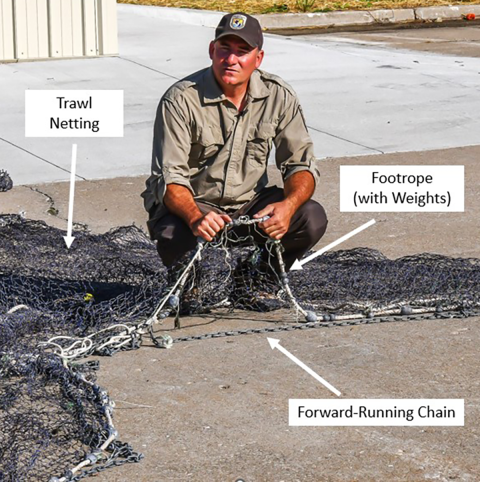
Cod-end: The end of the trawl, opposite of the Mouth. The purpose is to collect and hold the catch for removal. The Cod-end may contain structures additional netting to increase capture or minimize escape or separate fish by size category. A buoy line is often tied to the Cod-end. Denier: a unit of weight by which is measured the thickness of the individual fibers which make up the threads of a synthetic fabric. Higher denier means thicker, more durable netting. 210d means 210 Denier. Deterring rope: a line used to help keep fish from leaving the cod-end upon retrieval of the trawl. Floats: Buoyant material of various sizes and shapes used to provide additional floatation, especially to help hold open the trawl mouth. Floats (buoys) also are attached to retrieval lines to indicate position of or aid in the retrieval of a trawl. Footrope or Groundrope: A line forming the bottom of a trawl mouth, attached to trawl netting. The Footrope is weighted on benthic trawls through leadcore rope, chains, or weights. Rock- or mud-rollers can be added to the Footrope. Forward-running chain: A chain added to the Footrope that can provide extra weight to benthic trawls, disturb the substrate to increase catch, and protect the Footrope from snags. | ||||||||
This is a benthic Otter trawl demonstrating the Footrope and the Forward-Running Chain. | ||||||||
Fyke: The word "fyke" comes from the Dutch word "fuik" which means "trap" or “fish trap”; “Fyke” is a term associated with some fish sampling gears, as “Fyke Net”.In the instructional videos, the term “Fyke” is used to describe a structural modification to the cod-end intended to reduce fish escape by closing flaps with slow water movement thereby trapping fish in the cod-end. Another function is to hold the cod-end open for fish entrance during slower velocity sampling. This fyke would be installed in the cod-end with the rigid metal ring facing the trawl mouth and the vinyl edging facing the cod-end. When the net slows or stops, the fyke will collapse, trapping fish in the cod-end. | ||||||||
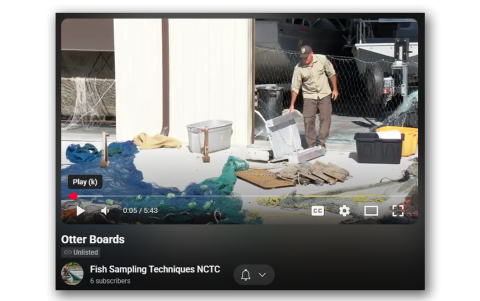
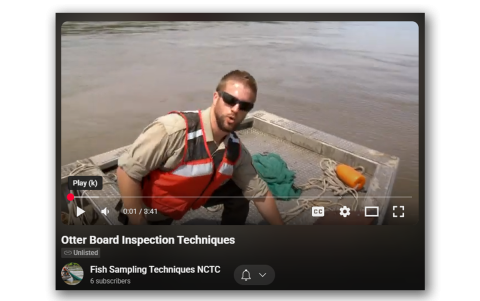
Headrope or Headline: A line forming the top of a trawl mouth, attached to trawl netting. Floats are added to the Headrope. Hobbling: The addition of lines to reduce the depth of a trawl mouth. Lazy Line: A line tied towards the cod-end of a frame trawl that facilitates bringing only the cod-end on deck for emptying the catch instead of the entire trawl. Otter Boards: A square or rectangular-shaped structure made of wood or metal (aluminum). Otter boards have metal attachments for securing lines, adjusting angles, adding weight, and protecting board surfaces. A pair of otter boards is attached by sweep lines to each side of the mouth of a trawl and set at an angle keeping the net open as it is pulled through the water. Otter boards and trawl being deployed. | ||||||||
“Poly”: A term used in the videos that refers to polyethylene. Sapphire netting: a knotted netting made of high density polyethylene and co-polymers. Raschel netting: a knotless netting. Common fibers are Polyester, Nylon, and Polyethylene. Raschel has a smoother surface which is helpful when a soft netting is needed to minimize damage to captured fish. Be advised that Raschel netting is more difficult to repair compared to knotted netting. This anchovy trawl is a “trawl within a trawl” wherein the inner, softer, but more delicate Raschel netting (black colored) is protected by more durable outside netting (green colored). | ||||||||
Scalene Trawl: “Scalene” is a company model name of a surface trawl. It is a modification of a surface trawl to enable very shallow surface trawling. Wings: Extensions of netting from the mouth toward the Otter Boards. The purpose is to restrict lateral movement and escape of fishes. An instructor is holding up one wing of a surface trawl. | ||||||||
| Back to Top |