States
Alabama, Arkansas, Colorado, Georgia, Illinois, Indiana, Iowa, Kansas, Kentucky, Louisiana, Michigan, Minnesota, Mississippi, Missouri, Montana, Nebraska, New York, North Carolina, North Dakota, Ohio, Oklahoma, Pennsylvania, South Dakota, Tennessee, Texas, Virginia, West Virginia, Wisconsin, WyomingEcosystem
Lake, River/streamSince their entry into the lower Mississippi River 50 years ago, invasive carp multiplied rapidly and became abundant in some areas, spreading into the major tributaries within the Mississippi River basin’s broad reach and now also threatening the Great Lakes. Over five decades, invasive carp have depleted the vitality of many rivers, lakes and reservoirs and now represent one of the most urgent, wide-ranging and complex environmental challenges of our time.
Up and down the Mississippi River waterways and throughout the Great Lakes, the U.S. Fish and Wildlife Service and our partners are working together across the waterscape to protect the environment, our favorite outdoor pastimes and our economic prosperity from the destructiveness of invasive carp. Nearly 50 conservation partners have formally organized to carry out about 80 projects related to invasive carp management.


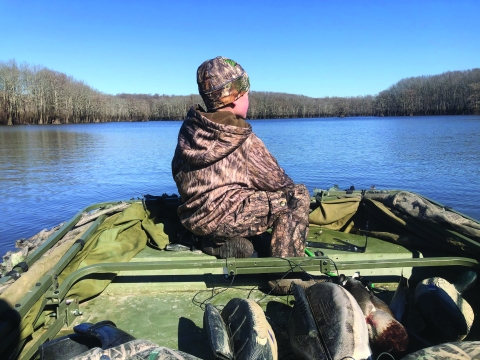
What makes invasive carp so harmful?
Invasive carp are voracious feeders that grow and multiply quickly and have no significant predators. When they move into an area and become established, they leave a trail of destruction in their wake.
- Invasive carp thrive in nutrient-rich waters and disrupt the food web in aquatic environments. They can wipe out populations of other aquatic species — from zooplankton and vegetation to mussels and fisheries.
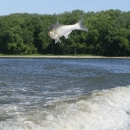
- Invasive carp jeopardize the safety and quality of our outdoor experiences, causing physical harm to anglers and boaters when they leap from the water and diminishing opportunities for on-the-water recreation where they are abundant.
- Invasive carp have significant economic impacts in communities that rely on certain commercial fisheries and outdoor recreation and tourism-related businesses. They threaten our broader economic stability the more they spread.
Where are invasive carp populations now?
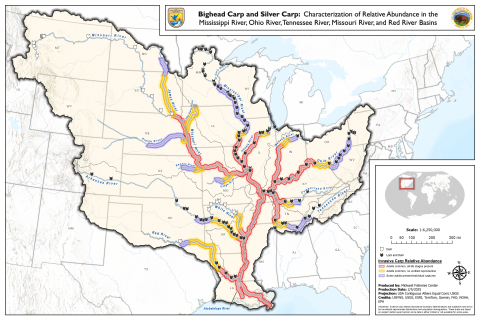
The distribution of each of the four kinds of invasive carp in North America is different. Grass carp are the most widespread throughout the continent while the others remain in the Mississippi River basin. Grass carp have historically been detected in all of the Great Lakes except Lake Superior and this is the only one of the four species with an existing population in the Great Lakes – specifically in western Lake Erie. Silver and bighead carp have a similar range and are the most widespread throughout the Mississippi River basin. Less is known about the distribution of black carp compared to the others because they are rarely captured, but we are learning more by working with commercial fishers to gather specimens for research.
As invasive carp became established throughout the lower Mississippi River, they moved into the major tributaries, including the Arkansas, Red and White Rivers in the lower region, upstream into the Ohio, Tennessee and Cumberland Rivers reaching east and the Missouri River reaching west, and then into the Illinois River toward the Great Lakes. In recent years, they have increasingly spread into the upper Mississippi River region as well.
The population densities of invasive carp vary considerably by species and location and invasive carp are not necessarily established in every location where they are detected. Within the Mississippi River basin, there are still some outer reaches, reservoirs and areas between navigation dams that do not have established invasive carp populations. Many of our projects are focused on reducing the abundance of established invasive carp populations as much as possible and holding the line to prevent them from expanding their range.
More specific information on each species is available from the U.S. Geological Survey’s Nonindigenous Aquatic Species Database showing the current distribution of bighead carp, black carp, grass carp and silver carp in North America.
What are we doing to manage invasive carp?
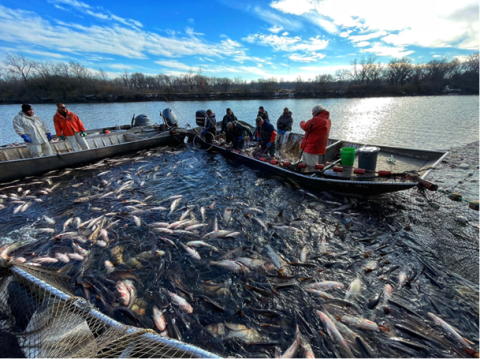
Invasive carp management is led by state natural resource agencies working with dozens of other partners, including the U.S. Fish and Wildlife Service, to leverage expertise and resources. Our agency also serves a lead role in administering grant programs to both state and federal agencies to support invasive carp management.
Eradicating an invasive species is almost always impossible in large, open aquatic ecosystems. Partners work together to develop new technologies and scientific advancements to refine our approaches, create new solutions and improve results.
Our collective efforts vary in different locations and by species, but coordinated management mainly falls under these inter-related categories:

- State-led targeted mass removal for the most suppressive effect
- Developing deterrent technologies and constructing barriers to impede invasive carp movement and prevent range expansion
- Monitoring to inform all aspects of management and detect new spread early so we can prevent additional populations from establishing.

Mass removal
Overall, about a dozen states along the Mississippi River and its major tributaries carry out invasive carp targeted mass removal programs, with the largest programs in Kentucky, Tennessee and Illinois. These and several other states work with commercial fishers to enhance their removal efforts and use special methods that allow millions of pounds of invasive carp to be removed from our waters each year. Some states also offer harvest incentive programs.
Mississippi River basin states are also working with fish processors, wholesalers and others to develop a commercial supply chain for removed fish. The way removed fish are distributed varies from state to state. Ultimate uses include pet food, various food products, fertilizer, “carp leather” products and bait. The State of Illinois launched a special effort to expand domestic and international commercial markets for these fish that are widely consumed around the world. Read about Copi..
Deterrents and barriers
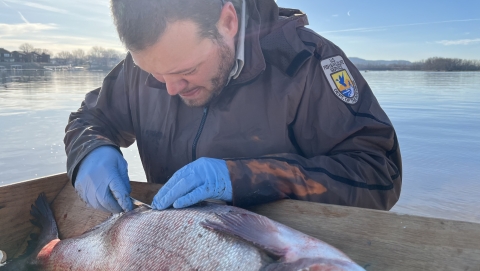
Lock and dam sites on the Mississippi River and its tributaries have served to slow or impede the spread of invasive carp to some extent, and existing infrastructure at certain sites is conducive to testing different deterrent technologies. Major deterrent project sites include:
- An electric dispersal barrier system in the Chicago Sanitary and Ship Canal in the uppermost reach of the Illinois River
- A bio acoustic fish fence, or BAFF, at Barkley Lock and Dam on the Cumberland River in Kentucky
- An underwater acoustic deterrent system at Lock and Dam No. 19 on the Mississippi River near Keokuk, Iowa.
In these and other locations, partners are developing and evaluating deterrent technologies such as underwater electrical currents, bubble curtains, acoustics or sound waves, strobe lights and carbon dioxide, often in combination.
Partners are also constructing different kinds of barriers to block potential pathways for invasive carp movement. Good examples are three barrier projects in Indiana and Ohio designed to protect the Great Lakes from intermittent high-water events that could enable invasive carp to spread from the Mississippi River basin. In parts of the southern United States with open river conditions, water control structures and weirs are being considered for use in deterring movement between rivers and floodplain lakes.
Monitoring
To help inform all aspects of invasive carp management, partners use several methods to monitor existing invasive carp populations and screen for their presence in new areas. Monitoring also allows us to gather, consolidate and analyze crucial data for measuring our progress.
Monitoring the distribution, abundance, congregating habits and movement of invasive carp populations helps us understand the best areas to target for mass removal and prioritize potential sites for deterrents and barriers. On-the-water sampling for early detection and rapid response are key aspects of preventing additional invasive carp populations from becoming established.
We use a variety of methods, such as electrofishing, different kinds of netting, telemetry tracking, side-scan sonar and hydroacoustics to monitor invasive carp populations. We also use eDNA sampling – or environmental DNA – as an early detection tool in uninvaded waters to help guide priorities for where to sample further with traditional fishing gears.
Partnerships for invasive carp management
Nearly 50 natural resource management agencies and others have organized into geographic partnerships to most effectively manage invasive carp throughout the Mississippi River and Great Lakes basins. These partnerships are among the largest coordinated conservation efforts in North America.
Six partnerships are based on sub-basins of the Mississippi River and organized under the umbrella of the Mississippi Interstate Cooperative Resource Association, known as MICRA. Established in 1991, MICRA unites 28 states and three federal agencies.
The MICRA partners originally organized to promote collaboration in managing aquatic species that inhabit shared waters or cross state boundaries. Partners work together to conserve native fisheries and mussels as well as gamefish such as bass and trout. Over the last 10 years, MICRA has significantly strengthened efforts to manage invasive carp. The sub-basin partnerships cover the Lower Mississippi River sub-basin; Arkansas, Red and White Rivers sub-basin; Ohio River sub-basin; Tennessee and Cumberland Rivers sub-basin; Missouri River sub-basin and Upper Mississippi River sub-basin.
A growing concern that invasive carp could spread into the Great Lakes spurred the establishment of another partnership in 2010. The Invasive Carp Regional Coordinating Committee brings together 26 members in the United States and Canada. This partnership is most focused on blocking pathways into the Great Lakes basin and reducing the Illinois River invasive carp populations because of the Chicago area waterway’s connection to Lake Michigan. While partners have been able to hold the line on Illinois River invasive carp populations, the grass carp population in western Lake Erie – the only invasive carp population in the Great Lakes – is of urgent concern.
These partnerships produce annual plans describing priority projects underway to manage invasive carp. Currently there are about 80 projects being carried out altogether.
Learn more about MICRA’s priority projects for invasive carp management.
Learn more about the ICRCC’s priority projects to protect the Great Lakes from invasive carp.
Our collective commitment
The Mississippi Interstate Cooperative Resource Association includes 31 partners and the Invasive Carp Regional Coordinating Committee has 26 members. Some organizations are members of both.
In addition to the formal members of these partnerships, scores of other partners at the community, state and national levels contribute to invasive carp management. These include conservation groups, outdoor recreation organizations, commercial fishers, businesses and trade associations and academic institutions.
What can others do to help prevent the spread of invasive carp?
Anglers and boaters, and other vigilant citizens, make significant contributions by notifying state natural resource agencies when they encounter invasive carp and educating others about best practices that can prevent the spread of invasive species. Stop Aquatic Hitchhikers! is a national campaign that helps those who recreate on the water be part of the solution to help prevent and slow the spread of aquatic invasive species.
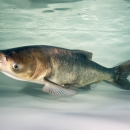
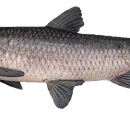
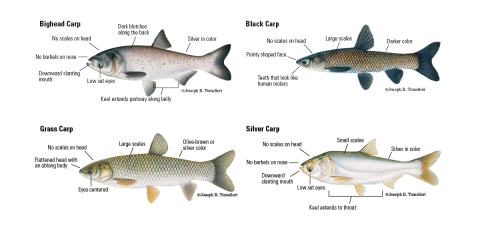
To prevent the spread of invasive carp, you can familiarize yourself with the physical characteristics of the four species. Other fish species sometimes are mistaken for invasive carp, including the common carp, blue sucker, bigmouth buffalo, smallmouth buffalo and golden shiner.
If you catch an invasive carp, please do not release the fish back into the water. Instead, after humanely killing the fish, freeze it in a sealed plastic bag, note the date and specific location where it was caught and contact your state or provincial natural resource agency as soon as possible. The same applies if you observe an invasive carp or find a dead one. You can notify your state natural resource agency of any captures and sightings by using this invasive species report form.
To make sure you don’t unintentionally violate state and federal wildlife laws:
- Do not keep a live invasive carp in your possession.
- Do not travel across state lines with an invasive carp in your possession.
- Do not move an invasive carp to another body of water even if it is dead.