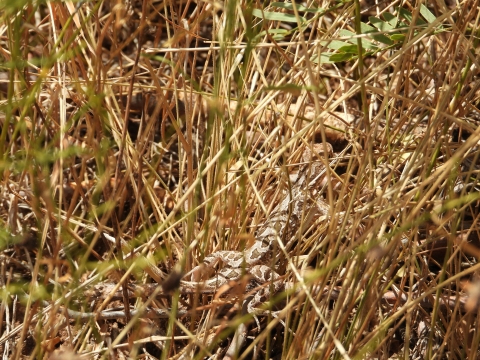
It’s summer, when the ground shimmers with heat, the sun blazes overhead, and U.S. Fish and Wildlife Biologist Justin Crow is systematically surveying for the Plateau spot-tailed earless lizard on the Goodfellow Air Force Base in San Angelo, Texas. In between walking long survey lines, Crow and other Service biologists escape back to their truck to cool off in the air-conditioning, rehydrate and then regain gusto to hike another survey line in the August heat. Because these cold-blooded lizards live for the heat in the desert of the Edwards Plateau, biologists must conduct surveys when the critters are most active.
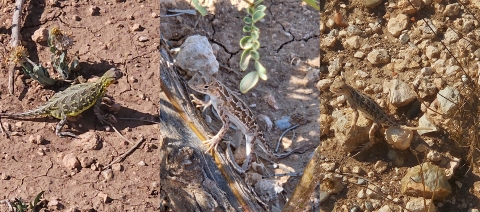
The Plateau spot-tailed earless lizard is hard to find, hard to see and hard to capture. It spends most of its life underground in burrows dug by other animals or by burying itself under loose soil. When on the surface, its brown speckled body blends into the dusty grasslands. If it senses detection, the skittish lizard will sprint into the nearest mesquite shrub for safety. Its speed and size—measuring about 4.5 to 6.0 inches from the nose to the end of the tail and weighing about a nickel— make this tiny lizard challenging to corral and catch.
Techniques used to survey other lizards don’t work for the Plateau spot-tailed earless lizard. Some lizards can be spotted while driving next to cotton and corn fields, but you can’t drive everywhere, and there are few roads to survey on the base. Attempts to search on foot also failed— Crow and his team walked the entire base (over 40 miles) on a grid pattern and found zero lizards. It was then they knew they needed help. Luckily reinforcements arrived.
Curiosity of Military Personnel
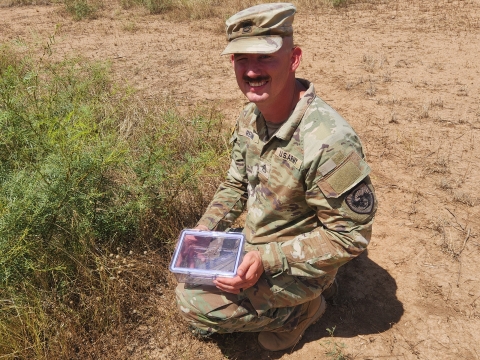
It doesn’t take an expert to find wildlife— it only takes curiosity (and knowing who to ask). After Crow’s no-show lizard survey, Environmental Protection Specialist at Goodfellow, Allen Hotchkiss, asked around at the base for help. Luckily, a member of the military with a passion for lizards had answers. Staff Sergeant Redmon took the Service biologists to the location where the lizards had last been seen, and immediately a lounge (group of lizards) of Plateau spot-tailed earless lizards was spotted basking in a sunbaked field of sparse grasses.
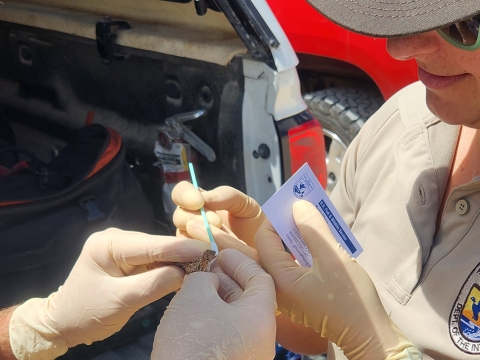
Staff Sergeant Redmon helped collect lizards to take body measurements, DNA samples and photos—especially backsides of the tails. The spotted pattern on their tails is unique to the individual, and software can analyze the pattern, “tailing” them apart. Collecting this information helps the Service with future conservation efforts.
Win-Win for Conservation and Defense
Recognizing that military lands contain some of the nation’s most valuable natural assets, Congress passed the Sikes Act in 1960 to protect them. The act requires military installations with significant natural resources to develop Integrated Natural Resources Management Plans in coordination with applicable state wildlife agencies and the U.S. Fish and Wildlife Service. Just as important, installations need to monitor outcomes from these plans to ensure they’re meeting conservation targets without compromising military readiness. More often than not, conservation is a win-win.
Knowing the lizards’ location helps improve military conservation management practices at Goodfellow Air Force Base. These lizards are often found in agriculture fields and along roads, especially unpaved rural roads. These areas are thought to mimic its preferred habitat of open skies, diggable soil, and plenty of prey. Understanding what parts of the Base the species is using can help track population health and habitat conditions, which can inform management decisions, tracks trends, and evaluate the impact of human activities on wildlife.
Finding new populations of the Plateau spot-tailed earless lizard, like those at Goodfellow Air Force Base, helps fill in missing puzzle pieces about the status of a species once thought to be vanishingly scarce. In 2024, the Service determined that the Plateau spot-tailed earless lizard did not need Endangered Species Act protection thanks to the extensive survey efforts by partners that recorded several thriving populations. The lizards lounging at the base are among the newest populations discovered since 2024, adding important data about the status of the species. Because of the inquisitiveness and passion of military personnel, the Service knows more about this elusive lizard and how to help it continue to flourish in the sweltering Texan deserts, under the hot sun.