


Pay your Entrance Fee for the Sacramento NWR Auto Tour on Recreation.gov!

Sacramento National Wildlife Refuge collects an entrance fee for the Auto Tour. 100% of the fees stay on the Complex. All 1-day, annual, and commercial vehicle passes are digital and are available at recreation.gov. Purchasing a pass is not required for visitors with a valid Federal Duck Stamp or valid Interagency Pass (more information on Visit Us).
Visitor Center is Open - limited days and hours

The Visitor Center is open on Fridays, 10am-3pm (subject to change), closed on Federal holidays. The exterior restrooms are always open. The nature store, operated by Friends of the Sacramento NWR, is closed for the summer season.
Curious about what to expect?
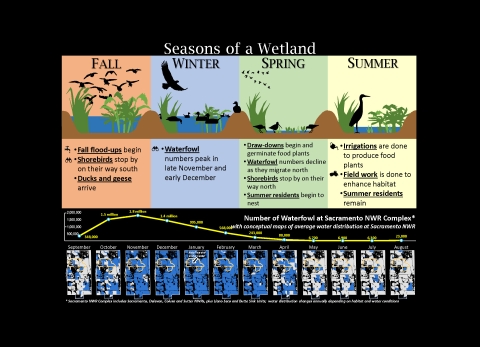
Check out our graphic summary on the seasonality of birds and water on our What to Expect - Seasons of a Wetland page.
Did you find an injured or abandoned animal or bird?
The Refuge Complex does not rescue, rehabilitate or accept injured or orphaned animals.
Please visit California Department of Fish and Wildlife's Native Wildlife Rehabilitation webpage for what to do and frequently asked questions, noting the following (copied directly from CDFW's webpage):
- DO NOT intervene without proper guidance from a trained professional (i.e., capture, handle, confine, feed/water).
- DO NOT drop off wild animals at a location, unless instructed to do so.
Live Web-Cam
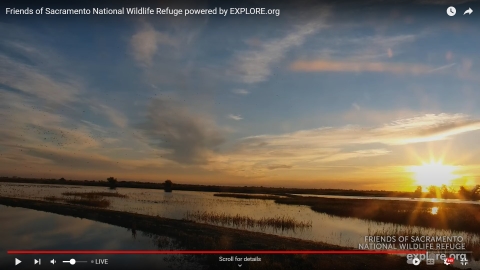
Questions: What's the weather like? Are there birds at the refuge?
Answer: Check out the Live Web-Cam *at Sacramento NWR, brought to you by Friends of the Sacramento National Wildlife Refuge. *Note: the solar-powered live webcam may default to highlight reels during long periods of fog or cloud cover due to lack of power.
Visit Us

Welcome to Sacramento National Wildlife Refuge!
Sacramento NWR is the Headquarters for the Sacramento NWR Complex, and offers a visitor center with restrooms and a picnic area, auto tour, information kiosks, observation decks, trails, photography blinds (by reservation only), environmental education programs, seasonal bicycling opportunities, and hunting.
Sacramento National Wildlife Refuge is one of the 5 National Wildlife Refuges (NWR) and 3 Wildlife Management Areas (WMA) that make up the Sacramento National Wildlife Refuge Complex:
- Sacramento NWR
- Delevan NWR
- Colusa NWR
- Sutter NWR
- Sacramento River NWR
- Llano Seco Unit (Steve Thompson North Central Valley) WMA
- Butte Sink WMA
- Willow Creek-Lurline WMA
Use the table (below), the left menu (computer), or the top right hamburger menu (three lines on mobile device) to navigate to the information that's most helpful for you:
| Find Your Way Around | Activities | Hunting |
|---|---|---|
| Visit Us A one-stop place for all your visiting questions, including hours, accessibility, what to expect, passes and permits and more! | Auto Tours Trails Bicycling | Hunting at Sacramento, Delevan, Colusa and Sutter NWRs |
| Maps Directions Brochures | Photography | Hunting (RIVER) at Sacramento River NWR |
| Visitor Center | Education and Outreach | Junior Hunters Mobility-Impaired Hunters Special Hunts |
Location and Contact Information
About Us
The Sacramento National Wildlife Refuge, split across Glenn and Colusa Counties, is located about 70 miles north of the metropolitan area of Sacramento and 7 miles south of the town of Willows. The refuge consists of 10,819 acres of wetlands, grasslands and riparian riparian
Definition of riparian habitat or riparian areas.
Learn more about riparian habitats.
What We Do
Resource Management
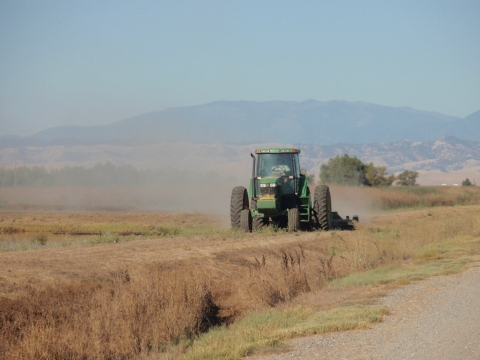
To help plants and wildlife, Refuge staff uses a variety of habitat management techniques to maintain, recover or enhance plant and wildlife values. Refuge staff carefully consider any management techniques and employ them in varying degrees according to the situation.
Conservation and Partnerships
The Complex is involved in many conservation endeavors, including Comprehensive Conservation Plans, Private Landowner Programs, and the National Wildlife Refuge System Improvement Act.
Our Organization
National Wildlife Refuge System (NWRS) Improvement Act of 1997:The NWRS Improvement Act defines a unifying mission for all refuges, including a process for determining compatible uses on refuges, and requiring that each refuge be managed according to a CCP. The NWRS Improvement Act expressly states that wildlife conservation is the priority of System lands and that the Secretary shall ensure that the biological integrity, diversity, and environmental health of refuge lands are maintained. Each refuge must be managed to fulfill the specific purposes for which the refuge was established and the System mission. The first priority of each refuge is to conserve, manage, and if needed, restore fish and wildlife populations and habitats according to its purpose.
Our Species
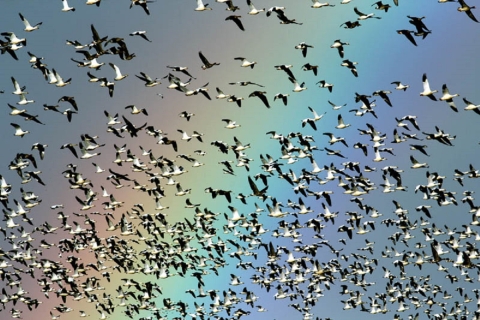
Sacramento National Wildlife Refuge is best known for migratory waterfowl. Migrating waterfowl are present September through April and numbers regularly peak at over 500,000 ducks and 250,000 geese. Sacramento NWR is an important wintering grounds for Tule Greater White-fronted Geese. The Sacramento NWR Complex provides nearly 70,000 acres of wetland, grassland, and riparian riparian
Definition of riparian habitat or riparian areas.
Learn more about riparian habitats for a wide array of waterfowl, shorebirds, raptors, waterbirds, songbirds, reptiles, and mammals. The Complex currently supports nearly 300 species of birds.