Pronghorn aren’t the first animal people usually think of when they hear the word migration. But in North America, 50% of the pronghorn population migrates through sections of Wyoming each spring and fall. One notable migration journey is 150 miles each way, from around Grand Teton National Park up to the Upper Green River Basin. Partners for Fish and Wildlife Program staff are working with the Wyoming Game and Fish Department and others to identify and remove barriers to migration. Keep reading to learn more uniquely North American mammal and how we at the U.S. Fish and Wildlife Service are working with others to ensure they have a bright future.
Wyoming’s Red Desert
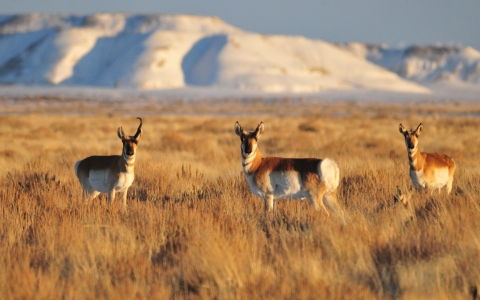
The southwestern corner of Wyoming is home to the Red Desert. This expansive area covers more than six million acres and is characterized by high elevation sagebrush sagebrush
The western United States’ sagebrush country encompasses over 175 million acres of public and private lands. The sagebrush landscape provides many benefits to our rural economies and communities, and it serves as crucial habitat for a diversity of wildlife, including the iconic greater sage-grouse and over 350 other species.
Learn more about sagebrush steppe habitat that has supported people and wildlife since time immemorial. This inspiring landscape, largely unchanged over time, is a symbol of the wild American West. Hundreds of thousands of people traversed this unyielding landscape on the Oregon, California and Mormon Pioneer Trails. The South Pass ascent on the western edge of the desert marked the halfway point of the cross-continental journeys. From there, emigrants split off for Oregon’s rich Willamette Valley, the California gold fields or the Great Salt Lake. Homesteaders who stopped in Wyoming built local communities and built a rich life that their descendants still enjoy today.
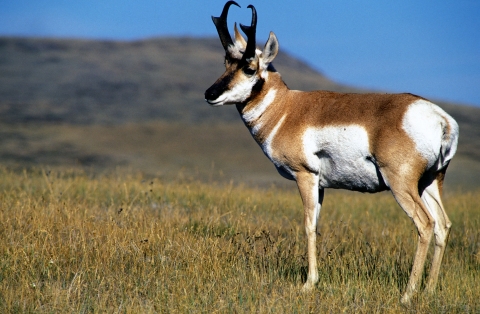
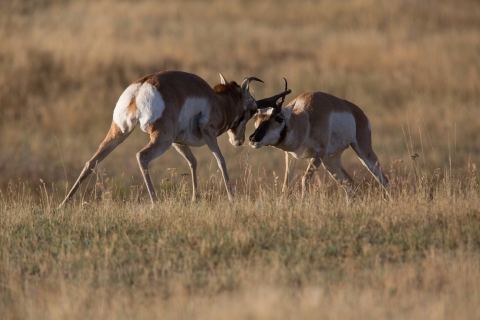
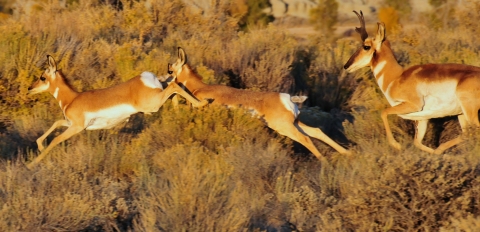
One of its most recognizable residents in the Red Desert is the pronghorn. The lithe, crème and brown animals are found only in North America and generations of Wyoming residents have admired and have harvested these animals as a part of their outdoor heritage. As an iconic symbol of the state, the Wyoming Game and Fish Department has had a pronghorn on their logo for 85 years. It is estimated that for decades, the Wyoming pronghorn population has been in a gradual decline across the state. Wyoming Game and Fish Department biologists have been working hard to understand the decline in population numbers in the Red Desert. This decline was significantly exacerbated by the extreme weather during the winter of 2022 through2023 where some individual herds in the Red Desert and elsewhere, lost up to 50% of their population.
State biologists conducted several years of research and monitoring using GPS collars to track the movement of migrating pronghorn as they move between the Red Desert and Upper Green River area to determine what may be impacting their survival. They discovered that some fencing is a restriction to the animals’ migration pathways, and in certain cases the pronghorn are not able to bypass the barriers at all. During a harsh and snowy winter, this proved fatal to thousands of pronghorn in the Red Desert.
Good fences can make good neighbors
Certain types of fences can unintentionally create barriers to movement along the pronghorn highway. Sheep fencing, with barbed wire at the top and a woven wire bottom make it difficult for pronghorn to jump over or crawl to pass through. Fences can be made more wildlife friendly, and an ambitious project in the Red Desert has done just that. The project was a joint effort involving a private landowner, the Partners for Fish and Wildlife team in Wyoming, Wyoming Game and Fish Department, Bureau of Land Management and several supporting organizations, including the Wyoming Wildlife and Natural Resource Trust, the Knobloch Family Foundation, the Wyoming Gand and Fish Department Trust, Muley Fanatics, The Wildlife Fund and the Wyoming Governor’s Big Game License Coalition.
This group of folks came together to make thousands of acres more accessible to pronghorns and other wildlife like elk while maintaining livestock infrastructure. More than 24 miles of sheep fence were replaced with wildlife friendlier fencing that includes welded pipe at strategic crossing points to allow elk to jump over and pronghorn to go under the fence safely, without injuring themselves on barbed wire. The fencing surrounded both private and Bureau of Land Management land. More than 9,000 acres of habitat are now accessible for the West’s iconic big game animals, while still allowing cattle to graze and stay safe.
Only in North America
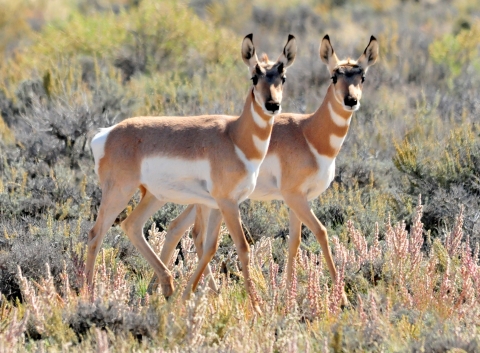
Though its scientific name, Antilocapra americana, means American antelope-goat it is neither antelope or goat. The species entire evolutionary history has taken place in America – it is found nowhere else in the world! Pronghorn can reach speeds up to 50 miles per hour and sustain it for over a half mile! By contrast, a cheetah can only hold its max speed of 50 to 80 miles per hour for no more than 30 seconds. Truly an example of America’s best wildlife athletes, they are the fastest land mammal in North America. Pronghorn bucks are identifiable by two large, black horns they grow and shed each year. These animals not only live in, but thrive in harsh, dry conditions that prove challenging for other animals. In a place where water is hard to find, they get most of the water they need from the plants they eat. They target moisture and nutrient dense forage and like cows, it’s processed by their stomach several times to extract every bit of needed sustenance. They can often be seen chewing their cud – just like a domestic cow.
An innovative American tradition
This project is just one example of the American ingenuity that defines our conservation programs and partnerships. Since 1987, nationally, we have assisted more than 25,000 landowners with more than 40,000 projects, restoring more than six million acres of habitat. The program offers technical and financial support to those interested in improving wildlife habitat on their land. Projects are voluntary and landowners maintain ownership of and manage their land while enhancing wildlife conditions. Our staff offer financial assistance and free assistance in planning, designing, overseeing, and monitoring habitat restoration, from small wetlands to extensive grasslands.
Learn more about the Partners for Fish and Wildlife Program and find a contact near you.