If you drive to Yosemite National Park from northern or central California, there’s a good chance you’ll go through El Portal.
Every year, hundreds of thousands of visitors pass through this small town on Route 140 at the western end of Yosemite Valley, the last place to fill up on gas or grab a bite to eat before entering the park. But for about 400 people — mostly park employees, contractors and their families — El Portal is home.
While residents have dramatic waterfalls, giant sequoias, majestic rock formations, and the Wild and Scenic Merced River at their doorsteps, they also live with the specter of natural disaster.
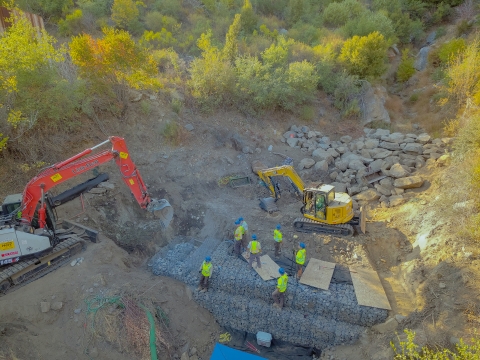
The forests on the mountainside above the town have burned twice in wildfires since the 1980s. With less vegetation to slow its flow, water rushes downslope during hard rains, funneling rocks and debris into a gully and toward El Portal’s water tanks and housing development.
The National Park Service had a retaining wall built partway up the gully in 1990 to keep the town safe. But after decades of pummeling by boulders, the structure was deemed at risk of failure after heavy rains in January 2023.
With another November rainy season fast approaching, the National Park Service needed to act quickly to protect the community.
Naturally, they called the U.S. Fish and Wildlife Service.
The nation’s premier conservation construction crew
Starting at the end of August 2025, a total of 30 Service employees from around the country supported the Yosemite National Park retaining wall and roadway reconstruction project in staggered two-week rotations over the course of six weeks, supplemented by remote staff providing essential logistical coordination. They were all members of a Maintenance Action Team.
These ad hoc teams bring together maintenance professionals from different field stations to work on short-term construction, demolition or habitat restoration projects — usually on Service lands. The project at Yosemite is the first time another federal agency has called on the Service’s Maintenance Action Team to handle a job.
Although other agencies have similar initiatives, the Service’s was the first and has grown to become the nation’s premier conservation construction program, while staying true to its roots. Shane Weigand, the national heavy equipment manager for the National Wildlife Refuge System, explained that Maintenance Action Teams started 15 years ago as a way to provide meaningful training opportunities for employees.
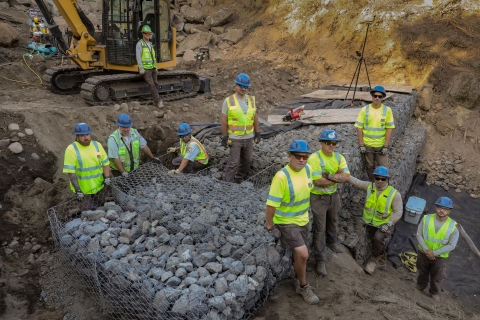
“In our day jobs, we work on isolated postage stamps of land across the United States,” he said. “Leaving your station to collaborate on new kinds of projects helps you get better at your trade, learn new skills, and build relationships with colleagues who can be a resource in the future.”
Training remains the top priority for Maintenance Action Teams, but the program has earned a reputation for efficient, cost-effective, high-quality work.
And word has gotten out. That’s why the National Park Service called when faced with an urgent and complex public safety project.
“They heard we were good at this kind of work and that we were quick,” Weigand said. “It would have taken a lot longer for them to bring on a contractor, and it would have been a lot more expensive.”
How much more expensive?
The estimate for the National Park Service to hire a private contractor for the month-long project was several million.
“We’re doing it for $1 million, and that includes everything — salaries, travel, equipment, and materials,” Weigand said.
Finding the best fit
The benefits go beyond the price tag.
Maintenance Action Teams are accustomed to working in environmentally sensitive areas on tight timelines — flexibility comes with the territory.
When the team arrived in El Portal to rebuild the retaining wall, they were not expecting to find the enormous pile of rocks that had backed up behind the structure.
But they adapted, removing or repurposing the rocks, while staying on schedule. This kind of surprise may have been a costly setback for a private contractor.
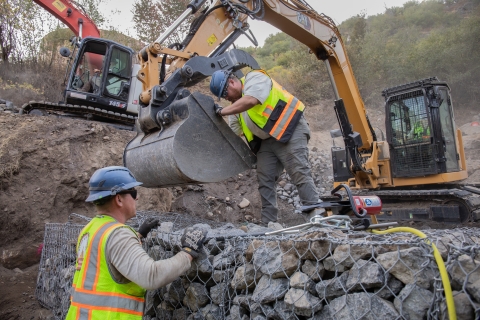
With or without the unexpected rocks, it was a challenging project. “The terrain at the site is very steep, and there’s not a lot of space to maneuver,” Weigand said.
The job required eight four-wheel-drive dump trucks and two excavators to transport rocks to the site of the wall, where team members hand stacked them inside wire baskets, called gabions, used as building blocks for the new structure.
“You might see something similar in a stream restoration,” he said. Because of the site conditions, this was no place for a concrete wall.
“This is what we’re good at,” Weigand said. “Finding solutions that are the best fit.”
Anywhere, anytime
While every Service region has a Maintenance Action Team that mobilizes to tackle projects in its geographic area, the team deployed to Yosemite drew participants from across the country, and across disciplines, to meet the needs of the high-stakes assignment.
The crew included heavy equipment operators, laborers, engineers, finance analysts and even an audio-visual specialist, who documented the work in progress.
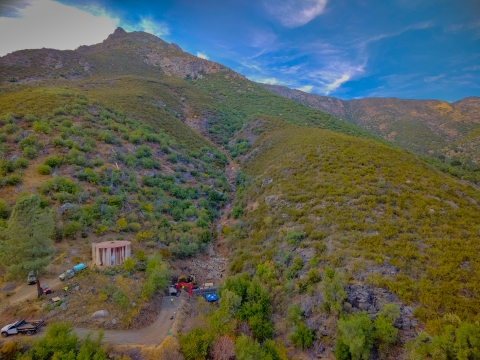
One of the images shows the precariousness of the work site: a niche at the bottom of a deep, rock-filled rut carved into the side of a mountain.
“Our projects are typically in wetlands, not on mountain sides,” Weigand said.
“This was an opportunity to put ourselves to the test in this iconic landscape and show that the Service’s Maintenance Action Team can do projects like this anywhere, anytime — and do them really well.”