


About Us
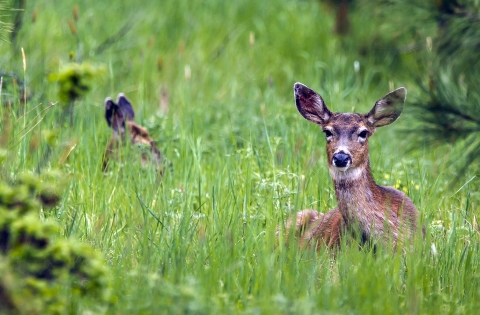
The refuge is a haven for plants and animals, supporting Washington's largest and healthiest populations of Oregon coyote-thistle, rosy owl-clover, Kellogg's rush, dwarf rush and long-bearded sego lily. A blend of oak, pine and aspen forests, wetlands, grassy prairies and streams supports a diverse and plentiful wildlife community. The rich habitat diversity sustains thriving populations of migrating waterfowl and songbirds. The rare Oregon spotted frog breeds in wetlands throughout the refuge. Elk are plentiful and frequently seen along refuge roads. And Conboy Lake supports the only breeding population of greater Sandhill cranes in Washington, around 25 pairs.
While the scenery and the plentiful, charismatic wildlife are what draw people in, visitors soon discover that Conboy Lake NWR offers hidden treats, esoteric gems that will keep them returning for years. Elk and deer may be the stars, but visitors soon learn about—and come to appreciate—Oregon spotted frogs, nesting greater Sandhill cranes and the variety of rare plants found on the refuge. A quiet place outside of hunting seasons, solitude is an easily found commodity and greatly appreciated by those coming from bustling metropolitan areas. As a national wildlife refuge national wildlife refuge
A national wildlife refuge is typically a contiguous area of land and water managed by the U.S. Fish and Wildlife Service for the conservation and, where appropriate, restoration of fish, wildlife and plant resources and their habitats for the benefit of present and future generations of Americans.
Learn more about national wildlife refuge , this living system will satisfy your longing for splendor and serenity, just as it did for the indigenous peoples, explorers, loggers and ranchers who were first drawn to the valley’s plentiful resources.
And history is an important part of Conboy Lake. Native Americans once depended on the area's plentiful resources; in fact, they still do, collecting plants for food and religious purposes. These same resources drew settlers to the area, arriving in the 1870s. One of the early homes, the Whitcomb-Cole Hewn Log House, still stands and is listed on the National Register of Historic Places. You are invited to stroll through the house and imagine the struggles these early settlers faced.
Our Mission
The mission of the National Wildlife Refuge System is “To administer a national network of lands and waters for the conservation, management, and where appropriate, restoration of the fish, wildlife, and plant resources and their habitats within the United States for the benefit of present and future generations of Americans.”
Conboy Lake NWR’s mission (refuge purposes) include “use as an inviolate sanctuary . . . for migratory birds,” the “protection of natural resources,” and to “conserve wildlife . . . or plants . . . which are listed as endangered species or threatened species.”
Other Facilities in this Complex
The Central Washington National Wildlife Refuge Complex consists of three national wildlife refuges—Columbia, Conboy Lake, Toppenish—and the Hanford Reach National Monument. To learn more about the Complex, Please visit: Central Washington National Wildlife Refuge Complex.


