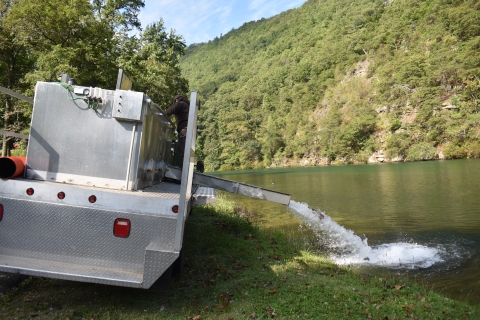
Every year, millions of Americans try their luck at trout fishing. Many of the trout caught in states such as Georgia, North Carolina, New Mexico, Massachusetts, Missouri, and Tennessee began their lives hundreds or even thousands of miles away at Erwin National Fish Hatchery.
Each year Erwin National Fish Hatchery ships around 20 million trout eggs as a primary producer of the US Fish and Wildlife Services National Broodstock Program. This program ships close to 50 million eggs annually to support federal, state, and tribal hatcheries across the country.
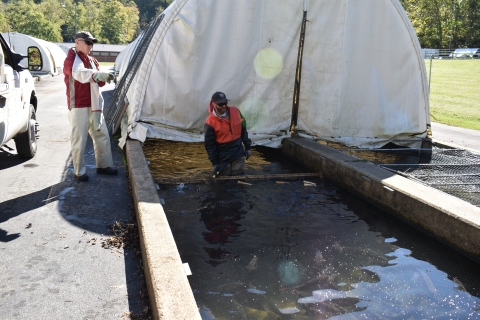
It takes a lot of planning and effort for fish eggs to successfully reach their destination. Receiving hatcheries make their requests for eggs three years in advance. This allows staff at Erwin to calculate the number of fish needed to produce the requested eggs. With that information staff at Erwin NFH can ensure they rear enough eggs producing fish to to produce the necessary number eggs to fulfil these egg requests, along with keeping a little extra for insurance.
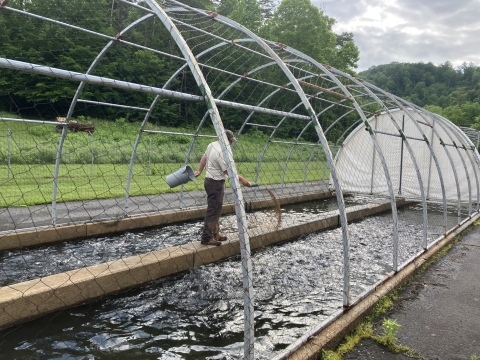
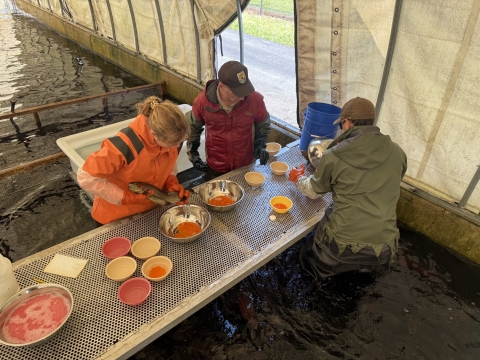
The couple years consist of daily feedings, weekly raceway cleanings, and monthly measurements to ensure that the fish are on track to produce the eggs most efficiently. After a full two years the fish are finally ready to spawn. Males and females are sorted and seperated, and each week the females that are ready to lay eggs are set aside for spawning. Eggs from the females and milt from the eggs are carefully stripped into a bowl where fertilization takes place. After fertilization is complete the eggs are brought into the tankroom and placed in special incubation jars until they reach the "eyed-egg" stage.
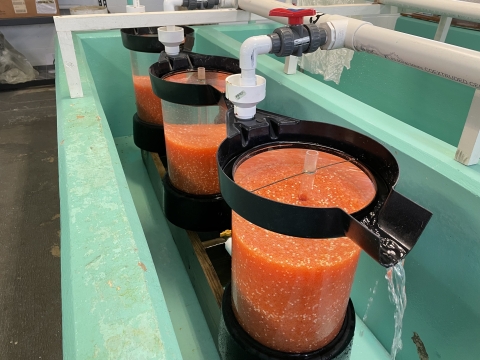
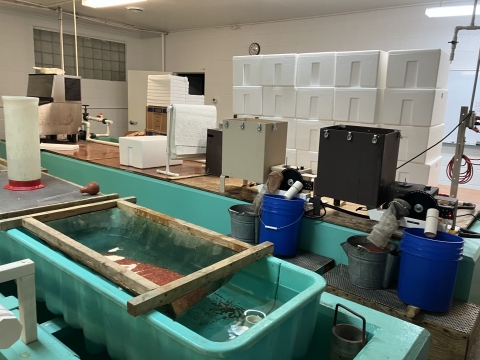
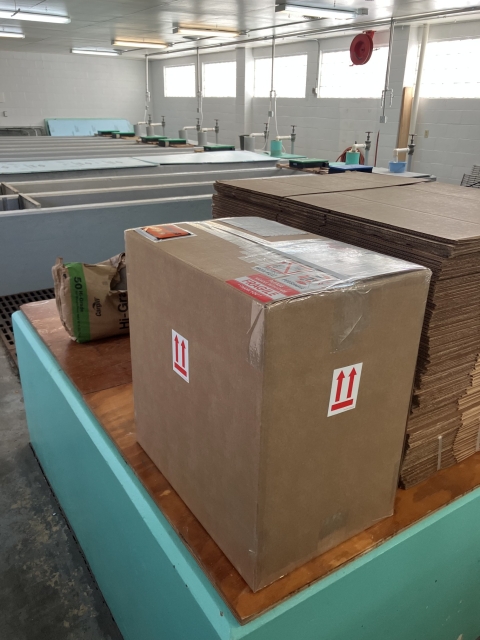
"Eyed-eggs" are eggs that have developed a clearly visible eye. That is when biologists know the eggs strong enough to survive the shipping process. Before the eggs are shipped to another hatchery, any dead eggs are removed and the healthy ones are packed into coolers filled with ice. The coolers are then placed into shipping boxes, ready to be sent to hatcheries across the country
Receiving hatcheries will carefully unpack the eggs, and acclimate them to their new environment and water temperature. They place the eggs into their facility's hatching system. These are usually something like such as McDonald jars, Heath stack trays, misting systems, or hatching tables. Hatcheries will raise these fish until they reach their desired stocking size, and will stock them in rivers, streams, and lakes all across the country for the public to enjoy.
These fish are used to support recreational and mitigation in the southeast and other regions. Trout originating at Erwin can be caught in places like New Mexico, North Carolina, Massachusetts, Oklahoma, Tennessee, and many more states. This helps to support local economies all across the country. A 2023 report from the NC Wildlife Resources Commission showed that trout fishing in just North Carolina alone created a $1.38 billion economic impact, highlighting the importance of recreational fishing and the hatcheries that support it.