Written By

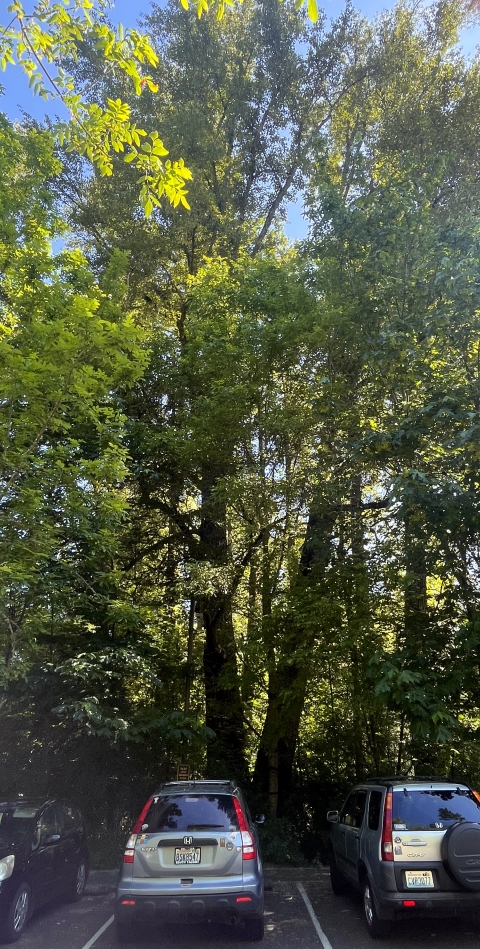
For several years, Acting Refuge Manager Kurt Roblek has been eyeing a double-trunked cottonwood tree, recognizing it as a threat even while most people don't notice it at all.

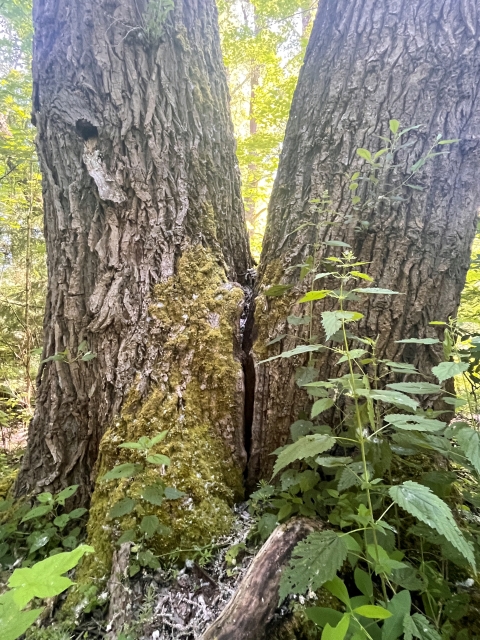
The tree's highest trunk rises over 170 feet above the thicket of salmonberry, hawthorn, and stinging nettle that surrounds it. But Kurt waded in to have a closer look. He suspected the seam dividing the two trunks might be widening. So he hammered in two nails, one on either side of the split, and took a measurement.
In April 2023, the gap between the nails measured 116.72 millimeters. By April 2025, the gap had widened to 151.69 mm. But by June 30, 2026, the gap had increased to 310 mm. Not only was the gap increasing, it was spreading faster.

But Kurt wasn't waiting around. Haunted by the thought of the trees collapsing suddenly and causing harm, he had already started the lengthy process of finding a contractor to help solve the problem. He brought in a professional arborist for an assessment. One trunk was staying mostly upright, while the other leaned more and more. Could the upright one be retained?
But no. The arborist said there was no way to just remove one of the trunks and leave the other standing. The remaining one would be too vulnerable, weakened by the loss of its partner. They both had to come down.
The trouble was the proximity of the tree to a parking lot and the Education Center. There is no safe way to bring down the trees without a crane, which allows much more control over the process. Kurt chose a contractor able to do the job using a crane to reduce risk.
The summer season is busy, with hundreds of visitors thronging the level, scenic trails daily. Nearly half a million visitors come to the refuge annually, in part because of its easy access off Interstate 5 as well as proximity to the state capital of Olympia, Joint Base Lewis-McChord, and the city of Tacoma. But parking is limited to 97 spaces in two lots. The first lot is the one close to the trees. Kurt decided to make the first parking lot, Education Center, and adjacent Nature Explore Area (designed for children to play in) off-limits during the tree removal process to make room for the crane to operate and to keep everyone safe. The main trail will not be affected.
But this is a wildlife refuge. Rather than have the entire tree taken down, Kurt elected to leave shorter 30-foot snags standing, so animals like woodpeckers and raccoons can enjoy newly available habitat. When other trees at the refuge have been trimmed of dangerous dead limbs, Kurt has made sure to leave as much of the tree trunks and limbs as possible, a continuing benefit to wildlife.
The tree removal is scheduled to take place July 21-22, with cleanup possibly continuing into July 23. Branches will be chipped, and the chips taken to another part of the refuge to mulch newly planted trees. Larger sections of trunk will be kept by the refuge for other uses. Visitors should obey signs directing them away from the area for their own protection.
For questions, please contact us at nisqually@fws.gov.