Within the circular enclosures found in the far southwest corner of Arizona, shuffling boots fill the winter air with dust. As soon as there is just enough daylight to see, when temperatures are at their coolest, the work begins. One goal unites a dedicated crew of nearly 30: safely, calmly, and quickly workup nearly 50 endangered Sonoran pronghorn before the day gets too warm. As the desert sun rises, they race to conserve this incredible species.
For the past two decades, a multi-agency team has met annually to support the recovery of the species. A severe drought in 2002 nearly wiped out the U.S. population of Sonoran pronghorn, leaving 21 individuals remaining in Arizona at the time. In response, federal and state agencies secured six individuals from the Mexican government to prevent the endangered pronghorn’s extirpation (local extinction), improve the gene pool, and establish a cooperative semi-captive breeding program in Arizona. “Semi-captive” means that the pronghorn are still wild, but live in a large, enclosed pen that excludes predators, and where natural breeding and behaviors occur.
“It really does take a village to save a species,” said Aleksa Mckay, wildlife biologist with Arizona Ecological Services in Tucson and the Sonoran pronghorn species lead. “All of these different organizations and partners have vested interests in recovering the species. It's impressive how far we have come with the recovery efforts.”
The endangered pronghorn’s range spans across multiple land agencies in southwestern Arizona, and the pronghorn can move freely between them. These places include Kofa and Cabeza Prieta National Wildlife Refuges, Organ Pipe Cactus National Monument, Bureau of Land Management lands, military lands, and tribal lands. The Endangered Species Act mandates that federal agencies take action to conserve species, and each of the partners play a role in contributing to recovery.
Pronghorn Conservation on a Military Range
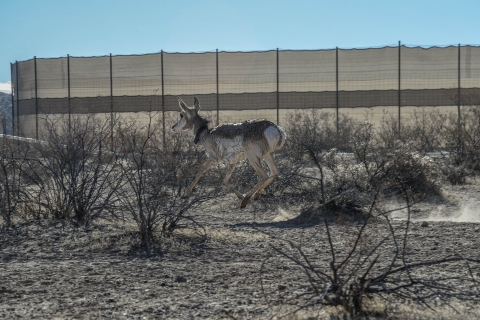
As a result of successful captive breeding at the Cabeza Prieta National Wildlife Refuge facility, and subsequent releases into the wild, nearly half of the nation’s endangered Sonoran pronghorn are found at the Barry M. Goldwater Range in southwestern Arizona. Fighter jets, bombs and weapons don’t faze the pronghorn as they feed on desert plants such as cacti and thorny bushes. Long-term studies have shown that the animals become habituated to the noises from military training, often being observed to pause, lift their heads, and then return to eating. Vehicles and helicopters cause more disturbances than do bombs or bullets.
“We are committed partners towards the recovery of this iconic species of the Sonoran Desert,” said Aaron Alvidrez, 56th Range Management Office wildlife biologist. “We have not documented any pronghorn mortality due to Air Force training missions. We balance military readiness with conservation.”
The Department of War has been a committed partner when it comes to implementing the ESA’s conservation goals. Alvidrez has participated in the pronghorn capture and release event for two decades as a member of the Sonoran Pronghorn Recovery Team, helping to refine the methods. The species is highly sensitive and becomes stressed when handled, so improving capture methods is critical to its recovery.
This is Not a Rodeo

Before the capture and release event, Arizona Game and Fish Department employees put high-value enticements like molasses pellets inside of the high-walled three-interconnected circular enclosures called bomas. The pronghorn become comfortable entering the bomas, and when enough are inside, personnel will remotely trigger a sliding door.
On the day of the event, pronghorn are isolated three at a time into a designated boma. They are captured and restrained for their safety, worked up, and immediately released back into the breeding pen or sedated and transported to their new home at a release site. The workup of the animals includes assessing their health, administering vitamin and disease prevention inoculations, adding identifying ear tags, and, for those being released into the wild, adding radio collars for tracking once they are released. Ideally, all of this is done in less than three minutes.
Although it may appear chaotic, each action taken by the team is purposeful and deliberate. The team works mostly in silence, whispering only when necessary to keep the animals calm. The capture event has become a well-oiled machine. The pronghorn are handled as quickly and efficiently as pit crews maintain racecars, and then the speeding animals are sent on their way.
“They're very skittish, cautious animals,” said Greta Schmidt, wildlife biologist at Cabeza Prieta National Wildlife Refuge and the Sonoran Pronghorn Recovery Team coordinator. “Their behaviors are adaptations evolved from living alongside the American cheetah. Their whole way of surviving is to be really wary of things.”
Work continues until all the pronghorn have been handled, only pausing if personnel observe a pronghorn in distress and restarting when the animal is calm again. After the workup, most of the pronghorn are returned to the pen. Some are transferred to other locations on federal lands, such as the Barry M. Goldwater Air Force Range. Here, they tend to frequent a permanent feeding and water development called Uken Tank which is named after Colonel Jim Uken, the retired director of the Range Management Office at Luke Air Force Base. Colonel Uken was an advocate for Sonoran pronghorn, and the feeding and watering tank bearing his name has proven to be critical in drought years, allowing for higher survival rates for fawns.
Capture and Release Day Video
During the capture and release day, the safety of the pronghorn is priority. Each person knows their role and follows their training. They break up into several teams, and a person can be a member of more than one team. This behind-the-scenes video provides an overview of team names and roles and show a typical capture and release day.
Racing Towards Recovery

As the sun rises higher in the sky, the winter air has warmed and the capture event comes to an end. Everyone is covered in dirt and sweat and is shaky from the high-adrenaline day. Although they are weary, the team feels energized knowing that they helped in the recovery of the species.
The Sonoran Pronghorn Recovery Team has managed one of the most effective recovery projects in recent history. Today, about 450 Sonoran pronghorn are found in Arizona, and another 500 live in Mexico. The semi-captive breeding program in Arizona is a temporary measure, continuing only until the species recovers to self-sustaining populations and thrives once again in the American southwest.
“The Sonoran pronghorn are an integral element of this landscape, and they add to what makes the Sonoran Desert such a unique, biodiverse place,” said Schmidt. “They are the charismatic megafauna in the desert, and they are worth saving.”