Written By

Since 2022, the United States Fish and Wildlife Service’s (USFWS) Warm Springs Fish Technology Center (FTC) has been rearing a small number of Frosted Flatwood Salamanders (Ambystoma cingulatum), nicknamed ‘Frosties’. Frosties are listed as threatened under the Endangered Species Act of 1973 due to a combination of critical habitat loss and irregular weather over the decades. The Warm Springs FTC joined The Frosted Flatwoods Salamander Conservation Breeding Working Group to assist in captive rearing and propagation research.The Conservation Breeding Working Group is led by The Amphibian Foundation, a non-profit organization founded at the request of the USFWS, and consists of amphibian experts from accredited zoos across the country. Warm Springs FTC and fellow Conservation Breeding Working Group Partners are working to better understand this illusive species in the captive setting. We aim to identify best husbandry practices and captive propagation protocols in hopes to one day rear animals intended for release.

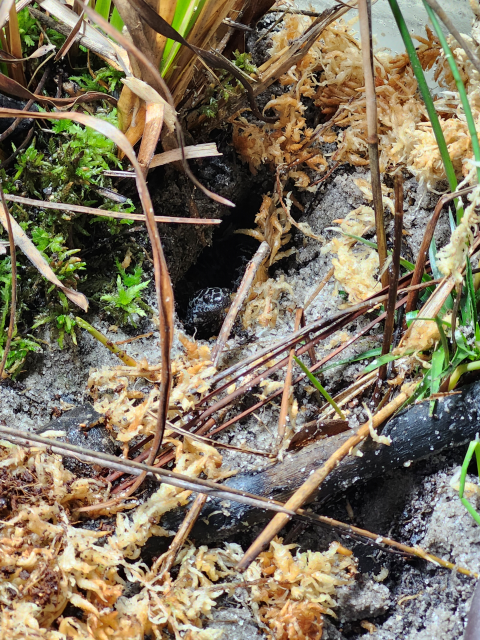
In September 2025, USFWS Fish Biologist, Valerie Kearny, and Bureau of Indian Affairs (BIA) Watercorps Intern, Maya Bass, collected soil and plants native to the Frosties’ range with Georgia Department of Natural Resources State Herpetologist, Daniel Sollenberger. Frosties are from the fire-dependent, longleaf pine-wiregrass ecosystem of the Southeastern US. The collected plants went into Warm Springs FTC’s breeding vivarium, designed to mimic Frosties’ natural breeding habitat. Hydrology, photoperiod, temperature, and water chemistry were all important components considered during vivarium construction. Kearny and Bass also inoculated the vivarium with several species of isopods and worms Warm Springs FTC cultures to feed the captive salamanders.
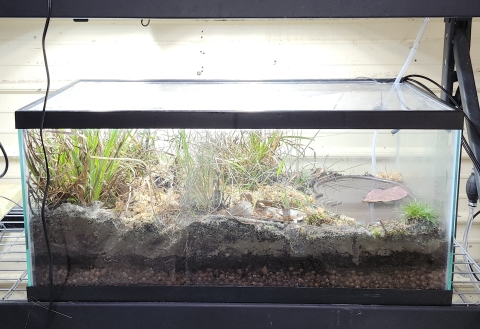
As of early November 2025, the Warm Springs FTC breeding vivarium is home to multiple Frosted Flatwoods Salamanders. Kearny and Bass regularly and closely inspect the enclosure for any jelly-like globs that could indicate eggs. The team has also placed a night vision camera nearby to monitor the nocturnal animals’ behavior. Frosties spend most of their lives in burrows underground but emerge at night to travel to ecotonal areas of ephemeral wetlands during the breeding season.
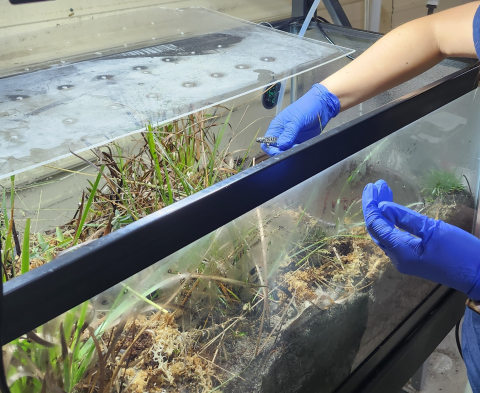
Captive propagation is just one component to the recovery strategy for Frosted Flatwoods Salamanders. Properly protecting and stewarding the land where these animals natively reside is of the upmost importance. The Warm Springs FTC team is honored to be a part of the Frosted Flatwoods Salamander Conservation Breeding Working Group and greater recovery team. Kearny and Bass are excited to continue monitoring the new enclosure this breeding season and hope to continue progressing and improving the captive rearing and propagation project at Warm Springs FTC.
Written By