


Law Enforcement
U.S. Fish and Wildlife Service law enforcement officers have a wide variety of duties and responsibilities. They enforce federal, state and refuge hunting regulations that protect migratory birds and other game species from illegal take and preserve legitimate hunting opportunities. Officers help visitors understand and obey wildlife protection laws. By fostering understanding and instilling in the visiting public an appreciation of refuge resources, laws, and regulations, our law enforcement encourages voluntary compliance through education, outreach, and law enforcement actions while in a welcoming and safe environment. Refuge law enforcement works collaboratively with law enforcement officers from other federal, tribal, state, and local agencies.
Law enforcement issues should be referred to the refuge manager. For a full list of refuge rules and policies, click here.
You may also report violations to 1-844-FWS-TIPS (397-8477) or by email at nwr_tips@fws.gov
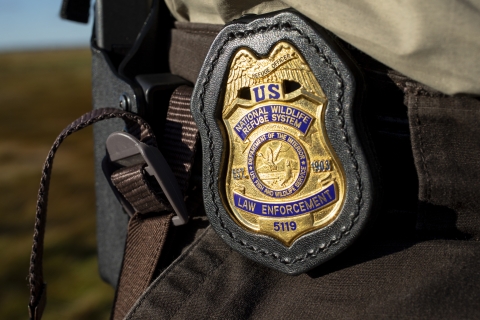
Law enforcement (LE) is essential to virtually every aspect of wildlife conservation. Refuge Law Enforcement not only plays a big role in protecting wildlife but also works to promote awareness of wildlife laws and protection through collaboration with refuge Visitor Services staff.
USFWS Law Enforcement's mission is to protect wildlife resources. Through the effective enforcement of Federal laws, Law Enforcement (LE) contribute to Fish and Wildlife Service efforts to recover endangered species, conserve migratory birds, preserve wildlife habitat, safeguard fisheries, combat invasive species invasive species
An invasive species is any plant or animal that has spread or been introduced into a new area where they are, or could, cause harm to the environment, economy, or human, animal, or plant health. Their unwelcome presence can destroy ecosystems and cost millions of dollars.
Learn more about invasive species , and promote international wildlife conservation. Service LE focus on potentially devastating threats to wildlife resources – illegal trade, unlawful commercial exploitation, habitat destruction, and environmental hazards.
LE objectives are to:
- Uncover major commercial activity involving illegal trade of protected wildlife and wildlife products;
- Protect domestic and foreign wildlife species that enter into interstate and international commerce that are protected by treaty or otherwise under Federal jurisdiction; and,
- Enhance legitimate use and enjoyment of migratory birds and other wildlife.
LE priorities include:
- Investigating wildlife crimes on wild populations of federally protected species, with emphasis on commercial exploitation and/or habitat destruction and modification;
- Investigating wildlife crimes on wild populations of species protected by state or foreign laws, with emphasis on interstate and foreign commercial exploitation;
- Providing support and assistance to refuge enforcement activities on Service lands and to other Federal agencies on lands they manage;
- Inspecting import or export wildlife shipments, containing federally protected species; special emphasis on commercial exploitation, CITES Appendix I, II, or III species, threatened or endangered species, and species protected by state or foreign law, including species indigenous to the United States; and,
- Promoting awareness of, and support for, Federal wildlife laws and the role of law enforcement in protecting our wildlife resources and heritage.
How do I become a law enforcement officer with USFWS?
Refuge Officer Qualifications
Refuge officers are commissioned law enforcement officers. You are required to carry firearms and other defensive equipment; therefore, you must be at least 18 years old, and physically and emotionally fit. A 2 or 4-year degree in natural resources conservation, criminal justice, or a related field is desirable, although applicable experience may be substituted for education.
Needless to say, you must like working outdoors in all kinds of weather! You also must enjoy working with people, because most of your job will consist of contacting and interacting with refuge visitors, neighbors, and other employees.
We suggest that you visit a national wildlife refuge national wildlife refuge
A national wildlife refuge is typically a contiguous area of land and water managed by the U.S. Fish and Wildlife Service for the conservation and, where appropriate, restoration of fish, wildlife and plant resources and their habitats for the benefit of present and future generations of Americans.
Learn more about national wildlife refuge and talk to the staff or an officer, if possible.
Physical Fitness
Physical fitness is crucial in obtaining and maintaining a commission. Before entry and then annually, officers must undergo a physical examination and be physically and medically capable of performing the essential duties of the position efficiently, without hazard to themselves or others.
Other Tests Performed
You must pass a series of psychological screening tests before entry.
Age
You must be between the ages of 18 and 37 before entry.
Background Investigation
You must undergo an initial background investigation.
Drug Tests
You must be tested before entry, and periodically thereafter.
Firearms Qualifications
You must qualify periodically with the weapons that you carry.
Training
After being selected, you must successfully complete different phases of training as a refuge officer including but not limited to:
- 18 weeks at the Federal Law Enforcement Training Center (FLETC) Glynco, Georgia
- 2 weeks of Refuge Officer Basic School
- 10 weeks of the Field Training and Evaluation Program
Your performance will be evaluated in all phases of the training.
To find available federal wildlife officer jobs and education requirements, go to USAJobs.gov, search “GL 1801” and/or “GS 1801,” and filter by “U.S. Fish and Wildlife Service” or “Department of the Interior.”