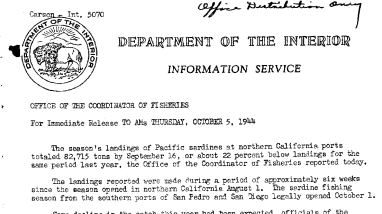
The season's landings of Pacific sardines at Northern California ports totaled 82,715 tons by Sept. 16, or about 22 per cent below last year's catch

This is a news release written by Rachel Carson as part of the Department of the Interior Information Service, Office of the Cooridnator of Fisheries. This was for "office distribution only." This report states that the number of Pacific sardines at California ports was 22 per cent below last years total for the specific time period. Biologists credit this to poor spawning periods, cool summer weather, and lack of young fish added to the stock since 1939. Fishery industry;

Author(s)
Rachel Carson
Publication date
Facility
A sunset over Izembek Lagoon with a cloudy sky reflecting over the water
Alaska's Izembek National Wildlife Refuge lies between the highly productive waters of the Bering Sea and the Gulf of Alaska. The heart of the refuge is Izembek Lagoon, a coastal ecosystem that's home to one of the world's largest eelgrass (Zostera marina) beds. Hundreds of thousands of waterfowl,...
Seven pronghorn in field at Hart Mountain National Antelope Refuge
Hart Mountain National Antelope Refuge was established in 1936 to provide a range for remnant antelope herds. Refuge management practices have since been broadened to include conservation of all wildlife and native plant species characteristic of this high-desert habitat. Public enjoyment,...
A Long-billed Curlew walking through grass at Fish Springs National Wildlife Refuge in Utah
Fish Springs National Wildlife Refuge is located on the southern extreme of the Great Salt Lake Desert, and the natural springs have been essential in meeting human and wildlife needs over the past 11,000 years. The area is the ancestral homelands to the once nomadic Goshute (Gosiuta) tribe. These...
A pair of Horned Puffins with brightly colored yellow and red bills perches on a cliff near their nest. The cliff in the background is blurred.
The Alaska Maritime National Wildlife Refuge stretches from the spectacular volcanic islands of the Aleutian chain to the Inside Passage, and north to the Chukchi Sea, providing essential habitat for marine mammals and some 40 million seabirds, representing more than 30 species.
Media Usage Rights/License
Public Domain
Subject tags
Work of the Service
Wildlife refuges
Waterfowl
Water birds
Surveying
Shorebirds
Mammals
Laws & Regulations
Islands
History
Employees (USFWS)
Boats
Biologists (USFWS)