Invasive Carp eDNA Program Process for Making Program Changes and QAPP Modifications

The Invasive Carp (IC) eDNA Monitoring Program Quality Assurance Project Plan (QAPP) is a controlled document that is reviewed annually by IC eDNA Monitoring Program staff. Program staff consists of Midwest and Northeast Regions Fish and Wildlife Conservation Offices (FWCO), Project Leaders (PL), Whitney Genetics Lab (WGL), and Regional Offices (RO). This document outlines the process for addressing IC eDNA Monitoring Program QAPP changes.


Each year when revisions to the QAPP are proposed through the eDNA QAPP Revisions Microsoft Form (eDNA QAPP Revisions), there are situations when proposed changes are more than grammatical in nature. These changes should be addressed with an appropriate level of review and subsequent decision-making processes. This document outlines the processes that should be followed if IC eDNA Monitoring Program staff are suggesting a higher-level change (further described below). These higher-level changes will need an experimental research project proposal (described below). An experimental research project would be any major change to a Program process or scientific method (sample collection, processing or analysis) that would potentially affect results.

Author(s)
Woman smiles.
Data Coordinator
Data Management ,
Fish and Aquatic Conservation
Expertise
ArcGIS Pro,
ArcGIS Online,
ArcMap,
R coding,
ArcGIS Applications,
ArcGIS Survey123,
Section 508 compliance,
Microsoft Power Automate,
Microsoft Power Apps,
Hydrologic Analysis,
ArcGIS Field Maps
Onalaska,WI
Publication date
Media Usage Rights/License
Public Domain
Program
A man is fishing in a boat with three young girls. The kids are excitedly pulling a fish out of the water.
Healthy fisheries and waters are the foundation of America’s outdoor traditions and give us the freedom to fish, boat, and enjoy the benefits of outdoor recreation. The Fish and Aquatic Conservation programs work with states, tribes, and communities to provide a comprehensive approach to freshwater...
Silver Carp Jumping
Aquatic invasive species cause tremendous harm to our environment, our economy, and our health. They can drive out and eat native plants and wildlife, spread diseases, and damage infrastructure. We work to protect our waterways and the communities that depend on them from the threat of invasive...
View from a sandy bluff overlooking a turquoise-blue lake, with clear water fading to deep blue toward the horizon. Green forested shoreline curves into the distance under a bright blue sky with a few wispy clouds, while leafy shrubs and branches frame the foreground.
The Great Lakes Aquatic Invasive Species Early Detection and Monitoring Program is part of the Great Lakes Restoration Initiative’s efforts to protect and restore the Great Lakes from aquatic invasive species. The U.S. Fish and Wildlife Service, in collaboration with partners, leads and implements...
Species
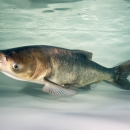
Underwater photo of a bighead carp in a tank with white background

Bighead carp (Hypophthalmichthys nobilis) are native to eastern Asia and are one of four nonnative fish referred to as “invasive carp”. These fish are large, deep bodied fish that have a large head and a large toothless mouth with a protruding lower jaw. The bighead carp eyes are far...

FWS Focus
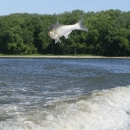
A Silver carp jumping out of the water with boat wake below and a tree lined shoreline in the background

Silver carp (Hypophthalmichthys molitrix) are one of four nonnative fish species belonging to a group commonly referred to as “invasive carp”. Native to eastern Asia, silver carp were introduced to the United States during the 1970’s and 1980’s to private fish farms and wastewater...

FWS Focus
FWS and DOI Region(s)