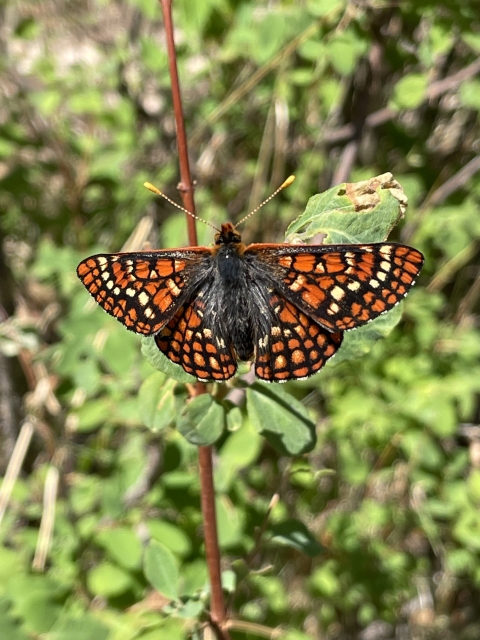
ALBUQUERQUE, N.M. – The public can now review and comment on the U.S. Fish and Wildlife Service’s draft recovery plan for the endangered Sacramento Mountains checkerspot butterfly. The recovery plan’s goal is to recover the butterfly so that it no longer needs protections under the Endangered Species Act. The 30-day public comment period opens today and closes on Oct. 23, 2025.
The Service listed the Sacramento Mountains checkerspot butterfly as endangered in 2023. Threats to the butterfly include altered wildfire regimes, climate variability, incompatible grazing, invasive plants and recreation. The butterfly inhabits high-altitude meadows atop the Sacramento Mountains, an isolated mountain range in south-central New Mexico. It requires a specific host plant, New Mexico penstemon, and nectar sources such as orange sneezeweed for survival.
The Service, in collaboration with tribes, stakeholders and partners, develops and implements recovery plans to support the conservation and recovery of endangered and threatened species. These are not regulatory documents, and implementation of actions is not required by the ESA. Instead, recovery plans serve as road maps with specific management actions to foster cooperation in conservation for listed species and their ecosystems.
The draft recovery plan describes actions that are considered necessary for the recovery of the Sacramento Mountains checkerspot butterfly, establishes downlisting and delisting criteria and estimates the time and cost to implement these recovery actions. The draft recovery plan’s strategy will focus on captive rearing to expand and augment wild populations, reintroducing individuals, engaging with partners to develop and implement conservation plans that reduces species’ threats, conducting further research to effectively manage the species and annual monitoring of the species and its habitat.
To successfully conserve species like the Sacramento Mountains checkerspot butterfly, the Service embraces partnership, cooperation and a long-term commitment of working together. Within Lincoln National Forest, the U.S. Forest Service built fenced exclosures and started restoration efforts to protect butterfly habitat from overgrazing, as well as to increase the number of nectar sources and host plants. Proposed forest management plans may help restore habitat and connectivity throughout the range of the butterfly. In addition, the Albuquerque BioPark began captive rearing of the Sacramento Mountains checkerspot butterfly in 2022. Information collected from partner’s conservation efforts was used to inform the draft recovery plan.
The Service encourages the public, federal and state agencies, tribes and other stakeholders to review the Sacramento Mountains checkerspot butterfly draft recovery plan and provide comments. Submit comments by mail to the New Mexico Ecological Services Field Office, 2105 Osuna Road NE, Albuquerque, New Mexico 87113 or by email at nmesfo@fws.gov.