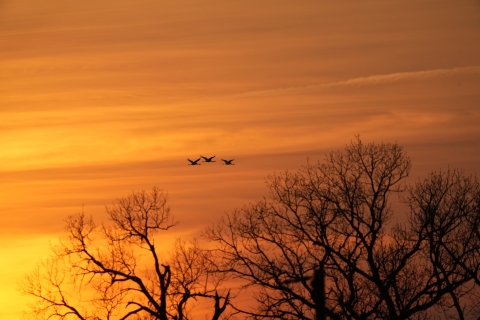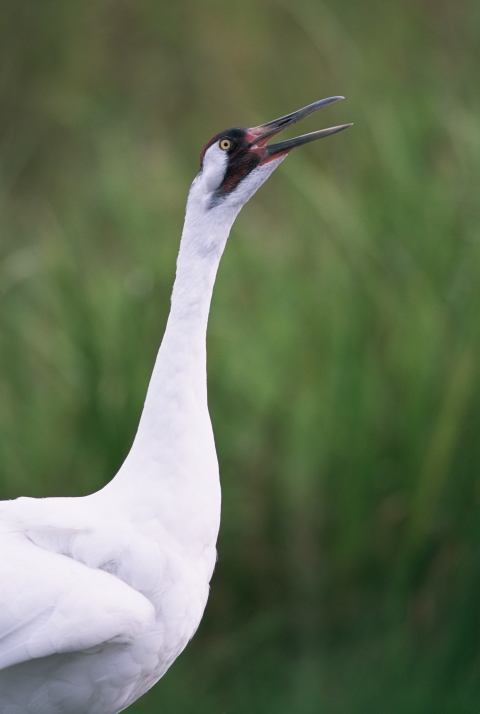
Jet, Okla. – Every spring and fall at Salt Plains National Wildlife Refuge seasoned birders know to keep a keen eye for the elusive whooping crane. Their bright white plumage may blend in with the salt flats, but their crimson crest, dark under eye malar stripes, and black wing tips stand out. A large proportion of these rare, endangered birds, known as whoopers by those that study and care for them, make extended pit-stops at the refuge each fall as they migrate from their breeding grounds at Wood Buffalo National Park in Canada to their wintering grounds at Aransas National Wildlife Refuge along the Texas coast. This winter, however, visitors and birders at Salt Plains helped identify a behavior never seen from whooping cranes: a group of eight individuals, six adults and two tawny-feathered juveniles, decided to stay for the season rather than seek the estuaries of coastal Texas.
New Behaviors
“I first realized we may be observing a new whooping crane behavior during our yearly Christmas Bird Count Christmas Bird Count
The nation's longest-running community science bird project, the Christmas Bird Count occurs December 14 to January 5 every season and is coordinated by Audubon.
Learn more about Christmas Bird Count ,” said the Refuge’s Wildlife Biologist Glen Hensley. “We had multiple groups of volunteer surveyors report whooping crane sightings on January 3rd, the latest they had ever stayed at the refuge. It wasn’t until then I realized the whoopers were hanging around and might remain here for the whole winter.”
Small numbers of whooping cranes have stayed late into December at Salt Plains before but have always taken off for Aransas National Wildlife Refuge before the new year. With the insights provided by community scientists, Hensley kept a close eye on the small flock to see if they would stick around or continue south.
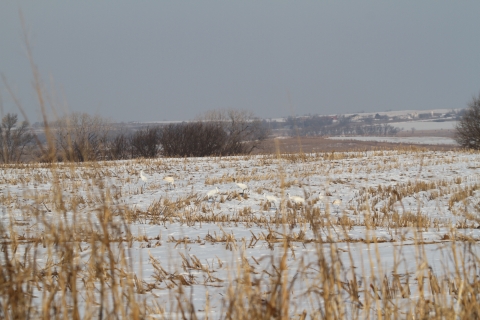
In late January, an arctic blast pushed into Oklahoma, bringing with it temperatures in the single digits and around eight inches of snow. Many of the whooping crane researchers thought that this frigid weather may prompt the cranes to continue south to the warmer coast. As temperatures dropped and snow fell, Hensley thought he likely wouldn’t see this group until next fall.
“After things had thawed out, I headed to the refuge thinking the cranes had probably moved on,” said Hensley. “But on my drive in I saw the full group, grazing on scrap corn on the snowy ground of their favorite field.”
The cranes stuck around all winter, with a dedicated group of service biologists and community scientists keeping a close tab on them, before they headed north in early March.
A Population on the Climb
Since 1938, Service biologists have been tracking the number of wintering whooping cranes at Aransas National Wildlife Refuge. This species was perilously close to disappearing from the wild in 1941, when only 14 adults and 2 juveniles were counted in the wild at Aransas. But dedicated conservation efforts, including partnerships conserving habitat throughout the Central Great Plains, have created conditions for the whooping crane numbers to steadily climb. Today their population exceeds 550 individuals.
As the whooping crane population has increased, so has their usage of habitat away from their core wintering grounds. Scientists have noted this behavior in recent wintering grounds surveys, with crane observations demonstrating a range expansion to habitats surrounding Aransas National Wildlife Refuge. Over the past decade, another growing group of whooping cranes has been wintering over 30 miles inland from the typical estuarine marsh habitat. Individual cranes have even been observed staying on the Texas coast all summer, despite the intense Texas summer heat.
“As the population climbs, we are seeing these iconic cranes exhibit new behaviors,” says the Service’s Whooping Crane Coordinator Kevin McAbee, “These resilient birds are showcasing their adaptability, something that will help them adjust to changing landscapes. Each year these whooping cranes seem to do something we haven’t observed in the last 100 years. It is exciting that this species continues to remind us that we have lots to learn about their ecology and behavior.”
While this is the first observation of a group of whooping cranes stopping their southern migration in Oklahoma, it is part of a behavioral trend biologists have been seeing. As winter weather becomes less predictable and migratory birds adjust by lingering farther north it becomes even more important to conserve the network of wetlands and grasslands that underpin the Central Flyway.
Managing with Whoopers in mind
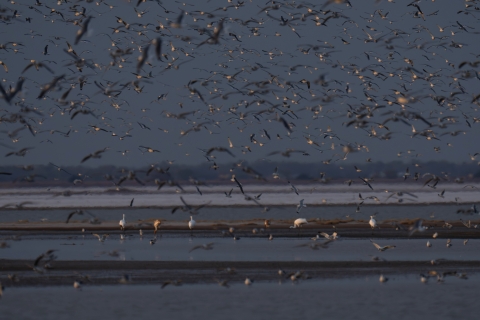
The Central Flyway is a major North American bird migration corridor that spans the Central Great Plains, from the Canadian prairies to the Gulf Coast, providing essential habitat for resident species and millions of migrating birds, all while supporting local economies and recreational opportunities. Maintaining protection for places that retain water within this biome, like prairie potholes in the north and playa lakes in the south, is vital to migratory bird conservation. Whooping cranes need wetlands and foraging habitats that meet their needs at least every 185 miles (300 km), making places like Salt Plains National Wildlife Refuge an oasis in an often otherwise dry landscape.
Salt Plains National Wildlife Refuge was designated as critical habitat for the whooping crane in 1978. Its expansive salt flats and shorelines provide ideal habitat for the elusive cranes, who tend to avoid brush and other features that may harbor predators. The refuge has been hard at work in past years to conserve this important habitat. One ongoing project is the management and treatment of salt cedar. This hardy, invasive shrub can withstand the high salinity soil in and around the salt flats, allowing it to encroach into habitats native plants cannot. Removing this brush helps preserve the salt flats for species like whooping cranes and snowy plovers, more than 20 percent of whose continental breeding population nests on the refuge.
Refuge Manager Shane Kasson is excited to see the increased utilization of the refuge by whooping cranes. “This tells us that that we're on the right path, that we're providing suitable habitat for them, which is what we're here to do. Its validation that we are doing the right work.”
Whooping cranes, like many other animals, are well known for foraging in areas soon after prescribed fires. Down at Aransas National Wildlife Refuge, where whooping cranes typically winter, biologists often observe them flying in immediately after the embers cool from prescribed burns to find one of their favorite treats, toasted acorns. Salt Plains also implements prescribed fires regularly to control invasive species invasive species
An invasive species is any plant or animal that has spread or been introduced into a new area where they are, or could, cause harm to the environment, economy, or human, animal, or plant health. Their unwelcome presence can destroy ecosystems and cost millions of dollars.
Learn more about invasive species and keep prairie habitat open and free from woody encroachment.
“The only week we didn’t get eyes on the wintering whooping cranes was right after we completed our 1,500-acre prescribed burn prescribed burn
A prescribed burn is the controlled use of fire to restore wildlife habitat, reduce wildfire risk, or achieve other habitat management goals. We have been using prescribed burn techniques to improve species habitat since the 1930s.
Learn more about prescribed burn in February,” Hensley shares, “I suspect they were tucked away in that expansive burned area feeding.”

Community Scientists
Each year, members of the public all along the migratory pathway report whooping crane sightings. These sightings are confirmed by resource professionals, informing biologists about migration timing, locations and habits. The breadth of information they share improves species monitoring, which in turn benefits guidance provided to habitat managers and project proponents alike.
“This information helps us improve project recommendations for the benefit of the cranes and develop better guidance to avoid, minimize, and mitigate adverse effects, conserving the species on both fronts,” said Wildlife Biologist Matt Rabbe, who collects and analyzes whooping crane sightings for the Service, maintaining a database of records dating back before the species was listed under Endangered Species Act.
Looking Forward
As the whoopers finish migrating north to their Canadian breeding grounds at Wood Buffalo National Park this spring, Service biologists are turning their heads to the future. Once wintering and nesting sites are established, whooping cranes tend to have very strong site fidelity, often returning year after year to the same spots. Staff at Salt Plains National Wildlife Refuge have worked hard to maintain habitat that is conducive to whooping crane’s life needs and are excited to see what the cranes choose to do next year.
“I was surprised to see whooping cranes wintering this far north, but I wasn’t surprised they chose Salt Plains,” said Kasson. In saline salt flats reminiscent of the Texas Coast, maybe these whoopers felt right at home.
As the population climbs, these increasingly adaptable birds are finding ways to make the environment their own. Their use of new habitats increases the resiliency of the species, ensuring the population isn’t completely reliant on just a few key areas. Service biologists continue to work towards the recovery goals outlined in the 2007 International Recovery Plan for Whooping Crane, and the contributions of birders and conservationists across the Central Flyway are helping the recovery move forward.
“With the dedicated assistance of hundreds of volunteer observers, we will continue to monitor the whooping crane population as they travel through the Central Flyway,” explained McAbee “We are waiting with anticipation to see if these eight pioneer cranes decide to winter at Salt Plains again, and if others may eventually decide to follow their example.”
While anyone can help us learn more about whooping cranes, it is important to make sure that your observations don’t accidentally disturb them. Do not approach whooping cranes or exit your vehicle to approach them. Please maintain a distance of at least a quarter mile, as they can easily be startled. The process for reporting sightings varies by state, so visit your state’s Wildlife Department website or reach out to your local Fish and Wildlife Service Office to find out how your whooping crane observations could benefit the species recovery.