Written By

In the quiet wetlands and pine forests of eastern Washington, a quiet but powerful presence has taken root over the past century: the moose. Once a rare sight in the state, moose have become a symbol of ecological resilience and a star attraction at Turnbull National Wildlife Refuge.
Early Sightings and Expansion
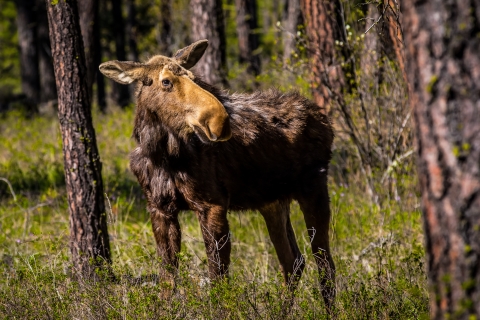
Moose were not always part of Washington’s wildlife tapestry. The first confirmed sighting dates back to 1929, when a hunter photographed a bull moose near Twin Lakes in Ferry County. In the 1950s, biologists began finding physical evidence — shed antlers and carcasses — in the Selkirk Mountains of Pend Oreille County. By 1972, a small but stable population of about 60 moose had established itself in the region.
Since then, the population has grown dramatically. By 2015, estimates placed the number at 5,000, with moose expanding their range south and west from their core habitat in the Selkirks into the Okanogan, Blue Mountains, and even the Columbia Basin. This expansion was aided by habitat changes, particularly the regrowth of aspen and willow following wildfires.
The Shiras Moose: Washington’s Resident Subspecies
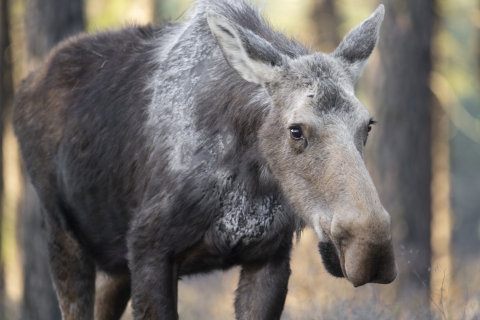
The Shiras moose (Alces alces shirasi), also known as the Yellowstone or Wyoming moose, is the smallest of the four North American moose subspecies. Native to the Rocky Mountains and adjacent regions, Shiras moose are known for their dark brown coats, light-colored throat bell, and relatively compact antlers. Despite their smaller size, Shiras moose are still massive animals. Adult bulls can weigh up to 1,200 pounds and stand nearly six feet tall at the shoulder. Their antlers, while more modest than their Alaskan cousins, can still span over four feet.
Shiras moose are highly adaptable. They thrive in mountainous terrain, riparian riparian
Definition of riparian habitat or riparian areas.
Learn more about riparian zones, and wetland habitats, feeding on a variety of vegetation including willows, aspens, aquatic plants, and woody shrubs. In summer, they often cool off in ponds and lakes, diving for submerged plants. In winter, they migrate to lower elevations in search of food and shelter from deep snow.
The Shiras moose is named for George Shiras III, a United States representative and conservationist who pioneered the use of nighttime flash photography. He is credited as having discovered the subspecies that now bears his name while on a trip to Yellowstone National Park.
Turnbull National Wildlife Refuge: A Moose Haven
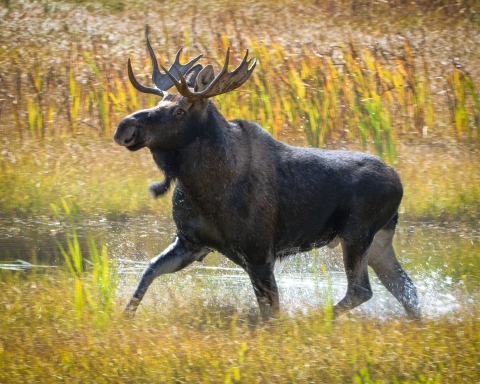
Established in 1937 by President Franklin D. Roosevelt to protect migratory waterfowl, Turnbull National Wildlife Refuge spans over 23,000 acres of the Channeled Scablands, a unique geological landscape shaped by ancient floods and volcanic activity. The same mosaic of wetlands, ponderosa pine forests, and meadows which support migratory waterfowl also provides ideal habitat for Shiras moose.
Moose began appearing at Turnbull in the 1990s, with sightings becoming more frequent over time. In the early 2000s, the Washington Department of Fish & Wildlife (WDFW) began relocating moose from urban areas in Spokane to the refuge as a way to to reduce human-wildlife conflicts. The moose quickly found ideal conditions: abundant wetlands, regenerating aspen stands (especially after wildfires), and minimal human disturbance. Today, moose are permanent residents at Turnbull, breeding and ranging across the refuge year-round. Their presence has become so common that staff have occasionally found them lounging near the front doors of refuge buildings.
Ecological Impact and Management

While moose are a charismatic addition to the refuge, their impact on the landscape is significant. Voracious browsers, moose can consume 50 pounds of vegetation per day in summer. Their feeding habits can significantly impact riparian ecosystems, especially young aspen stands, which are also critical for birds and other wildlife. To protect these habitats, Turnbull staff use browse protection fencing around restoration areas.
Moose are also a priority species under WDFW’s conservation programs. The agency monitors populations through aerial surveys, GPS collaring, and hunter harvest data. Since 1977, Washington has offered limited-entry moose hunting permits, with numbers increasing as the population has grown. The state’s management goals include maintaining healthy populations while allowing for recreational, educational, and cultural uses.
A Wild Encounter: Safety and Stewardship

Despite their calm appearance, moose can be unpredictable and dangerous, especially during calving season (May–June) in spring or the rut (September–November) in fall. Their size alone makes them a serious hazard. Visitors to Turnbull are advised to keep at least 25 yards away, leash their pets, and avoid startling these massive animals. Moose can be unpredictable and have been known to charge when threatened particularly if dogs are present.
Still, for those who respect their space, Turnbull offers a rare opportunity to witness these majestic creatures in their natural habitat. Fall is one of the best times to visit, when bull moose are active and the aspen trees blaze with color. Early summer is also ideal, as calves begin to explore the refuge under the watchful eyes of their mothers.
A Conservation Success Story
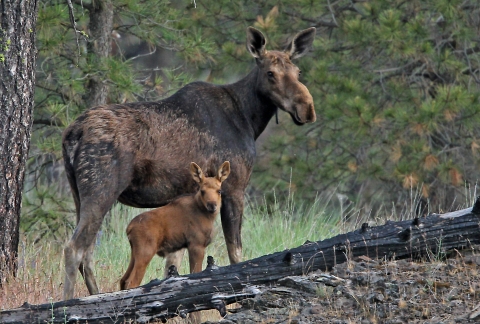
The story of the Shiras moose in Washington, and especially at Turnbull NWR, is one of ecological resilience, thoughtful stewardship, and public engagement. From their tentative arrival in the 20th century to their thriving presence today, moose have become an integral part of the state’s wildlife heritage and a defining feature of eastern Washington’s wildlands.
As climate change climate change
Climate change includes both global warming driven by human-induced emissions of greenhouse gases and the resulting large-scale shifts in weather patterns. Though there have been previous periods of climatic change, since the mid-20th century humans have had an unprecedented impact on Earth's climate system and caused change on a global scale.
Learn more about climate change , habitat loss, and human development continue to challenge wildlife across the West, places like Turnbull NWR stand as vital sanctuaries. Whether you’re a wildlife photographer, a birder, or just a curious hiker, there’s no better place to witness the quiet majesty of the Shiras moose. Their presence is more than just a spectacle, it’s a testament to the refuge’s mission of protecting and restoring native ecosystems. Here, amid the wetlands and ponderosa pines, the moose roam — silent, powerful, and enduring.
References:
Base, D. L., Zender, S., & Martorello, D. (2006). History, status, and hunter harvest of moose in Washington State. Alces, 42, 111–114. Retrieved from https://alcesjournal.org/index.php/alces/article/view/393
Boone and Crockett Club. (n.d.). B&C Member Spotlight – George Shiras III. Retrieved September 26, 2025, from https://www.boone-crockett.org/bc-member-spotlight-george-shiras-iii
Cascade PBS Staff. (2018, October 11). Washington’s first-ever moose census. Cascade PBS. Retrieved September 26, 2025, from https://www.cascadepbs.org/2018/10/washingtons-first-ever-moose-census
Clarridge, C. (2018, October 25). Turnbull National Wildlife Refuge is a go-to spot to see WA’s wild moose. The Seattle Times. Retrieved September 26, 2025, from https://www.seattletimes.com/life/outdoors/turnbull-national-wildlife-refuge-is-a-go-to-spot-to-see-was-wild-moose/
Ferrell, M. (2019, January 25). An increasing presence: Moose of the North Cascades. North Cascades Institute. Retrieved September 26, 2025, from https://blog.ncascades.org/naturalist-notes/moose/
Harris, R. B., Atamian, M., Ferguson, H., & Keren, I. (2015). Estimating moose abundance and trends in northeastern Washington State: Index counts, sightability models, and reducing uncertainty. Alces, 51, 57–69. Retrieved from https://alcesjournal.org/index.php/alces/article/view/146
Nadeau, M. S., DeCesare, N. J., Brimeyer, D. G., Bergman, E. J., Harris, R. B., Hersey, K. R., Huebner, K. K., Matthews, P. E., & Thomas, T. P. (2017). Status and trends of moose populations and hunting opportunity in the western United States (WDFW Publication No. 01955). Washington Department of Fish & Wildlife. Retrieved September 26, 2025, from https://wdfw.wa.gov/publications/01955
NatureMapping Foundation. (n.d.). Distribution map – Moose (Alces alces). Retrieved September 26, 2025, from http://naturemappingfoundation.org/natmap/maps/wa/mammals/WA_moose.html
Washington Department of Fish & Wildlife. (n.d.). Moose (Alces alces). Retrieved September 26, 2025, from https://wdfw.wa.gov/species-habitats/species/alces-alces