Written By


This month biologists from the Coastal Program completed a phragmites control project at an approximately 80-acre section of mostly high salt marsh salt marsh
Salt marshes are found in tidal areas near the coast, where freshwater mixes with saltwater.
Learn more about salt marsh at the Little Creek Wildlife Area adjacent to Bombay Hook National Wildlife Refuge near Port Mahon, Delaware.Patches of invasive phragmites are encroaching on the high marsh habitat and disrupting the ecosystem. Phragmites is a tall, invasive wetland grass that forms a dense monoculture and outcompetes the native marsh grass (Spartina patens). The Coastal Program is partnering with the DE DFW to control the phragmites. The biologists sprayed an herbicide to reduce the phragmites and allow the native marsh grass to recolonize the treated areas.
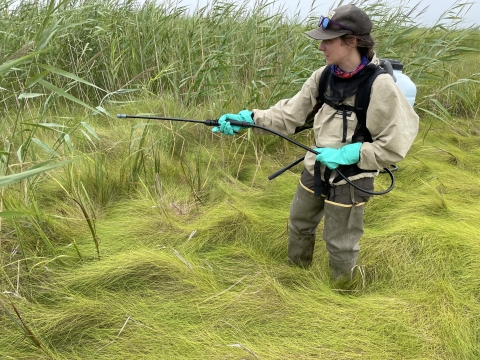
This spraying is a strategic priority because of the value of the high marsh in the treatment area but also because there are two salt marsh restoration projects adjacent to the treatment area that the Coastal Program is a partner on. One is a project utilizing low-cost/low tech measures to re-establish more natural tidal processes in the marsh. The second is in an adjacent low marsh that is targeted for placement of 77,000 cubic yards of dredged material from the nearby Little River within the next two years. In addition to the Coastal Program, the partners will include several Delaware resource management agencies, including the DE DFW, and the U.S. Army Corps of Engineers. The goal of the “beneficial use” of dredged material project is to create a healthy and resilient marsh that includes high marsh because of its value as habitat for rare marsh birds such as the saltmarsh sparrow and the Federally threatened eastern black rail.
The 4,700-acre Little Creek Wildlife Area has the highest concentration of breeding saltmarsh sparrow on Delaware state-owned land. Threatened eastern Black rail has also been historically documented at this site and the habitat indicates that it is still a suitable site for black rail. A recent study by Delaware State University discovered audio evidence of the presence of black rail at the Milford Neck Preserve to the south of Little Creek Wildlife Area.

The Coastal Program and DE DFW know that the phragmites is degrading the 80 acres of high marsh being sprayed but also know that, if left untreated, will aggressively invade the two adjacent restoration sites. Next year the DE DFW will be more likely to have the capacity to takeover some of the spot management of phragmites at the site. This effort supports numerous State and Federal conservation plans, including the Delaware Wildlife Action Plan and Salt Marsh Bird Conservation Plan led by the Atlantic Coast Migratory Bird Joint Venture.