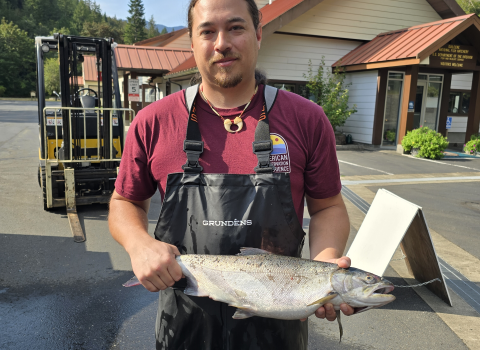
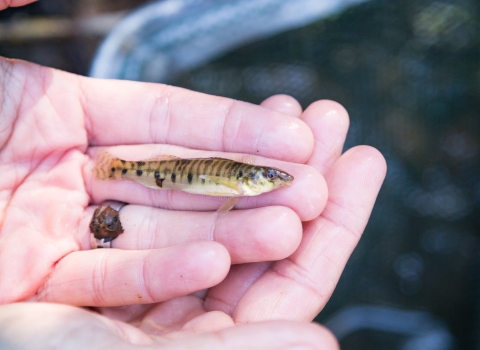
; Tests conducted by the U.S. Fish and Wildlife Service revealed that levels of PCBs and dioxins in fish produced by national fish hatcheries in the Northeast do not exceed existing federal consumption safety levels, according to the U.S. Fish and Wildlife Services Northeast Regional Director Marvin E. Moriarty.
; The Service conducted its studies in response to an article in the Jan. 9 issue of the journal "Science," which documented the presence of contaminants in farm-raised fish that are fed the same diet as the hatchery fish. Each year the Service provides approximately 14,000 excess Atlantic salmon, lake trout and rainbow trout from its hatcheries to Northeast states for recreational fish stocking. However, the Service stopped providing fish to states in February pending a thorough review of the situation, Moriarty said.
;
; "Based on the test results, we will provide the hatchery fish to states that request them for their recreational fisheries, but we are recommending that state fish and wildlife directors discuss the test results with their public health officials to ensure public health risks are addressed," Moriarty said. Consumption advisories are normally issued by a states public health department taking into account Food and Drug Administration regulatory limits and Environmental Protection Agency advisory levels for contaminants.
;
; The Services Fish Technology Center in Lamar, Penn., tested samples of Atlantic salmon, lake trout and rainbow trout from five federal hatcheries for PCBs, dioxins, mercury and other organochlorines. Hatchery-reared trout samples primarily fell within the EPA advisory of one-half meal per month. Hatchery-reared salmon were within the one-half to one meal per month advisory level.
; "We are working to ensure that we use the best available fish food with the goal of eliminating contaminants," Moriarty said. "Our hatcheries are also looking at incoming water and other potential contaminant sources. Our primary goal is to produce healthy fish for the public."
; Additional information on this issue and the results of the contaminants tests may be found at http://northeast.fws.gov/fisheries/issues/issues.htm.
;
; The fisheries program in the Northeast Region manages 11 national fish hatcheries, 13 fishery resource offices, a fish health center, and a fish technology center in 13 states from Maine to Virginia.
;
The U.S. Fish and Wildlife Service is the principal federal agency responsible for conserving, protecting and enhancing fish, wildlife and plants and their habitats for the continuing benefit of the American people. Nationally, the Service manages 69 national fish hatcheries, 64 fishery resource offices and 81 ecological services field stations. It also operates the 95-million-acre National Wildlife Refuge System, which encompasses 542 national wildlife refuges, thousands of small wetlands and other special management areas. The agency enforces federal wildlife laws, administers the Endangered Species Act, manages migratory bird populations, restores nationally significant fisheries, conserves and restores wildlife habitat such as wetlands, and helps foreign governments with their conservation efforts. It also oversees the Federal Aid program that distributes hundreds of millions of dollars in excise taxes on fishing and hunting equipment to state fish and wildlife agencies.
;
>-FWS-
>