Location
States
New MexicoEcosystem
River/stream, WetlandIntroduction
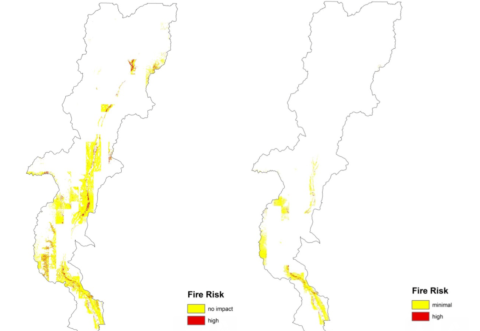
Climate change is predicted to both decrease river flows and increase evapotranspiration rates throughout the western US. These changes can, in turn, increase the risk of severe fires in riparian riparian
Definition of riparian habitat or riparian areas.
Learn more about riparian areas, affecting wildlife species composition and the long-term sustainability of high-value habitat for many species. The riparian forest along the banks of the Rio Grande in New Mexico is subject to competing land and water uses, increasing human populations, and climate change climate change
Climate change includes both global warming driven by human-induced emissions of greenhouse gases and the resulting large-scale shifts in weather patterns. Though there have been previous periods of climatic change, since the mid-20th century humans have had an unprecedented impact on Earth's climate system and caused change on a global scale.
Learn more about climate change pressures.
Historic fire behavior is not well understood for riparian habitats throughout the Southwest. Some models such as bioclimate envelope models, which predict the distribution of species based on tolerance of environmental conditions, are useful to estimate climate change responses, but do not capture the influence of disturbances like fire and invasive species invasive species
An invasive species is any plant or animal that has spread or been introduced into a new area where they are, or could, cause harm to the environment, economy, or human, animal, or plant health. Their unwelcome presence can destroy ecosystems and cost millions of dollars.
Learn more about invasive species on future habitat suitability. This study aimed to incorporate bioclimate envelopes, adaptive capacity and fire regime changes to improve species distribution modeling.
Key Issues Addressed
The Rio Grande Basin contains important water sources and habitats for municipalities, agriculture, recreation and wildlife in Colorado, New Mexico and Texas. It also contains critical habitat types for a number of riparian-dependent species including the endangered southwestern willow flycatcher and the Rio Grande Silvery Minnow. Natural resource managers are particularly concerned about the effects of climate and related changes on riparian habitats, which support a disproportionate amount of the biodiversity in the region.
Climate change is expected to alter river flows through modified precipitation regimes and higher temperatures that increase evapotranspiration rates. Mean annual runoff is projected to decrease 7.3 to 14.4% by 2050. Increased fire potential, though not well defined for riparian habitats, is also an issue, since it may favor the establishment of non-native species like Tamarisk and accelerate the degradation of native riparian forests. Human populations in the region are expected to grow considerably, putting more pressure on natural systems like the Rio Grande that are highly vulnerable to degradation. Resource managers therefore need information and tools to identify future conditions under various climate and fire scenarios.
By assessing and understanding the impacts of climate and related disturbances on these important habitat types, managers will be able to better focus limited resources and identify opportunities for promoting natural regeneration of riparian woodland and wetland habitats. This project demonstrates the challenges that lay ahead for wildlife species inhabiting the Rio Grande, including a much hotter future with more sporadic precipitation events, the loss of riparian habitat integrity, and the importance of preserving refugia.
Project Goals
Integrated Approach: Develop a process for integrating data from multiple sources to improve predictions of future climate and fire impacts on twelve species:
American bullfrog (Rana catesbeania), an introduced invasive species
Northern leopard frog (Lithobates pipiens)
Lucy's warbler (Oreothlypis luciae)
Southwestern willow flycatcher (Empidonax traillii extimus)
Western yellow-billed cuckoo (Coccyzus americanus occidentalis)
Hispid cotton rat (Sigmodon hispidus)
New Mexico meadow jumping mouse (Zapus hudsonius luteus)
Occult bat (Myotis occultus)
Long-legged bat (Myotis volans)
Yuma bat (Myotis yumanensis)
Black-necked gartersnake (Thamnophis cyrtopsis)
Western painted turtle (Chrysemys picta bellii)
Data Sharing: Synthesize data on future climate, hydrology, fire behavior, and resulting species distributions
Sensitivity Analysis: Provide information on species’ sensitivities and thresholds under future conditions
Decision Support Tool: Develop an integrated decision support tool to better describe the vulnerability of plants and birds to interactive disturbance processes
Project Highlights
Integrated Approach: Researchers used principles from risk assessment to combine information on expected change in climate, hydrology, vegetation and wildfire to generate more robust estimates of impacts for wildlife species. By overlaying habitat suitability maps with fire risk maps, researchers demonstrated the cumulative impacts of expected climate and fire for wildlife species that live in the Rio Grande Bosque.
Sensitivity Analysis: Assessments identify which wildlife species are most at risk and where along the Rio Grande the greatest cumulative changes are likely to occur.
Mapped Refugia: Map outputs identify potential refugia with little expected habitat change and fire potential.
Lessons Learned
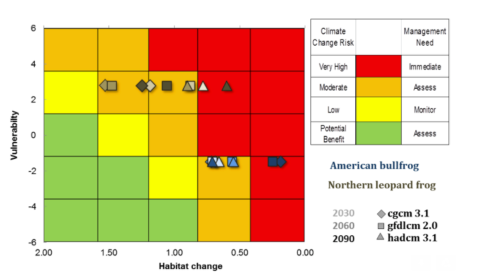
Emerged Patterns: Under future climate and fire conditions, wildlife species either experience decreased or total loss of suitable habitat or increased suitable habitat projected outside of currently occupied ranges.
Predicting future habitat conditions for wildlife is limited by the shortcomings of currently available methods. Measures of current and future hydrological change (e.g. river flow), though likely important components of species’ habitat, are difficult to incorporate into traditional species habitat suitability models. In addition, habitat suitability models may underestimate potential loss of usable habitat if additive effects of disturbances like wildfire are not considered. In this analysis, fire risk often reduced the availability of habitat predicted to be suitable under future climate regimes. Finally, habitat suitability models only estimate habitat change and not the biological capacity of a species to adapt to shifting habitat and altered disturbances. Risk matrices proved to be an effective framework for combining spatial habitat and non-spatial information on adaptive capacity.
The results of this analysis indicate that changing climate and fire conditions may lead to drastic declines in available habitat for some species. Other species may see an increase in habitat, although increases are often into novel habitats. The results of this analysis improved scientific and management knowledge of potential interactive effects of climate and fire for species habitat, but did not improve on issues relating to the incorporation of hydrological data into species habitat models.
Next Steps
Pursue funding for additional studies, as more information is needed on species response to different types of fire to fully comprehend future risks associated with changing fire regimes
Update and explore alternative wildfire behavior predictions for the Rio Grande Region
Funding Partner
- U.S. Bureau of Reclamation WaterSMART Program
Resources
- USDA Forest Service Rocky Mountain Research Station
Grassland, Shrubland, and Desert Ecosystems Program, Rocky Mountain Research Station
Contacts
- Megan Friggens, Research Ecologist, USFS Rocky Mountain Research Station: meganfriggens@fs.fed.us
Rachel Loehman, Research Landscape Ecologist, USGS Alaska Science Center: rloehman@usgs.gov
Lisa Holsinger, Ecologist, USFS Rocky Mountain Research Station: lmholsinger@fs.fed.us
Deborah Finch, Program Manager and Supervisory Biologist, USFS Rocky Mountain Research Station: dfinch@fs.fed.us
Case Study Lead Author
- Rob Campellone, Senior Research Specialist, University of Arizona
Suggested Citation
Campellone, R., M. (2020). “Vulnerability of Riparian Obligate Species in the Rio Grande to the Interactive Effects of Fire, Climate and Hydrological Change.” CART. Retrieved from https://www.fws.gov/project/rio-grande-riparian-species-vulnerability.