



Photo By/Credit
Melissa McGaw/NCWRC
Media Usage Rights/License
Public Domain
Image
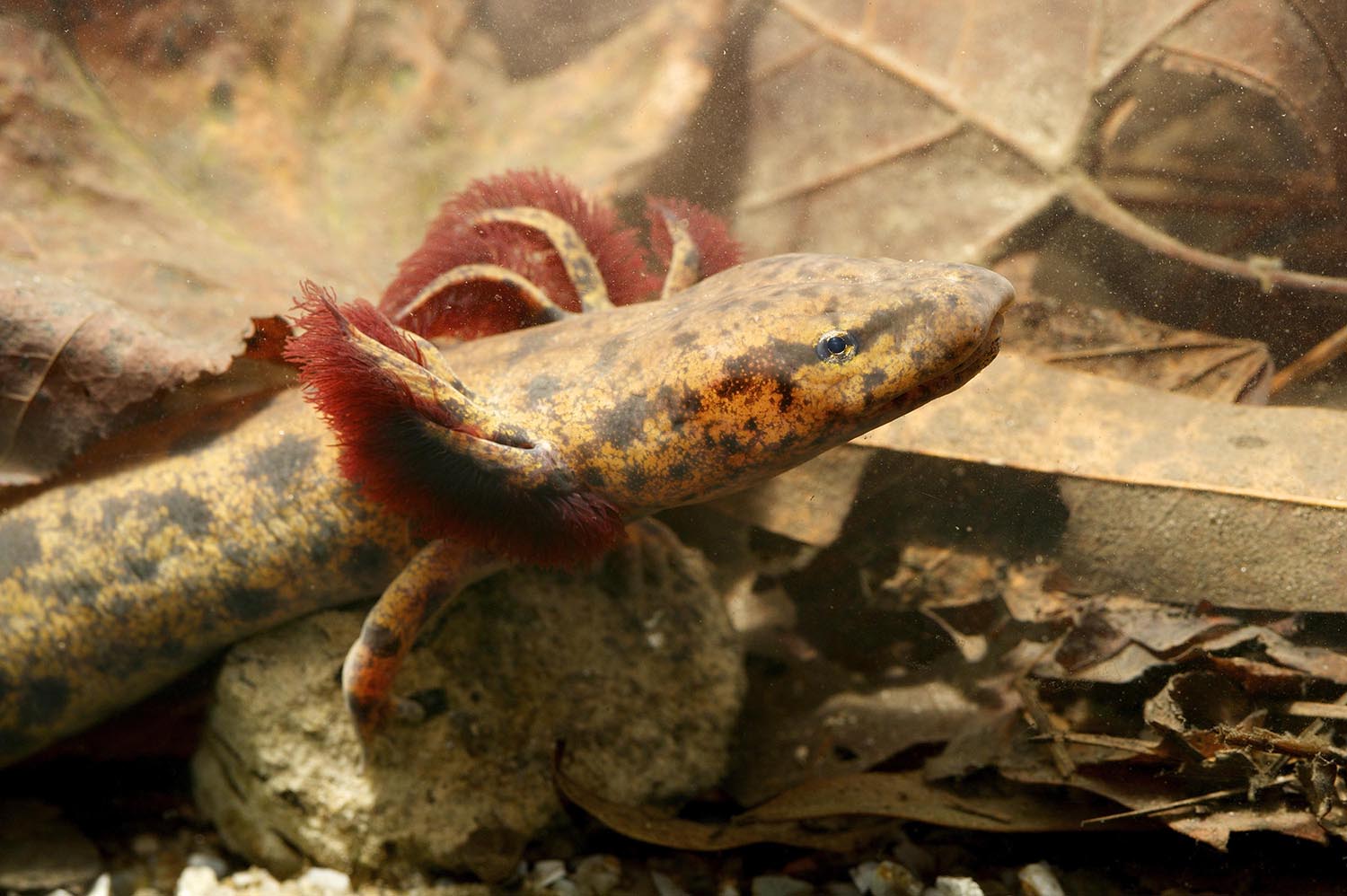
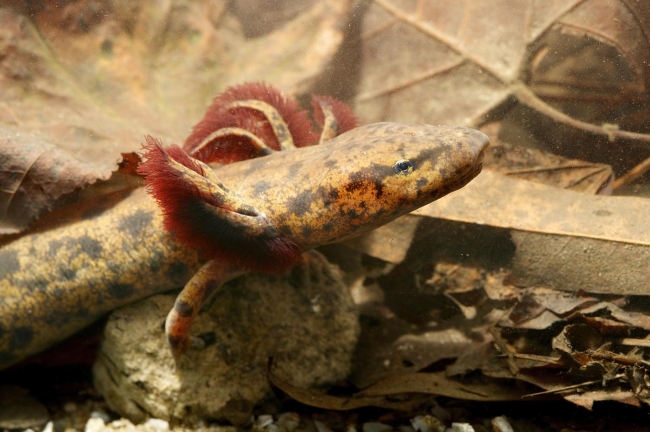
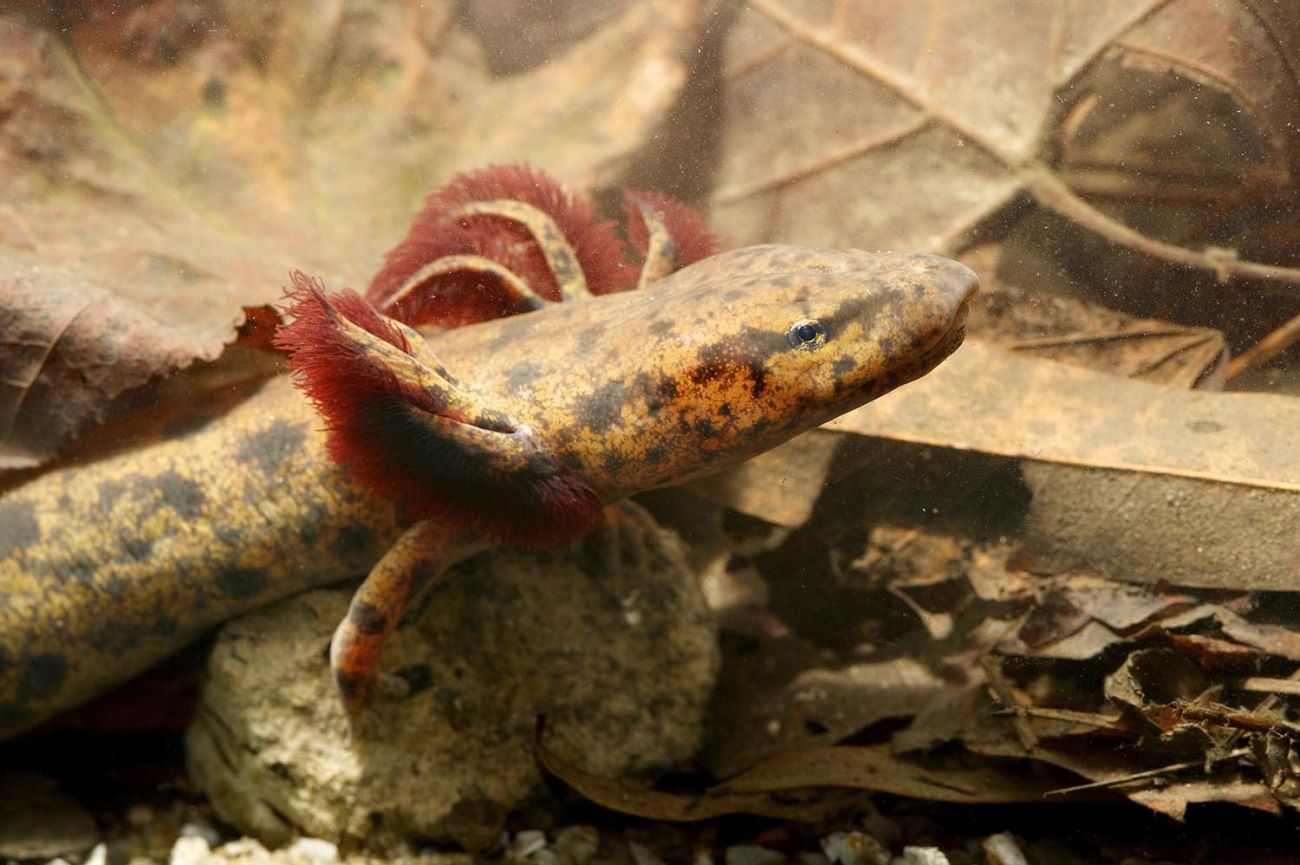
The Neuse River waterdog, Necturus lewisi, is a medium-sized newt, family Proteidae, found in two rivers of North Carolina. This partial view of the salamander showcases the cylindrical, flattened and elongate head with and a squared-off nose. Notice the three dark-red, feathery gills projecting from either side of the head. The dorsal coloration is a light rusty brownish, with the belly being a paler brown or grayish. There are roundish, dark brown or blackish spots on both the dorsal and ventral surfaces, and a dark line through the eye. The skin is smooth and slimy. Out of view are the lower torso, the laterally compressed tail and its hind legs. The limbs are rather small, and the front and hind feet have four toes each (unlike most salamanders, which have five toes on each hind foot).
In April, 2022 Partners at North Carolina State University – PhD student Eric Teitsworth and his advisor Dr. Krishna Pacifici – recently wrapped up their fourth season of field sampling for Neuse River Waterdog (Necturus lewisi), a large permanently aquatic salamander endemic to eastern the Neuse and Tar-Pamlico River basins of North Carolina that was listed as threatened in July 2021. Through this project, funded by the Raleigh Ecological Services Field Office and the North Carolina Wildlife Resources Commission, and in partnership with the United States Geological Survey’s North Carolina Cooperative Fish and Wildlife Research Unit, they have surveyed 164 locations and documented 565 Neuse River Waterdogs at 75 of the sites, some of which had no previous records or only historical records of the species. Many of the sites were surveyed two or three times before the species was detected, and this work is yielding important insights about our understanding of the Neuse River Waterdog’s detectability, current distribution, and drivers of their distribution, all of which is essential scientific data for informing recovery planning and implementation, and our Section 7 responsibilities in a rapidly urbanizing landscape.
In April, 2022 Partners at North Carolina State University – PhD student Eric Teitsworth and his advisor Dr. Krishna Pacifici – recently wrapped up their fourth season of field sampling for Neuse River Waterdog (Necturus lewisi), a large permanently aquatic salamander endemic to eastern the Neuse and Tar-Pamlico River basins of North Carolina that was listed as threatened in July 2021. Through this project, funded by the Raleigh Ecological Services Field Office and the North Carolina Wildlife Resources Commission, and in partnership with the United States Geological Survey’s North Carolina Cooperative Fish and Wildlife Research Unit, they have surveyed 164 locations and documented 565 Neuse River Waterdogs at 75 of the sites, some of which had no previous records or only historical records of the species. Many of the sites were surveyed two or three times before the species was detected, and this work is yielding important insights about our understanding of the Neuse River Waterdog’s detectability, current distribution, and drivers of their distribution, all of which is essential scientific data for informing recovery planning and implementation, and our Section 7 responsibilities in a rapidly urbanizing landscape.
Ecosystem
River/stream
Species