


Species that are considered uncertain risk need a more in-depth assessment beyond the Ecological Risk Screening Summary to better define the species’ risk to U.S. environments.
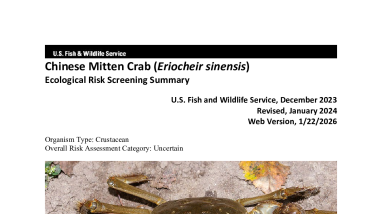
Eriocher sinensis, Chinese mitten crab, is a crustacean native to the coastal rivers and estuaries of the Yellow Sea in China. This species is catadromous, spending most of its life in freshwater and must return to the sea for successful reproduction. It is one of the few invasive species invasive species
An invasive species is any plant or animal that has spread or been introduced into a new area where they are, or could, cause harm to the environment, economy, or human, animal, or plant health. Their unwelcome presence can destroy ecosystems and cost millions of dollars.
Learn more about invasive species that impact both freshwater and marine ecosystems due to its unique life history. E. sinensis has a long history of utilization as a food source and in traditional medicines. Eriocheir sinensis is federally listed as injurious wildlife under the Lacey Act and is regulated in at least 17 states. It has been introduced into several countries throughout Europe, Japan, Canada, and the United States. Its burrowing activities cause destabilization of stream banks, leeves, and dykes. Crabs caught up in fishing nets cause damage to the nets and caught fish. They are also responsible for bait loss and damage to fishing gear causing abandonment of fishing grounds. There have also been impacts to operations at power generation plants in areas with high density of crabs. They can carry and transmit the crayfish plague pathogen. The History of Invasiveness for Eriocheir sinensis is classified as High due to its history of introductions and establishment outside its native range, and the negative impacts reported from those established populations. The climate matching analysis for the contiguous United States indicates establishment concern for this species. Areas of high climate match were found in the Northeast, around the Great Lakes, in California, and along most coastal areas except for the northern Pacific Coast. However, this species is catadromous so the climate matching analysis refers only to where the species can survive and not necessarily to where it can reproduce. The Certainty of Assessment for this ERSS is classified as Medium. High quality information is readily available, but the salinity requirement for reproduction complicates the interpretation of the climate matching results for areas without a connection to brackish or marine waters. The Overall Risk Assessment Category for Eriocheir sinensis in the contiguous United States is Uncertain due to the salinity requirement for reproduction.
Publication date
Type of document
Uncertain Risk
Media Usage Rights/License
Public Domain
Program


Species