


Species that are considered uncertain risk need a more in-depth assessment beyond the Risk Summary to better define the species’ risk to U.S. environments.
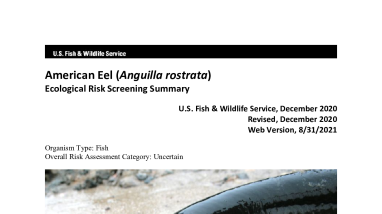
The American Eel, Anguilla rostrata, is a species of catadromous eel native to Atlantic coastal waters and inland rivers of portions of North, Central, and South American countries that border the Atlantic Ocean, Gulf of Mexico, and Caribbean Sea, including the United States. This species has significant trade history as a food fish and as bait both domestically and internationally. A. rostrata is regulated in California. There is documentation of introductions and stocking of this species outside of its native range in the United States and internationally. Limited information is available on impacts of introduction. This species can transmit the nematode Anguillicola crassus and has the potential to impact the European eel Anguilla anguilla where the American eel is established in Europe, as well as transmit other parasites and pathogens to native species. The history of invasiveness is Data Deficient. The overall climate match was High for the contiguous United States, and a high match was found in most eastern (includes the native range of this species) and central States. However, since this species cannot reproduce in non-marine environments, the climate match is only for areas where the species may be able to survive, but not reproduce. This species migrates between marine and freshwater environments. Because not all locations in the United States are conducive to such migration, inland establishment of this species may be limited according to habitat connectivity. The certainty of assessment is Low. The overall risk assessment category for Anguilla rostrata is Uncertain.
Publication date
Type of document
Uncertain Risk
Program


