Written By

Where do colonial waterbirds go when their nesting islands are underwater? This is a question for biologists working to conserve habitats for these birds along the Texas coast, as flooding conditions become increasingly more common. Colonial waterbirds, or seabirds and wading birds that form large “colonies” during the breeding season, have limited nesting site options. Extreme weather events that produce wind-driven waves, along with flooding tides, are causing coastal rookeries on our coasts to lose land and eventually submerge. Stopping, and in some instances reversing, the damage of coastal flooding requires significant resources and manpower.
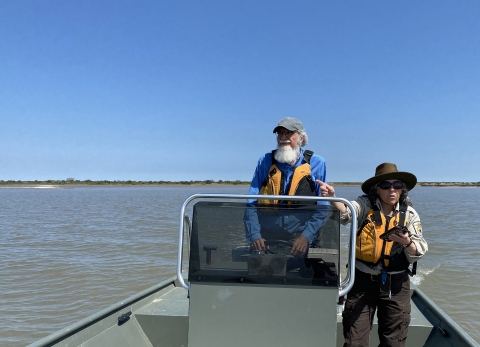
This work is currently underway for one small but important island along the Texas Gulf Coast: Dressing Point Island. To save the island, U.S. Fish and Wildlife Service biologists Jennifer Wilson and Woody Woodrow, along with a myriad of state partners and stakeholders, are working to halt continued erosion and eventually expand the island’s size and increase its elevation.
“Dressing Point Island is one of a handful of colonial water bird nesting islands that still exist along the Texas coast,” said Big Boggy National Wildlife Refuge Manager Curtis Jones. “The protection of this unique piece of the refuge will help ensure that nesting habitat remains into the future.”
This extensive conservation project required considerable planning by the Project Team consisting of multiple partners, including the U.S. Fish and Wildlife Service, Ducks Unlimited, the Texas Commission on Environmental Quality, the Texas General Land Office and Texas Parks and Wildlife Department. In 2015, the project received a significant boost in funding when it was chosen as a restoration project by the federal and state Natural Resource Damage Assessment Trustees as partial compensation for bird injuries from the Deepwater Horizon Oil Spill.
A Haven for Colonial Waterbirds

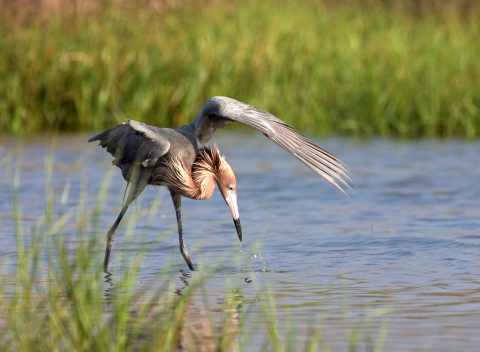
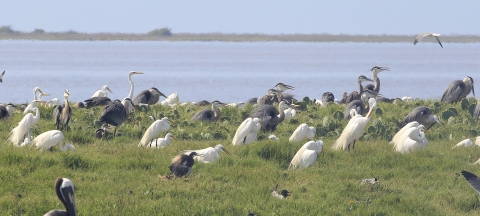
Dressing Point Island and nearby coastal and inland habitats make up Big Boggy National Wildlife Refuge, which was established in 1983 as a sanctuary for migratory birds. The island provides nesting and roosting habitat for multiple species of colonial waterbirds, including the state-threatened reddish egret and the now-recovered brown pelican.
Dressing Point Island is one of the last remaining natural rookery islands along the Texas Gulf Coast. Small islands are difficult for predators to access and create a safer environment for nesting birds and their chicks. Combined with their proximity to feeding grounds such as marshes, which provide a steady source of food for waterbirds, these islands provide crucial habitat for waterfowl and migratory birds.
Birds at Risk
Colonial waterbirds have faced threats for millennia, and more recent hazards have dramatically reduced their numbers. While they have been recovering from the effects of pesticides like DDT (banned since the late 1970s), they continue to be exposed to threats such as human disturbance and habitat loss.
In addition, their grouping behavior makes them uniquely vulnerable. Colonial waterbirds concentrate in large numbers during the breeding season and forage in limited areas. Their clustering increases competition between birds and puts them all at greater risk during extreme weather events. Winter storm fronts can produce very high winds and tropical storms, and while less frequent, can have lasting consequences, even when far from the island. Tropical Storm Alberto made landfall in Tampico, Mexico in July of 2024, more than 450 miles south of Dressing Point Island. The high tides associated with the storm raised water levels by four feet for an extended period of time, submerging most of the island. This displaced the nesting birds, leading to the loss of chicks and eggs. Three weeks later, Hurricane Beryl hit East Matagorda Bay, with winds approaching 100 mph.
A Shrinking Island

Dressing Point Island is a remnant of a peninsula that separated from the mainland more than a hundred years ago due to erosion from wind and water. The forces that created the island, combined with rising sea levels, continue to shrink it. Recent hurricanes and tropical storms shrank Dressing Point Island from 28 acres in 1988 to less than 4 acres today. At the same time, trees on the island have completely disappeared, leaving only grasses and a few shrubs.
Despite previous attempts to halt erosion and protect the island, it continued to shrink. With support from the Project Team, the island was selected for restoration in 2015. Working with Ducks Unlimited and their coastal engineers, the Project Team developed a longer-term solution by installing a limestone breakwater on three sides of the island. A breakwater is a structure structure
Something temporarily or permanently constructed, built, or placed; and constructed of natural or manufactured parts including, but not limited to, a building, shed, cabin, porch, bridge, walkway, stair steps, sign, landing, platform, dock, rack, fence, telecommunication device, antennae, fish cleaning table, satellite dish/mount, or well head.
Learn more about structure that “breaks” waves, creating a lagoon.
Building a Living Shoreline

Dressing Point Island’s breakwater serves multiple purposes, namely preventing erosion of the island and providing shelter for aquatic life. The protected lagoon between the breakwater and the island has reduced wave energy, which should improve water quality and clarity (lower its turbidity).
“Over time, creatures will colonize the breakwater to create a living shoreline that protects the island,” said Woodrow. “We finished construction this past spring and are already seeing results. The calm water on the island side shows that the breakwater is doing exactly what we want it to do.”
The breakwater rock is limestone derived from fossilized single-celled organisms called foraminifera. Limestone is chemically similar to oyster shells, (both are made up of calcium carbonate), and using this rock promotes encrusting organisms like oysters and mussels to live on the breakwater. Natural spaces between the limestone rocks invite stone crabs to inhabit the area, while the rocks themselves provide structure for other aquatic organisms. Seagrasses once commonly grew in East Matagorda Bay, and the slow water in the lagoon may support their return.
Restoring an Island

To further protect the island’s avian residents, the refuge and its partners are working to expand the island’s size, increase its height, and plant native trees and shrubs. Sand will be used to raise the island and increase its size, and a layer of topsoil will be added to support plants. Although Dressing Point Island may never return to its original 28 acres, adding both land and elevation should extend the island’s lifespan, expand the available nesting habitat and increase the numbers of colonial waterbirds using the site.
After the fill dirt compacts and stabilizes, native trees and shrubs will be planted. The plants, grown by the Galveston Bay Foundation, will provide habitat to nesting gulls, brown pelicans, and wading birds, as well as improve habitat for ground-nesting terns.
“The completion of this project represents the culmination of over 15 years of dedication to protecting and restoring Dressing Point Island,” said Taylor Abshier, regional biologist for Ducks Unlimited. “What we've accomplished here demonstrates the extraordinary power of collaborative conservation. Every partner brought irreplaceable expertise and unwavering commitment, and together we've created something that will benefit wildlife for generations to come.”
Hope on the Horizon
For almost two decades, Wilson and Woodrow and many dedicated individuals and organizations have worked to protect the fragile ecosystems along the Texas coast. They stay hopeful and steadfast.
“Even with all the challenges it has faced, Dressing Point Island remains a critical nesting site for colonial waterbirds,” said Wilson. “Even at its diminished size, the island has consistently high numbers of reddish egret nests. It’s a special place, and this project helps it remain so.”