


What We Do
Management and Conservation
Comprehensive Conservation Planning
Our comprehensive conservation plan (CCP) guides refuge management over a 15 year period. The plan includes long term goals, objectives, and strategies for management, and details the actions we will implement to protect species, manage habitats, and support various recreational and research uses of this refuge. The current CCP was approved on March 18, 2016.
The management decisions included in the CCP are a result of thorough environmental review and input from State agencies, the town of Chatham, local residents, conservation partners, and other stakeholders. Both a draft and final CCP/environmental impact statement (EIS) were published for public review and comment and are available on this webpage.

Our Projects and Research
Migratory Shorebird Research and Monitoring
Monomoy NWR provides crucial resting, nesting, and feeding habitat for a huge variety of migratory birds, including more than 40 species of shorebirds. In fact, the refuge is considered of the most important areas along the Atlantic Flyway for migratory shorebirds. The refuge has been designated an Important Bird Area in the state of Massachusetts and Site of Regional Importance by the Western Hemisphere Shorebird Reserve Network.
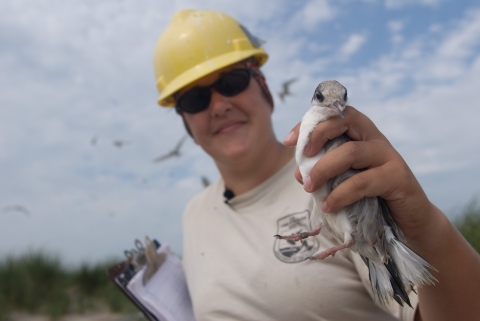
Refuge biologists and our partners conduct annual censuses of common, least, and roseate terns, as well as piping plovers, American oystercatchers, wading birds, and gulls. They also capture, band, and re-sight many bird species to track return and survival rates, and deploy transmitters to assess fine-scale movements. These data allow the Service and its partners to make informed conservation decisions both locally and on a larger flyway/hemispheric scale.
In the spring and summer, refuge biologists, interns, and partners also conduct extensive monitoring of the common terns, piping plovers, and American oystercatchers nesting on the refuge beaches, collecting detailed productivity data which is crucial for tracking the population status of these species, which are experiencing declines across the world. These data are reported to state and federal partners, and are important for implementing shorebird conservation tools to protect important summer breeding habitat.
Reducing Shorebird Disturbance
Human disturbance is any human activity that disrupts a shorebird's natural behaviors (such as foraging, resting, incubating a nest, or raising their chicks) forcing them to expend extra energy, abandon habitats, and significantly impacting their survival. Shorebirds see all humans and dogs as threats, even when we mean them no harm.
To help protect these vulnerable birds who call Monomoy NWR home, we are taking part in an effort stretching along the entire Atlantic coast to reduce human disturbance to shorebirds. The goal is to use a combination of research, outreach, and engagement techniques within our local community to help provide these birds a safe place to nest, raise their young, and stop to rest and feed during their perilous migratory journey.
You can play an important role in helping these amazing birds by learning about how you can Share the Shore, and by leaving pets at home when visiting the beach!
Learn more at: https://atlanticflywayshorebirds.org/human-disturbance/
Horseshoe Crab Surveys and Tagging
Monomoy NWR supports a highly productive populations of horseshoe crabs thanks to the protected and tranquil habitat the refuge offers. Horseshoe crabs are an incredibly important food source for migratory shorebirds, such as the Red Knot, during their northward spring migration. Red Knots, along with other shorebirds, have experienced precipitous declines in population of late, due to a variety of factors including habitat loss, human disturbance, as well as declines in horseshoe crab populations. Read more about these amazing species and their connection in this article by conservationist Drew Lanham.
Each spring and early summer, refuge staff and volunteers survey and tag individual horseshoe crabs to assess relative abundance and movements as part of the Service's Horseshoe Crab Cooperative Tagging Program. This project also keeps track of previously tagged individuals, relying on citizen scientists who report any horseshoe crabs caught or found with our tag! You can use the Horseshoe Crab Tag Form to report any tagged crabs that you find.
When handling horseshoe crabs, remember: never pick up a horseshoe crab by its tail, as you may injure it. Because horseshoe crabs are protected throughout Refuge lands and waters, Monomoy supports a highly productive population of this species; whose eggs are critical to migratory shorebirds.
Gray Seal Research
Monomoy NWR actively supports seal research each year to better understand seal ecology, population structure, movement rates, and diet.
Northeastern Beach Tiger Beetle Reintroduction
The federally threatened northeastern beach tiger beetle requires undisturbed sandy habitats free of heavy foot and vehicle traffic, such as those found on Monomoy. These insects live along the Atlantic coastline from Cape Cod to New Jersey, as well as along the Chesapeake Bay. A reintroduction project began when 23 larvae from Martha’s Vineyard were transplanted to South Monomoy in May of 2000. A second transplant released 34 more larvae. This trend was continued annually until 2004. The project has been highly successful, with a current population well in excess of 8,000 individuals. As northeastern beach tiger beetles are indicators of a healthy beach community, their success is highly significant for Monomoy NWR’s ecosystem. In 2021, 50 tiger beetle specimens were collected for a reintroduction project that is taking place in New Jersey.