Written By

A Million Dollar Milestone for Restoration in Maine’s Kennebago Headwaters
Partners have worked together over several years to restore the Kennebago headwaters, a remote and ecologically rich watershed in western Maine that provides critical habitat for wild Eastern brook trout, wood turtles, landlocked Atlantic salmon, Canada lynx, and many other native fish and wildlife. Its long, connected waterways, intact riparian riparian
Definition of riparian habitat or riparian areas.
Learn more about riparian forests, and cold, well-oxygenated streams make the Kennebago watershed a true wildlife stronghold, while also supporting the outdoor traditions that draw people to the region.
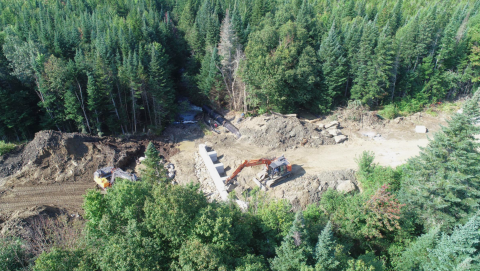
Since 2022, the U.S. Fish and Wildlife Service’s Gulf of Maine Coastal Program (GOMCP) has partnered with the Rangeley Lakes Heritage Trust (RLHT), the Maine Department of Inland Fisheries and Wildlife, and Trout Unlimited to reconnect streams and restore natural processes across the watershed. 2025 marked the culmination of RLHT’s $1 million Congressionally Directed Spending administered through GOMCP. The funding supported the replacement of seven undersized culverts with open-bottom stream crossings designed to mimic natural streambeds and provide continuous banks for wildlife passage. These new crossings allow fish and other aquatic organisms to access critical rearing and spawning habitats year-round and are resilient to extreme weather, ensuring safe, reliable access for recreation and timber transport. GOMCP staff conducted the stream assessments and surveys that informed the design of each new crossing.
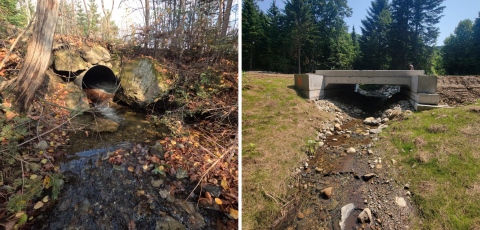
David Miller, Executive Director of RLHT shared “It has been a thrill working with our colleagues at GOMCP and others to restore some of the most important brook trout waters in the country. " In total, the replacements reconnected over nine miles of high-quality cold-water habitat.
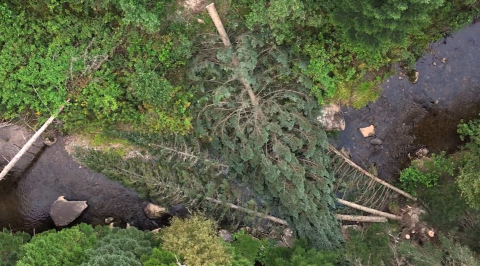
The funding also supported enhancing over six miles of stream and riverbank habitat with large wood additions, which slow flows, form pools, stabilize banks, and trap nutrients—creating shelter and food for fish and wildlife. GOMCP staff also assisted with stream assessments and surveys for four additional crossings that RLHT plans to replace in 2026 with funding from the USDA Natural Resources Conservation Service, helping maintain momentum for the next phase of restoration. Together, these efforts reflect the power of collaboration and long-term investment in Maine’s natural resources. Learn more by exploring this StoryMap.
Restoring Tides, Marshes, and Community Connections in Maine’s Kennebec River Estuary
Over the past four years, a partnership between the GOMCP and the Kennebec Estuary Land Trust (KELT) has helped advance tidal marsh restoration and tidal crossing resilience projects across Maine’s Kennebec River Estuary—an ecologically rich coastal landscape that supports migratory fish, salt marsh salt marsh
Salt marshes are found in tidal areas near the coast, where freshwater mixes with saltwater.
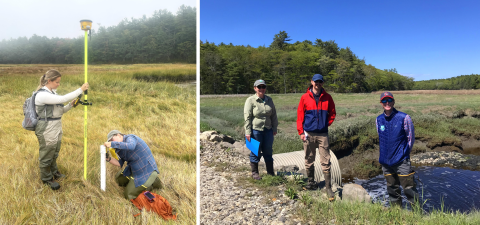
Learn more about salt marsh birds, and coastal communities. Through a $111,000 cooperative agreement from 2021–2025, the partners assessed vulnerable road crossings, collected critical water-level and habitat data, and worked side-by-side with towns, state agencies, and conservation groups to inform projects that will restore natural tidal flow and reducing flood risk. The effort advanced planning for restoring hundreds of acres of marsh in Georgetown, Woolwich, Arrowsic, Phippsburg, and beyond, while helping communities secure funding, advance engineering plans, and prepare major projects for construction and permitting.
The partnership also created tools to guide future restoration across the entire estuary. With support from USFWS, KELT developed a comprehensive tidal-crossing prioritization system that mapped more than 300 vulnerable sites across 11 coastal towns and is designed to evaluate ecological benefits, community needs, and project feasibility. This science-based framework will help towns and agencies focus resources where they can provide the greatest benefit to fish, wildlife, and coastal residents. USFWS and KELT also invested in people—engaging hundreds of volunteers in alewife and smelt monitoring, bringing high-school students into the field for hands-on science, and introducing young people to conservation careers in Maine.“For a community-based land trust to collaborate with USFWS, it significantly boosted KELT’s ability to fully engage at the local level in restoration and resilience work – a pillar in our strategic vision for conservation efforts in the Kennebec Estuary region. This partnership brought about a cross-pollination of resources, expertise, and connections furthering efforts of both KELT and the agency. As we move forward with these often complex and highly collaborative projects, the frameworks, systems, and lessons-learned from this four-year partnership will be key to our future successes,” says Becky Kolak, Executive Director of the Kennebec Estuary Land Trust.
Overall, the efforts of this four-year agreement strengthened the foundation for future marsh restoration work, established a lasting regional approach for tidal-crossing prioritization and planning, and expanded community engagement and citizen-science capacity—leaving the Kennebec Estuary better prepared for a resilient future.
Above It All: Drones Strengthen Conservation Partnerships in the Gulf of Maine
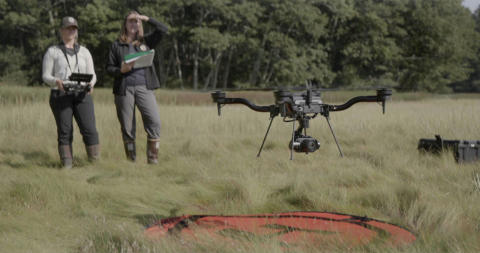
In 2025, GOMCP began using its new Freefly Astro, a U.S.-made drone operated by on-staff certified pilots and crew, to support partners across Maine and New Hampshire. Equipped with advanced cameras, the drone captures high-resolution aerial imagery that partners can use to plan restoration projects, track progress, and share their work with key stakeholders. By providing this technology in-house, GOMCP gives partners access to detailed data that might otherwise be costly. In 2025, GOMCP completed 42 flights totaling 13 flight hours, supporting six priority projects and benefiting over 15 partner organizations.
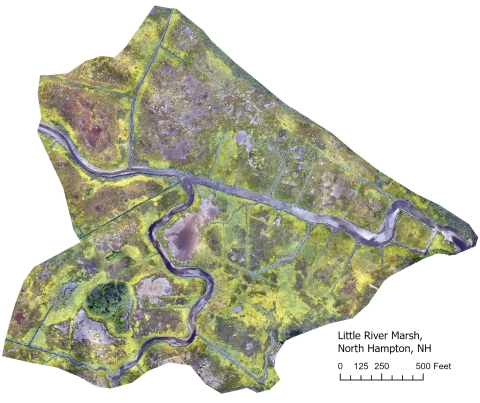
Drone technology is especially valuable for saltmarsh restoration, which improves habitat for at-risk species, protects roads and infrastructure from storms, and creates more opportunities for outdoor recreation. As part of the Cousins River Marsh Collaborative in Freeport, Maine, GOMCP uses the drone to create detailed maps of the marsh, highlighting vegetation patterns, expanding marsh pools, and areas where restoration could improve tidal flow. “This high-quality drone imagery makes the marsh more accessible to everyone—revealing its beauty, complexity, and vulnerability,” says Carrie Kinne, Executive Director of Freeport Conservation Trust. The imagery helps guide restoration work and provides a baseline for tracking changes over time. In New Hampshire, the drone also supports restoration planning at two Audubon-owned marshes in Hampton Falls and North Hampton, helping partners design improvements and monitor marsh conditions before and after work begins.
GOMCP’s drone also supports forest and habitat management in Kennebunk, Maine, in partnership with the Rachel Carson National Wildlife Refuge, The Nature Conservancy, and the Maine Department of Inland Fisheries and Wildlife. Aerial imagery helps partners understand forest structure before mechanical thinning and prescribed fire treatments. These efforts will restore fire-adapted ecosystems, reduce hazardous fuel loads, manage invasive species invasive species
An invasive species is any plant or animal that has spread or been introduced into a new area where they are, or could, cause harm to the environment, economy, or human, animal, or plant health. Their unwelcome presence can destroy ecosystems and cost millions of dollars.
Learn more about invasive species , and improve habitats for priority wildlife, including the New England cottontail.
GOMCP continues to strengthen partnerships by utilizing this drone technology, making USFWS conservation efforts more efficient, effective, and accessible.
Celebrating the Past, Honoring the Present, and Looking Towards the Future
In 2026, the Gulf of Maine Coastal Program marks 35 years of voluntary, partnership-based conservation work since its establishment in 1991. This milestone coincides with the 250th anniversary of the United States, offering a moment to reflect on decades of work conserving America’s lands, waters, and natural heritage. We honor the dedication and conservation achievements of current and past GOMCP staff and partners across the Gulf of Maine. As coastal challenges continue to grow, GOMCP looks ahead to building on its collaborative efforts to protect wildlife, restore lands and waters, and ensure these coastal landscapes continue to benefit the American people for generations to come.