As the northernmost national wildlife refuge national wildlife refuge
A national wildlife refuge is typically a contiguous area of land and water managed by the U.S. Fish and Wildlife Service for the conservation and, where appropriate, restoration of fish, wildlife and plant resources and their habitats for the benefit of present and future generations of Americans.
Learn more about national wildlife refuge east of the Great Lakes, Aroostook National Wildlife Refuge in Maine is a mix of untouched forests, grasslands, and wetlands. Despite its somewhat remote location, the visitor center was recently buzzing with people wanting to learn about a new partnership to enhance conservation on the refuge and strengthen relations between the government and the federally recognized Mi’kmaq Nation.
On Earth Day, officials from the U.S. Fish and Wildlife Service and Mi’kmaq Nation came together at a public event to celebrate a co-stewardship agreement that solidified the partnership between Aroostook National Wildlife Refuge and the Nation.
The holiday’s theme of joining together to protect the Earth fit perfectly with the collaboration and stewardship that led to the agreement.
In the beginning
In 2024, wildlife refuge specialist Lachlin Robertson spent the summer at Aroostook National Wildlife Refuge as part of a trainee program to learn more about the refuge system.
Refuge manager John Magera encouraged Robertson to pursue projects that interested him. Because Aroostook National Wildlife Refuge is part of the Northern Maine National Wildlife Refuge Complex and managed by staff at Moosehorn National Wildlife Refuge, Aroostook doesn’t have dedicated full-time staff. Robertson’s presence opened the refuge up to new possibilities.
Upon arrival, Robertson met up with longtime volunteer and the first president of the Friends of Aroostook, Wayne Selfridge, for a tour of the refuge. During the tour, Selfridge mentioned there was a tree species called brown ash present on the refuge that held cultural significance to a nearby tribal nation.
With his background in forest ecology, Robertson researched the tree to learn its significance. He learned that the wood of the brown ash tree could be permanently bent and historically was favored for making snowshoe frames, barrel hoops, canoe ribs, and woven baskets. He also learned that this tree species is threatened by an invasive species invasive species
An invasive species is any plant or animal that has spread or been introduced into a new area where they are, or could, cause harm to the environment, economy, or human, animal, or plant health. Their unwelcome presence can destroy ecosystems and cost millions of dollars.
Learn more about invasive species of beetle called the emerald ash borer that is making its way through the northeastern United States.

It was then that he knew exactly what project he wanted to pursue in his time at Aroostook.
“I immediately knew I wanted to work with the tribe and help them access their ancestral natural resources,” Robertson said.
He and Selfridge reached out to the Nation to see how they could collaborate to protect the brown ash.
Working with the Mi’kmaq Nation
The Mi’kmaq Nation received federal recognition in 1991, when they were known as the Aroostook Band of Micmacs. Since time immemorial, the Mi’kmaq have occupied the lands south and east of the Gulf of Saint Lawrence, the Maritime Provinces and other regions along the Atlantic Seaboard of Northeastern America. Aroostook National Wildlife Refuge is located within the Nation’s ancestral homeland. The Nation possesses tribal lands that border the refuge.
This proximity reinforces the value of a partnership between the Nation and the refuge, according to Shannon Hill, Environmental Health Director for Mi’kmaq Nation.
As a citizen of the close-knit tribal community in Aroostook County, Hill had met members of the refuge's highly dedicated Friends Group and frequented the refuge’s visitor center to get native species plush toys for her family. But when Robertson and Selfridge reached out about ways to collaborate, a partnership between the two governments truly started to form.
“The refuge doesn't typically have dedicated full time staff, so it was great to have Lachlin there,” Hill said. “He made the connection with us and reached out to see if he could meet with our forester to talk about brown ash.”
Robertson informed Hill that the trees were present on the refuge and that he wanted to work with the Nation to allow sustainable harvest while protecting the stands from emerald ash borers. Hill arranged for the Nation’s forester and one of their elders to visit the refuge to determine if the trees were ready for immediate harvest.
Fortunately, they were able to harvest some logs for tribal basket makers.
After this first successful collaboration, Robertson, Selfridge and Hill began brainstorming other ways to work together.
Lynx Trail
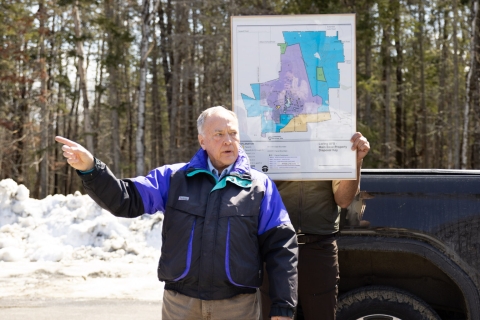
Selfridge had a vision to create an interpretive trail that would connect the refuge and the Nation’s lands.
After presenting the idea to the Nation and receiving permission from Hill, Selfridge and Robertson spent weeks walking through the properties to envision a perfect trail. It had to display the wealth of habitats present in the area while evoking what the land looked like when it was stewarded by the Mi’kmaq Nation prior to the twentieth century.
They decided on a two-mile stretch that featured new and old forest, riparian riparian
Definition of riparian habitat or riparian areas.
Learn more about riparian areas and wetlands. It was named Lynx Trail in recognition of the Canada lynx abundant in the area. In Mi’kmaq language, the trail is called Apugsign (“ah-book-see-gen"). The interpretive signs along the trail tell the history of the Mi’kmaq Nation and include Mi’kmaq language translations and pronunciation guidance. Robertson was especially excited about the development of these signs.
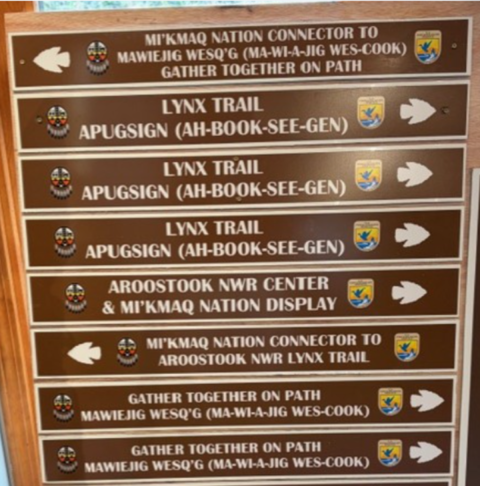

“It makes me so happy to think that people will be able to read the Nation’s language while walking through and learning about the lands they’ve historically stewarded,” Robertson said.
With so much great work completed in just a few weeks, both parties were interested in continuing the partnership. But with Robertson’s time at the refuge coming to an end, the Nation had concerns about their access to refuge lands and Service resources going forward. They had to come up with a plan to ensure the refuge and Nation could continue their co-stewardship relationship for the land without a dedicated employee at the refuge.
After reading an article about a co-stewardship agreement out west, Hill proposed the idea at a meeting of Service staff and Nation members.
In her words, “It was time to put a ring on it.”
The Service’s regional tribal liaison Tim Binzen informed the group that a productive and collaborative partnership for conservation had developed between the Rappahannock Tribe and Rappahannock River Valley National Wildlife Refuge in northern Virginia.
This success story provided inspiration to get started on a new co-stewardship agreement in the Northeast.
The agreement
In the months following Robertson’s departure from Aroostook, the Nation and Service staff worked together to draft a co-stewardship agreement, which was finalized in early 2026.
The agreement outlines how the refuge and Mi’kmaq Nation will share knowledge, facilitate access to each other’s lands and facilities, and collaborate on programming at the refuge and on the Nation’s lands to preserve cultural knowledge and educate the public about the Nation’s heritage.
Along with collaborating on grant applications and maintaining a database of native plants present on the refuge, the refuge committed to creating opportunities for citizens of Mi’kmaq Nation to gain experience in refuge operations and ecological research.
The refuge had already done outreach with tribal youth.
“For the past couple summers, we've been bringing our youth up for a summer camp and the last day is always at the refuge,” Hill said. “They get to go up to the visitor center and play a couple outside games with the volunteers. And then they get little coupons to spend in the gift shop to buy a little stuffed animal souvenir.”
With enhanced access to refuge lands, Hill says they have plans for wildlife management studies in the refuge’s Little Madawaska River division. “We plan on doing some eDNA testing this summer and we're going to include that property in our study area.”
Continued maintenance of the Lynx Trail and an expansion of the trail network between properties are also part of the agreement.
Though there is no transfer of land as part of this agreement, Hill says it provides the Nation with something equally valuable.
“We don’t have much money to buy land back, but access to ancestral homelands for cultural practices is the next best thing,” Hill said.
Signing day

With the agreement written and finalized, all that was left to do was make it official.
On Earth Day, the Mi’kmaq Nation and the Service held a signing event in the visitor center of Aroostook National Wildlife Refuge.
To kick off the day, attendees heard remarks from Robertson, Hill, and Binzen, who reflected on the origins and growth of the co-stewardship collaboration. Then, Acting Northeast Regional Director Sharon Marino and Mi’kmaq Nation Chief Sheila McCormack spoke before signing the agreement, joining the refuge and Nation into an official partnership that can be renewed every five years.
As this was the first tribal co-stewardship agreement Marino had signed, she remarked on how excited she was to see how it would strengthen relations between the refuge and Nation going forward.
“I was honored to sign this agreement with Chief McCormack,” Marino said. “We look forward to working with the Nation as partners to steward the wildlife, plants, and habitats that make this place so special.”

After the signing, attendees stepped outside to view the trailheads for the Lynx Trail (Apugsign) and see Robertson and former Mi’kmaq Nation Tribal Historic Preservation Officer Jenny Gaenzle install two of the new interpretive signs.
Hill hopes this agreement will inspire similar ones across the country.
“I want this agreement to make a big splash, not only with U.S. Fish and Wildlife, but I want other agencies to see what we're doing and maybe use that as inspiration to reach out to us and work together,” Hill said.
In reflecting on the journey from inquiring about brown ash to finalizing an agreement to collaborate for half a decade and beyond, Robertson recalled attending the Mi’kmaq Nation’s traditional celebration, called a Mawiomi, and finding a special craftwork.
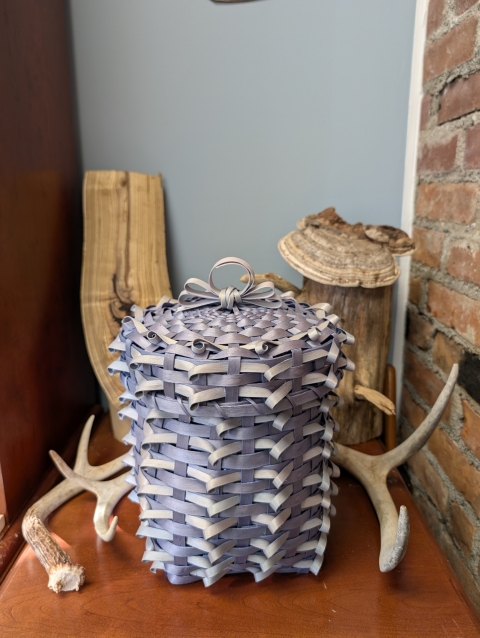
“I visited an artisan basket weaver’s booth and bought a beautiful lilac and silver basket that he made from brown ash,” Robertson said. “Every time I look at that basket now, I think about what an absolute pleasure it was working with the Mi’kmaq Nation and I just can’t wait to see what comes next.”