After forty-five years, Hiawatha Forest National Fish Hatchery has a new name.
The hatchery, located in Brimley, Mich., on the Upper Peninsula, became Sullivan Creek NFH as of October 21.
In addition to a new name, the hatchery is also sporting a new look, in the form of a building over all sixteen of its raceways. Since this facility converted to a lake trout broodstock broodstock
The reproductively mature adults in a population that breed (or spawn) and produce more individuals (offspring or progeny).
Learn more about broodstock hatchery in 1994, it has provided an annual production of at least five million disease free eggs. These important broodstock will now have more protection from predators and the staff will have unlimited access to the fish no matter what the weather.
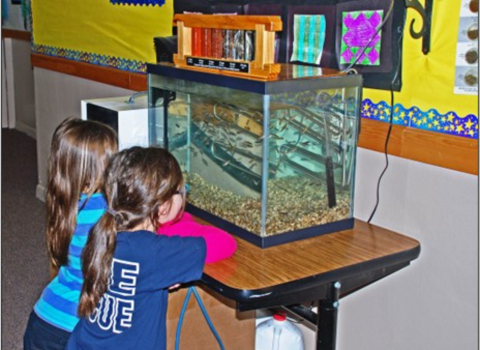
Despite the name change and facelift, Sullivan Creek hatchery’s overall mission remains the same: to rear lake trout for release in the Great Lakes, provide eggs for other fish hatcheries, and provide environmental education to more than 38,000 visitors each year. The hatchery annually produces 750,000 yearling lake trout for spring stocking and rears 15,000 lake trout broodstock.
“ Why, after all this time, is this facility getting a name change?,” said Curt Friez, Complex Manager for Sullivan Creek and Pendills Creek National Fish Hatcheries. “There are many reasons, but the most important one is to prevent confusion between the hatchery and the Hiawatha National Forest, which surrounds it.”
For years, said Friez, the public has assumed that because they have the same name, the hatchery and the forest were run by the same agency. However, the hatchery is run by the U.S. Fish and Wildlife Service, under the Department of Interior, while the forest is managed by the U.S. Forest Service, under the Department of Agriculture.
The name change is also logical because the creek that supplies the facility’s water is called Sullivan Creek, as is the road on which the hatchery is located.
“ This will put it more in line with most other national fish hatcheries since they are generally named after their water sources,” Friez said.
The name change may not seem like news to anyone who has been around the area for a while. Built in 1934, the hatchery was originally known as the Sullivan Creek Rearing Ponds. It has been through several name changes over the past seven decades, most recently in the late 1950s.
“ It seems only right to give this piece of history its original name,” said Hatchery Manager Friez.
The Fisheries Program of the U.S. Fish and Wildlife Service has played a vital role in conserving and managing fish and other aquatic resources since 1871. Today, the Fisheries Program is a critical partner with states, tribes, other governments, other Service programs, private organizations, public institutions, and interested citizens to conserve these important resources.
The nations fish and other aquatic resources are among the richest and most diverse in the world. These resources have helped support the nations growth by providing enormous ecological, social and economic benefits.
The U.S. Fish and Wildlife Service is the principal federal agency responsible for conserving, protecting and enhancing fish, wildlife and plants and their habitats for the continuing benefit of the American people. The Service manages the 95-million-acre National Wildlife Refuge System which encompasses more than 542 national wildlife refuges, thousands of small wetlands and other special management areas. It also operates 66 national fish hatcheries, 64 fishery resource offices and 78 ecological services field stations. The agency enforces federal wildlife laws, administers the Endangered Species Act, manages migratory bird populations, restores nationally significant fisheries, conserves and restores wildlife habitat such as wetlands, and helps foreign governments with their conservation efforts. It also oversees the Federal Aid program that distributes hundreds of millions of dollars in excise taxes on fishing and hunting equipment to state fish and wildlife agencies.