Written By

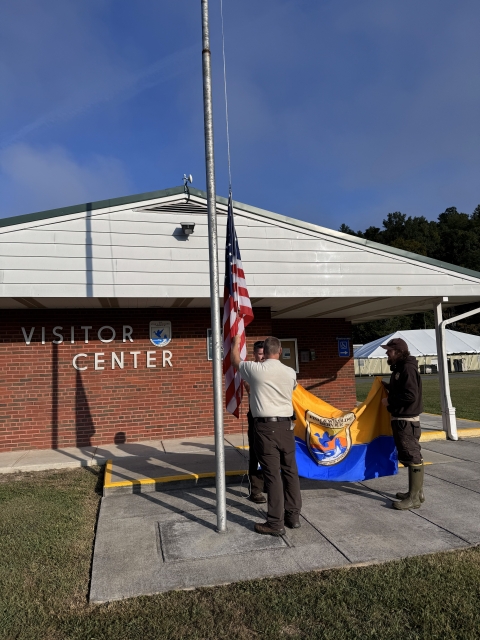
As part of the Flags Across America initiative for America’s semiquincentennial celebration, the U.S. Fish and Wildlife Service is sharing stories from the places where our commemorative flags have traveled. From historic hatcheries to vibrant refuges, each stop celebrates conservation as an enduring American value. Join us as we highlight the lands, waters, and wildlife that connect our nation’s past, present, and future.
Nestled along the historic Midland Trail in the heart of the Allegheny Highlands of West Virginia, White Sulphur Springs National Fish Hatchery has been a cornerstone of aquatic conservation for more than 120 years. Established in 1902 in the town of the same name, this historic hatchery was built to address declining fish populations.
The hatchery’s mission is anchored in the National Broodstock Program, a network dedicated to providing millions of disease-free fish eggs to partners nationwide, ensuring recreational fishing opportunities, supporting tribal subsistence fisheries, and aiding in restoration and recovery to conserve America’s natural resources.
On June 23, 2016, a 1-in-1,000-year storm flooded the White Sulphur Springs National Fish Hatchery, causing $1.7 million in damage. The disaster killed or contaminated 45,000 rainbow trout and destroyed insulation, mechanical and electrical systems, as well as nearby roads and fences. Wades Creek left two feet of debris in the broodstock broodstock
The reproductively mature adults in a population that breed (or spawn) and produce more individuals (offspring or progeny).
Learn more about broodstock facility, and raceways filled with sediment. Within a year, the hatchery was nearly restored, aided by eggs from Erwin National Fish Hatchery in Tennessee to replace their lost broodstock.
Now, a decade after the storm, White Sulphur Springs National Fish Hatchery produces and ships approximately 6 to 8 million rainbow trout eggs annually to 20 different federal, state and tribal hatcheries as far north as Maine and as far west as New Mexico and provides over 13,000 retired rainbow trout to the West Virginia Division of Natural Resources, the Maryland Department of Natural Resources and the Virginia Department of Wildlife Resources for stocking and recreational fishing!
“Our rainbow trout program is more than just producing eggs and stocking fish,” said hatchery manager Carey Edwards. “It’s about sustaining ecosystems, supporting recreational opportunities, and fostering a culture of conservation. Our recovery program works hand-in-hand with threatened and endangered species initiatives, ensuring that biodiversity thrives and future generations inherit waters rich in life and resilience.”
White Sulphur Springs National Fish Hatchery is also pioneering efforts to restore imperiled aquatic species. Hatchery staff have developed innovative captive holding, propagation, and reintroduction techniques to help recover the Big Sandy crayfish (Cambarus callainus), which is a rare native crayfish found only in parts of Virginia, Kentucky, and West Virginia. Biologists are also assisting with recovery efforts for freshwater mussels, including the Pistolgrip (Tritogonia verrucosa), Salamander mussel (Simpsonaias ambigua) and Black sandshell (Ligumia recta) species.

With educational displays and guided tours, White Sulphur Springs National Fish Hatchery offers a living classroom, making the hatchery an ideal destination for families, anglers, and anyone desiring to spend more time in nature. So, next time you are in the quaint city of White Sulphur Springs, in Greenbrier County, West Virginia, stop by and see conservation in action!

The Flags Across America journey has only just begun, and White Sulphur Springs National Fish Hatchery was the perfect place to start. Join us over the next year as we explore 25 of the Service’s National Wildlife Refuge System and Fish and Aquatic Conservation facilities that are the heartbeat of our conservation mission.
Next up, we follow the flags to the U.S. Fish and Wildlife Bozeman Fish Technology Center in Montana, where scientists are pioneering fish health research and developing cutting-edge treatments to keep our aquatic species thriving. Stay tuned for the next chapter on this historic tour!
Recreational Activities
Written By