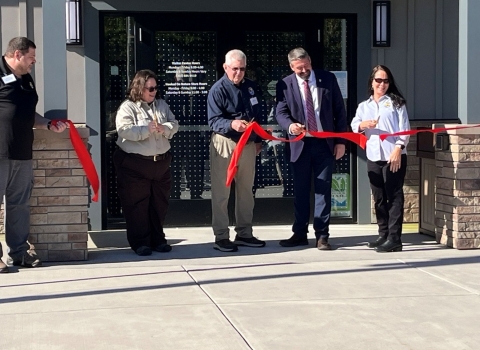
The Natural Resource Trustees for the 2010 Kalamazoo River Oil Spill announce the recent completion of a fish passage fish passage
Fish passage is the ability of fish or other aquatic species to move freely throughout their life to find food, reproduce, and complete their natural migration cycles. Millions of barriers to fish passage across the country are fragmenting habitat and leading to species declines. The U.S. Fish and Wildlife Service's National Fish Passage Program is working to reconnect watersheds to benefit both wildlife and people.
Learn more about fish passage project on Pigeon Creek, a tributary of the Kalamazoo River, in Calhoun County, Michigan. The Natural Resource Trustees working to restore the Kalamazoo River following the 2010 Enbridge Oil Spill include the U.S. Fish and Wildlife Service, Match-E-Be-Nash-She-Wish Band of the Pottawatomi Tribe, the Nottawaseppi Huron Band of the Potawatomi Tribe, the National Oceanic and Atmospheric Administration, Michigan Department of Environmental Quality, Michigan Department of Natural Resources, and the Michigan Depart of the Attorney General.
On July 25, 2010, Enbridge’s Lakehead Line 6B, a 30-inch diameter pipeline, ruptured near Marshall, Michigan, and discharged crude oil into a wetland adjacent to Talmadge Creek in Calhoun County, Michigan. The oil flowed down Talmadge Creek and into the Kalamazoo River which was in floodstage at the time. Oil flowed down the Kalamazoo River and through the river floodplain for approximately 38 miles to Morrow Lake. Numerous species of wildlife and their habitats were injured as a result of this spill, which remains the nation’s largest inland oil spill.
The Natural Resource Trustees selected restoration actions to compensate the public for the injury to natural resources and the loss of services, such as recreation, related to the spill. The Pigeon Creek E-Drive culvert replacement project is the first of those actions to be implemented by the trustees with funding from the Natural Resource Damage Assessment settlement with Enbridge. Prior to replacement, the stacked five-culvert system hindered the passage of aquatic organisms and did not adequately accommodate seasonal flooding.
The Calhoun Conservation District, led by Director Tracy Bronson and Project Manager Brett Riser, directed the effort to replace the inadequate structure with a single bottomless culvert that used natural cobble and an in-stream rock ramp to improve aquatic habitat and enable fish passage through the structure. The Conservation District partnered locally with the Calhoun County Road Department, Civil Engineers, Inc. of Battle Creek, and Sebastian Trucking and Excavating Inc. of Springport, Michigan, to plan, design and install the new culvert. In addition to improving habitat and passage, the new culvert is sized to accommodate seasonal floods associated with storm events.
The Calhoun Conservation District will implement two additional aquatic restoration projects on behalf of the Natural Resource Trustees and the public over the next two years. Additional information may be found at: https://www.fws.gov/midwest/es/ec/nrda/MichiganEnbridge/.
Latest Press Releases