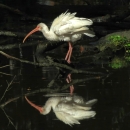
We assessed the movements, habitat use, and survival of tricolored herons (Egretta tricolor) and white ibis (Eudocimus albus) breeding in coastal Alabama, with the goal of supporting restoration and conservation planning in the aftermath of the Deepwater Horizon oil spill. We used satellite telemetry to mark 49 tricolored herons and 50 white ibis captured at coastal islands from 2020 to 2022, and tracked birds until July 2024. The data derived from satellite telemetry provided new insights into daily and seasonal movements, habitat use, and survival rates of these two colonial wading bird species.
Daily movement patterns from nesting colonies at Coffee, Marsh, and Gaillard islands showed that both species foraged primarily in nearby wetlands; birds from Coffee and Marsh islands foraged primarily at coastal sites on the mainland. Tricolored herons showed a strong dependence on emergent herbaceous wetlands, while white ibis demonstrated more flexibility, using not only wetlands but also human-modified landscapes including agricultural lands and a shellfish processing facility. Both species regularly relied on a mix of protected lands, including National Wildlife Refuges and State-managed tracts, as well as privately owned wetlands.
Seasonal tracking highlighted contrasting movement strategies. Tricolored herons showed true migratory behaviors, with a small proportion remaining as residents in coastal Alabama. Most migrants crossed the Gulf of America (formerly Gulf of Mexico; herein “Gulf”), with juveniles often staging first in Louisiana and adults flying directly to wintering areas in Mexico and Central America. Mortality during these crossings appeared high, underscoring the energetic challenges of migration, particularly across a large expanse of open water. In contrast to migratory tricolored herons, white ibis displayed more nomadic movements and remained largely within the southeastern United States year-round, shifting inland to freshwater and more developed habitats during the non-breeding season.
Survival analyses further underscored species differences. Estimated annual survival of tricolored herons was very low for both juveniles and adults, raising concerns for population resilience and long-term viability. However, 2020 was a year of high tropical cyclone activity in the Gulf, corresponding with high juvenile mortality that year. In contrast, estimated annual survival for white ibis was significantly higher than for tricolored herons, and was similar to survival rates found in other studies of ibis species.
Because of the differences between these two species, management implications diverge, particularly during the non-breeding seasons. Tricolored herons use wetlands not only in the northern Gulf, but also in Mexico and Central America in winter. However, there are proportions of both species that are present in coastal Alabama year-round. During the breeding season, nesting colonies on coastal islands depend on overlapping foraging areas, thus loss or degradation of wetlands poses risks beyond individual nesting sites. Protecting and restoring wetlands within 10–15 kms of active colonies may be important. In addition, many foraging areas lie outside of protected lands, thus conservation planning will require coordination among Federal, State, and local agencies as well as partnerships with private landowners. Continued restoration projects, such as those on Coffee and Marsh Islands, remain important for sustaining colony sites, while broader landscape-scale efforts are important to ensure connectivity and habitat availability. Finally, species-specific strategies should guide future restoration: tricolored herons would benefit from focused protection of specialized wetlands and migratory stopover areas, while white ibis management should account for their broader and more flexible use of both natural and human-modified landscapes.
Publication date
Type of document
Report
Media Usage Rights/License
Public Domain
Species