


Visit Us
National wildlife refuges offer us all a chance to unplug from the stresses of daily life and reconnect with our natural surroundings. Named for the famed explorers, Meriwether Lewis and William Clark, the landscape and rich wildlife of this refuge have changed very little in the past 200 years. Modern-day explorers visit this refuge to experience its wilderness qualities and enjoy the abundant wildlife resources. Lewis and Clark NWR is only accessible by boat. Native species of migratory birds, wild salmon, and other native plants and animals thrive where natural processes take precedence within the varied habitats of Sitka spruce swamps, riparian riparian
Definition of riparian habitat or riparian areas.
Learn more about riparian forest, tidal marshes, mudflats, and sand bars typical of the Columbia River estuary.
Activities
Click on the Activities below to learn more! Lewis and Clark NWR is only accessible by boat.
Related Documents
Other Facilities in the Complex

Lewis and Clark National Wildlife Refuge is managed as part of the Willapa National Wildlife Refuge Complex. A National Wildlife Refuge Complex is an administrative grouping of two or more refuges, wildlife management areas or other refuge conservation areas that are primarily managed from a central office location. Refuges are grouped into a complex structure because they occur in a similar ecological region, such as a watershed or specific habitat type, and have a related purpose and management needs. Typically, a project leader or complex manager oversees the general management of all refuges within the complex and refuge managers are responsible for operations at specific refuges. Supporting staff, composed of administrative, law enforcement, refuge manager, biological, visitor services, and maintenance professionals, are generally, but not always, centrally located and support all refuges within the complex.
Other refuges in the Willapa National Wildlife Refuge Complex include Willapa National Wildlife Refuge and the Julia Butler Hansen Refuge for the Columbian White-tailed Deer.
The Complex Headquarters Office is located at 7112 67th Place, Long Beach, WA 98631.


Rules and Policies
National Wildlife Refuges are places where wildlife comes first, and although people are welcome, activities are regulated and monitored to ensure that impacts are minimal to the plants and animals that call the refuge home, and so future generations can continue to enjoy for years to come.
Refuge Hours
Visitors are welcome to enjoy the refuge every day from sunrise to sunset. Lewis and Clark NWR is only accessible by boat.
Hiking
Public entry on the refuge islands is limited to foot travel only. There are no trails.
Dogs
Dogs are not allowed on the refuge except for dogs engaged in authorized hunting activities.
Bicycles
Bicycles are not allowed on the refuge.
Take Only Memories (and photos!)
Please do not collect or move archeological or historic objects, or any natural material such as plants, mushrooms, berries, and antler sheds. If you pick something up to take a closer look, put it back where you found it.
Camping
Camping is not allowed on the refuge. Nearby campgrounds are located in Skamokawa and Cathlamet, WA and in and near Astoria, OR.
Fires
Fires are prohibited.
Hunting
The Refuge’s estuary islands form a chain that begins at Tongue Point and follows the Oregon shore of the Columbia’s main river channel east to Welch Island. The Refuge includes over 12,000 acres of islands, sandbars, mud flats and tidal marshes which provide habitat for a variety of fish and waterfowl. Hunting of geese, ducks, coots, and snipe is permitted on the shorelines and interior sloughs of Refuge islands in accordance with federal and state hunting regulations. The hunting of all other species is prohibited.
Fishing
The refuge is accessible by boat only. Refuge waters include the Columbia River; sport fishing is regulated by the state of Oregon. Fishing season is generally open for at least one species year-round. Species include Chinook and coho salmon and sturgeon.
Closures
Areas within refuge boundaries may be closed to public entry due to sensitive species or restoration activities. Be aware of signs indicating closed areas.
Drones are prohibited on all National Wildlife Refuges
Launching, landing or disturbing wildlife by Uncrewed Aircraft Systems (drones) on national wildlife refuges is prohibited. UAS operators should not rely solely on applications such as AirMap, DJI Go or B4UFly to determine if a location is legal for UAS use. Such applications do not always capture accurate locations of public lands where UAS use is prohibited. Contact the refuge manager if you have questions. The use of UAS on or from refuge-administered lands for the purpose of taking commercial photography requires a permit in accordance with 43 CFR 5.1-12
Locations
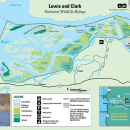
The Lewis and Clark National Wildlife Refuge consists of several units, spread out among islands located in the Columbia River between Washington and Oregon, and a small portion of shoreline in Oregon
Directions to the Refuge Office, located at Julia Butler Hansen Refuge:
The office is located along Highway 4 in Cathlamet, WA. Coming from the East, it is approximately 2-miles past Cathlamet. Coming from the West, it is approximately 4-miles past Skamokawa. Turn onto Steamboat Rd to enter the refuge.