Written By

In recent years, dogs have been lending a paw to natural resources professionals by detecting everything from turtles to invasive mussels. Now, trained dogs are supporting bat research, which will benefit conservation of Great Lakes forests and watersheds.
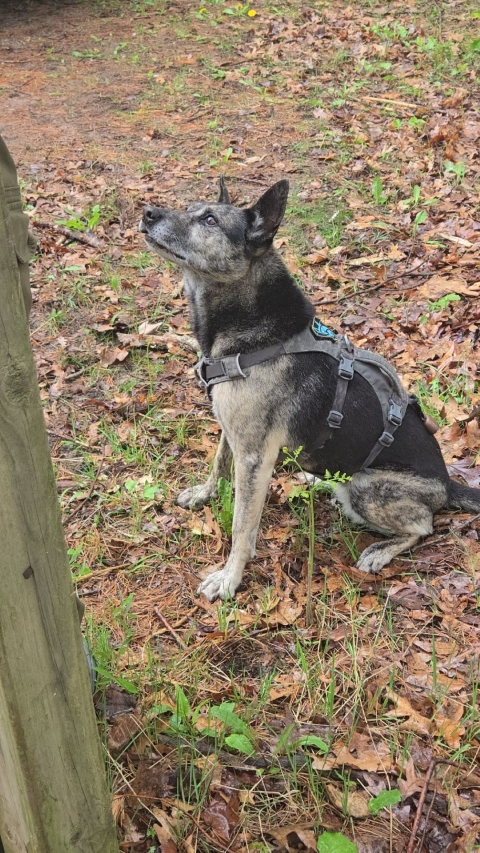
The Great Lakes Coastal Program and the Little Traverse Bay Bands of Odawa Indians are partnering to pilot a new way to survey and monitor bats on the Beaver Island Archipelago, a series of Great Lakes islands within the 1836 Ceded Territory in Michigan’s Straits of Mackinac region. In addition to protecting native ecosystems, bat conservation and recovery efforts indirectly benefit agriculture and forest products industries. Bats are significant predators of nocturnal insects, including many crop and forest pests, and several studies have highlighted their value to our national economy.
The project focuses on northern long-eared bats, a formerly abundant Michigan species that has experienced severe population declines over the last decade. Biologists are using ultrasonic acoustic monitoring to identify bat species assemblages and distributions on the Beaver Island Archipelago. They are also exploring the use of canine scent detection to identify bat summer roosting sites and inform future habitat management. The Coastal Program and GLRI are supporting the project through field-based technical assistance, acoustic data analysis, and funding support. Acoustic monitoring has been underway since last summer, and analysis of bat echolocation recordings have identified the likely presence of three to four bat species on Garden Island, part of the Beaver Island Archipelago, including the state threatened little brown bat.
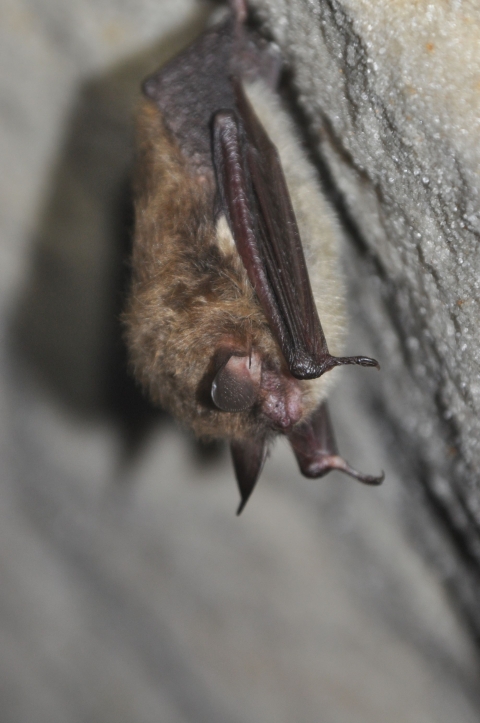
The dog training to detect bat guano (excrement) also began last summer and is continuing this year with more advanced field-based training to prepare the dogs for tree roost surveys, which will take place on the islands next summer. In 2026, dog training will focus on locating undocumented roosts, which are difficult to find using standard survey techniques, and fine-tuning search methodologies to ensure Little Traverse Bay Bands of Odawa Indians can continue these efforts once the pilot project is complete.
This project is complemented by a broader collaboration between the Service’s Ecological Services Program and several Michigan Tribal communities interested in building capacity and experience with bat monitoring and habitat management on Tribal lands. Additionally, the work is supported by the Michigan Department of Natural Resources, U.S. Forest Service, the Michigan Natural Features Inventory, and the U.S. Geological Survey Cooperative Research Group at Michigan State University. In 2025, bat mist netting and radiotracking conducted through this cross-agency collaboration with Tribes will aid in field-based training for the canine detection teams and advance efforts to locate and manage rare bat roosting areas on the lands of the Little Traverse Bay Bands of Odawa Indians.