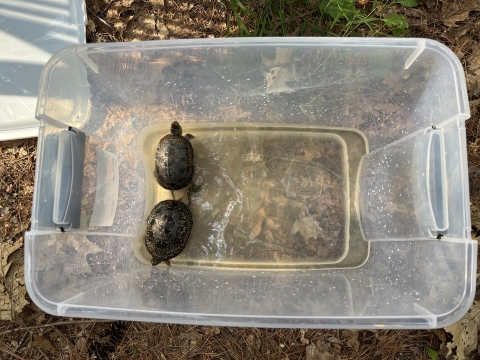
The two young turtles were raring to go, swimming in place in shallow water in their temporary holding tank as they awaited release into a nearby wetland.
“They aren’t usually this active,” said Deborah Jon Toupouzis, senior zookeeper at the Stone Zoo. “We think they can smell the swamp.”
But the crowd of about 40 people who had gathered at Great Meadows National Wildlife Refuge in Concord, Massachusetts, to see the turtles off wanted to savor the moment.
“It’s taken two decades to get here,” said Grace Bottitta, project leader for the Service’s Eastern Massachusetts National Wildlife Refuge Complex. “The turtles we’re releasing tonight are living proof that when we invest in habitat, science, partnerships, and the next generation of conservationists, we can make a lasting difference for species in need.”
The small turtles pining for the swamp were nine-month-old Blanding’s turtles that had just graduated from Zoo New England’s Headstart Program, established to give a leg up to this state-listed species. The program places hatchling turtles in the care of facilities, including local schools, over their first winter when they are most vulnerable simply because they are so small — about the size and weight of a quarter.
Blanding’s turtle hatchlings that overwinter in the wild are still about the size of a quarter in the spring. But the hatchlings that spend the winter in a facility come out significantly bigger — the two in the tank each weighed about a third of a pound — increasing the likelihood that they will survive to adulthood.

Since the program started in 2003, more than 800 headstarted Blanding’s turtles have been released at Great Meadows National Wildlife Refuge and surrounding wetlands.
So, what’s so special about these two? Their mom was a headstart, too.
Follow that turtle
In the spring of 2010, a female Blanding’s turtle climbed out of a marshy wetland at Great Meadows National Wildlife Refuge and began searching for a place to nest. She had traveled more than a mile by the time she found the perfect spot: the landscaping at a nearby office park.
She made a nest that produced 11 hatchlings — including a small female nicknamed Ivy who was taken to the Stone Zoo to headstart.
The following spring, Ivy and her siblings were released back into the wild at Great Meadows National Wildlife Refuge with small notches in their shells to enable researchers to identify them. But Ivy wasn’t seen again for a decade.
During a routine field survey in 2023, Zoo New England field technicians finally tracked her down.

“She looked big and strong, nearly reproductive size,” said Emilie Wilder, Associate Director of Conservation Engagement for Zoo New England. Zoo staff outfitted her with a radio transmitter to track her movements, hoping to find her nest in the coming years.
Then in the spring of 2025, senior field conservationist Jimmy Welch picked up the signal from Ivy’s transmitter and followed her as she left the refuge wetlands to search for a place to nest. When she finally selected a site in the wee hours of the morning, on adjacent conservation land owned by the Town of Concord, Welch was waiting nearby to mark and protect the nest.
Her nest produced seven healthy hatchlings and a conservation milestone: the first documented offspring from a turtle that had been through the headstart program.
A bright horizon
The crowd that gathered at Great Meadows National Wildlife Refuge in late June to witness the release of two of Ivy’s offspring (the others were headstarted by local schools and released with the students before the end of the school year) reflected the community of partners that made this conservation milestone possible.
There were representatives from Zoo New England, the Town of Concord, the Concord Land Conservation Trust, and the Massachusetts Department of Fish and Game, including Commissioner Tom O’Shea and Acting Director of the Division of Fisheries and Wildlife Eve Schlüter.
There were field technicians and animal care specialists, volunteers and interns, retired teachers whose students had headstarted turtles in the classroom, and residents of the nearby neighborhoods where female Blanding’s turtles make their nests.
And in addition to the young turtles, there was another guest of honor: Dr. Bryan Windmiller, founder of Zoo New England’s Blanding's turtle conservation program at Great Meadows National Wildlife Refuge, who led the program from its inception until retiring this year — just in time to see the second generation launch.
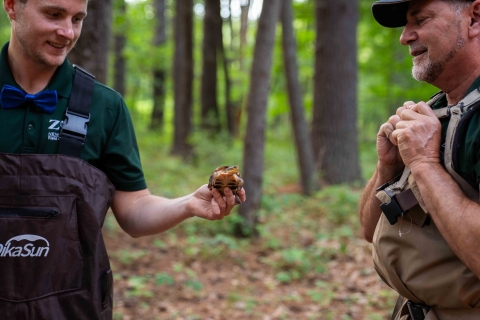
“Bryan has devoted his career to species conservation, building programs that have measurably reduced the decline of turtle species across the commonwealth,” said Eric Baitchman, Vice President of Animal Health and Conservation at Zoo New England.
Windmiller’s unique approach — a participatory model that engaged both children and adults in conserving natural treasures in their communities — was as important as the outcomes. “His work had an outsized impact on both rare species and the people who share their habitats,” Baitchman said.
Windmiller’s successful model is now being replicated at other locations in Massachusetts.
This collaborative approach to species conservation isn’t just nice to do — it's the only way to ensure a future for a highly mobile turtle species in a densely populated state. Strong community engagement also fosters a sense of guardianship that helps protect turtles from another threat: illegal collection and trade.
“There is a repeated truism that for Blanding’s turtles to persist, you need vast landscapes, huge unbroken landscapes, that are really hard to find in Massachusetts,” said Mike Jones, state herpetologist for MassWildlife. “But the Zoo New England team has shown that it's possible to muster a network of unconventional partners to help this species persist in relatively developed areas like Concord.”

Jones noted that in a protected landscape like Great Meadows National Wildlife Refuge, Blanding’s turtles can reach 80 years or older. “The turtles we release tonight may outlive some of us,” he said.
It sounded more like a hope than a hypothetical.
At the conclusion of the remarks, attendees walked to the edge of a wetland where Welch, Windmiller, and senior field conservationist John Berkholtz waded into the water to release the next generation of Blanding’s turtles.
The sun was starting to set as the turtles swam away, but the horizon for Blanding's turtles at Great Meadows National Wildlife Refuge is getting brighter and brighter.
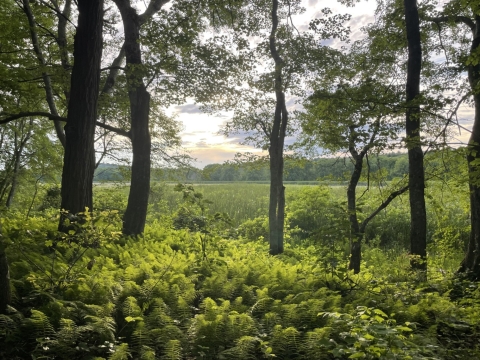
It is best not to publicize specific locations of wild turtles, as it could lead to habitat disturbance or illegal collection. However, the long-running Blanding’s turtle headstart program at Great Meadows National Wildlife Refuge is already well known as a successful example of this conservation approach and is supported by community engagement, stewardship and active monitoring.