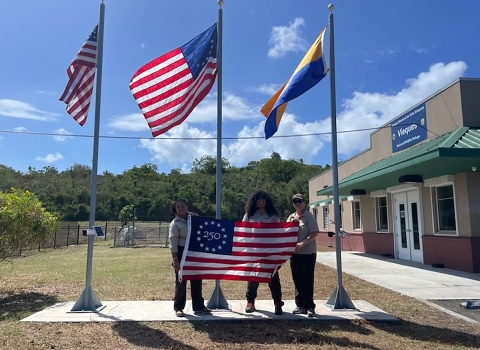
Established by President Calvin Coolidge in 1926 as a refuge and breeding ground for native birds, Johnston Atoll remains one of the most remote and biologically significant units of the National Wildlife Refuge System. Located approximately 780 nautical miles southwest of Honolulu, the refuge protects a unique subtropical ecosystem surrounded by thousands of square miles of open Pacific Ocean. Johnston Atoll National Wildlife Refuge recently celebrated its 100th anniversary.
Following decades of military use, Johnston Atoll has experienced a remarkable transformation. The refuge and the surrounding waters of the Pacific Islands Heritage Marine National Monument provide habitat for thriving coral reefs, sea turtles, sharks, marine mammals, and hundreds of thousands of seabirds. The refuge lands support 15 nesting seabird species, including the world's largest known colony of red-tailed tropicbirds.
One of the refuge's greatest conservation achievements was the successful eradication of invasive yellow crazy ants. First detected on Johnston Island decades ago, the ants spread across large portions of the island and posed a serious threat to nesting seabirds and native ecosystems. Yellow crazy ants attack adult and young birds, disrupt nesting behavior, and can dramatically alter island food webs. After more than a decade of planning, research, treatment, and monitoring by the U.S. Fish and Wildlife Service and partners. Conservation wildlife detector dogs were used at Johnston Atoll National Wildlife Refuge to confirm the successful eradication of invasive yellow crazy ants in 2021.

The project represents one of the most significant invasive ant eradications ever completed on a tropical island. The effort required consistent field work, innovative treatment methods, and close collaboration among federal agencies, researchers, and conservation partners. Today, Johnston Atoll provides safer nesting habitat for seabirds as we continue to restore the ecological integrity of the refuge.
Johnston Atoll stands as a powerful example of the National Wildlife Refuge System's enduring conservation mission. From its establishment in 1926 to the successful recovery of its native wildlife and habitats today, Johnston Atoll enters its second century having demonstrated how long-term stewardship, science, and partnership can protect some of America's most remote and extraordinary natural treasures for future generations.