Throughout his 32-year career with the U.S. Fish and Wildlife Service’s Office of Law Enforcement, retired Senior Special Agent Eric Holmes demonstrated his facility for every aspect of criminal investigation — from undercover work to data analysis to case strategy — in complex, multi-jurisdictional operations targeting systematic trafficking of elephant ivory, narwhal tusks, juvenile American eels, and more.
But he was admired as much by his colleagues for how he did it.
“Eric led not only by example but was intentional on showing newer agents what it took to be a successful investigator and provided a model for ethical and professional behavior,” said James Dowd, the Office of Law Enforcement’s Assistant Special Agent in Charge for Domestic Operations in the Northeast. “He was always willing to drop everything and do whatever was needed for the good of the mission.”
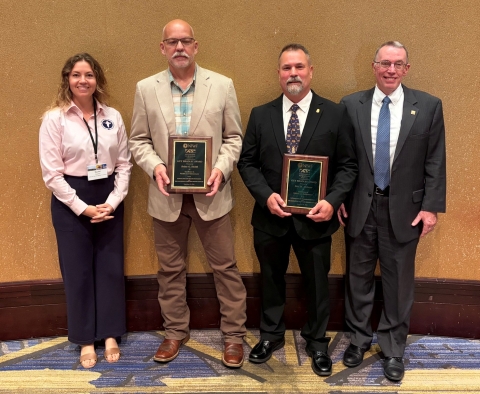
In September, Holmes received the 2026 Guy Bradley Award from the Association of Fish & Wildlife Agencies and the National Fish and Wildlife Foundation in recognition of his outstanding career and leadership. Named for Guy Bradley, a Florida game warden and the first wildlife officer killed in the line of duty while protecting the nation’s wildlife, the award is given annually to one state and one federal officer whose dedication to protecting natural resources has advanced the cause of wildlife conservation.
“Through his integrity, passion for the resource, and commitment to collaboration, Senior Special Agent Holmes exemplified the values of the Service,” said Doug Ault, Assistant Director, Office of Law Enforcement. “He was a natural leader and role model for colleagues and partners navigating the challenges and complexities of wildlife law enforcement.”
Holmes began his career with the Service’s Office of Law Enforcement in 1992 as a Wildlife Inspector in Ann Arbor, Michigan. In 1994, he moved to the Service’s Boston office, where he continued to excel as an inspector, making numerous valuable contributions to cases of special agents. It was a preview of what was to come.
In 1996, Holmes was hired as a Special Agent and stationed in Richmond, Virginia. Before long, his performance and reputation as a team player earned him a consequential new assignment: in 2001, he was transferred to East Orland, Maine, to reestablish the Office of Law Enforcement’s presence after years without a special agent stationed in the state. He prioritized building strong relationships with the Maine Warden Service and with Canadian partners, laying the foundation for numerous successful investigations focusing on domestic and international species and perpetrators. Operation Broken Glass is a case in point.
Based on his analysis of black-market price data, poaching trends, and other intelligence, Holmes recognized a growing threat to the American eel from the illegal trade in juvenile glass eels and brought North American law enforcement agencies together to respond through innovation and teamwork.
The resulting six-year investigation into the illegal glass eel trade involved 20 partnering agencies — representing international, federal, state, local, and nongovernmental organizations — collaborating to understand the scale of the problem and gather the evidence needed for prosecution.
The investigation showed perpetrators were using the legal fisheries in Maine and South Carolina to launder glass eels caught in other eastern states where commercial harvest of juvenile eels is prohibited.
Thanks to Holmes’ leadership, Operation Broken Glass uncovered more than $7 million in illegal exports to East Asia, resulted in the successful prosecution of 22 defendants who plead guilty to Lacey Act violations, and disrupted a sophisticated trafficking operation that posed an existential threat to a native species.
In both his investigative work and his professional relationships, Holmes consistently went above and beyond.
He set a high bar for wildlife law enforcement and helped others reach it by mentoring colleagues in the field and volunteering to teach courses for both federal and state law enforcement officers, including an intensive waterfowl-identification and Migratory Bird Treaty Act-enforcement training that only a handful of agents across the country were qualified to lead.
He was recognized with numerous awards throughout his career, including the U.S. Department of Justice’s Investigative Agent Public Service Award and the Assistant Attorney General for the Environment and Natural Resources Division Award. He was named the Northeast Conservation Law Enforcement Chiefs Association’s “Officer or the Year” three times.
But for Holmes, the opportunity to make a meaningful difference in conservation by working with others to combat wildlife trafficking was its own reward.
“Eric left the Office of Law Enforcement a better place,” Dowd said. “And I know he would do it all over again.”