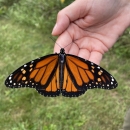
The fall monarch migration is fully underway! We at the U.S. Fish and Wildlife Service are fitting monarch butterflies with lightweight Bluetooth trackers as they migrate south toward overwintering habitat.
Emerging technology
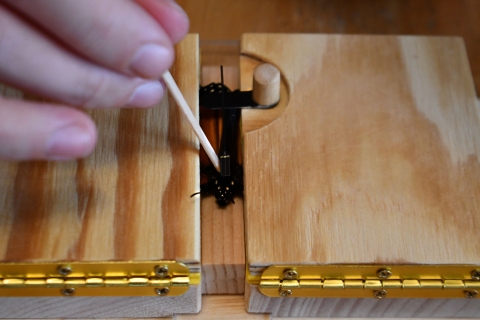
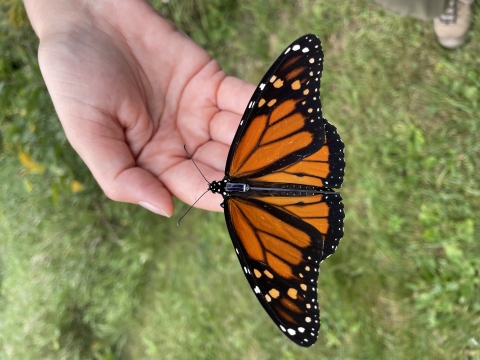
In fall of 2025, Project Monarch captured 200 migrating monarchs in real-time as butterflies flew from their breeding grounds to their overwintering sites. Because of their initial success, we have fitted even more monarchs this fall with solar-powered Bluetooth tags that weigh only six milligrams, it’s like carrying a small bag. The transmitter operates at 2.4 GHz, allowing smartphones to detect as they monarchs pass within signal range. Each detection provides new data about the monarch’s migration path.
From tagging to data collection
The Center for Pollinator Conservation staff recently participated in transmitter-tagging training with Monarch Joint Venture, Three Rivers Park District, the University of Minnesota and the Minnesota Zoo.
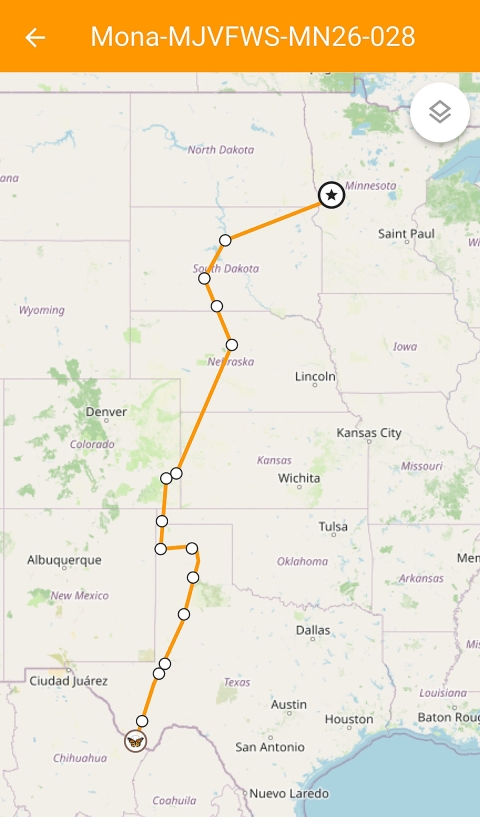
One of the monarchs tagged, Mona-MJVFWS-MN26-028, began migration in northwestern Minnesota. This male butterfly flew in a direct line to the Missouri River in central South Dakota. He then shifted south, before his last detection in the Big Bend area area of Trans-Pecos region in southwestern Texas,along the border with Mexico.
Another monarch named UB26-UT-06-Chew originated in northeast Utah on September 2 and was the first radio- tagged butterfly known to cross the U.S. border and be detected on October 11 in Santa Catarina, Nuevo León, Mexico.
The Center supports radio-tag deployments at several field stations within the National Wildlife Refuge System, including Prairie Wetlands Learning Center at Fergus Falls Wetland Management District, in Minnesota, Wichita Mountains National Wildlife Refuge, in Oklahoma, Santa Ana National Wildlife Refuge, in Texas and St. Marks National Wildlife Refuge, in Florida, among others.
Improving migration science
The new technology continues to generate significant interest. The Center for Pollinator Conservation and partners from Canada, Mexico and the U.S. launched the Tri-National Insect Movement Collaborative. The collaborative uses cutting-edge technology to answer key conservation questions, shares data, standardizes research methods and supports science-based decisions. It builds a foundation for future insect tracking. Monarch butterflies serve as the first focal point, and the methods developed here will help answer important questions as researchers deploy the technology with other pollinator species.
Researchers engaged with the Project Monarch and the Tri-National Insect Movement Collaborative are analyzing last year’s data and exploring the rapidly expanding dataset to better understand migration pathways, migratory success and roosting locations. Tagging will continue beyond the fall migration season, enabling researchers to investigate overwintering behavior, spring migration and breeding-season movements in the coming months and years.
Get involved
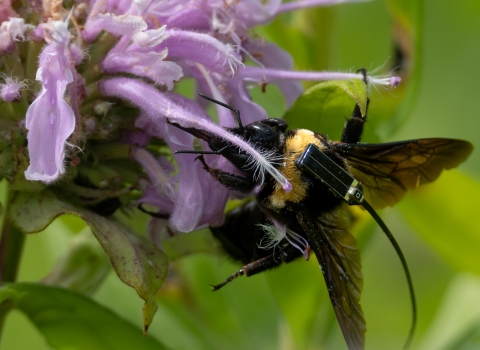
You can track individual monarchs on their journey to overwintering sites through the Project Monarch App. You can also learn about how we piloted similar technology to track bumble bees.
Learn more about the Tri-National Insect Movement Collaborative.