As part of the Flags Across America initiative for America’s 250th anniversary, the U.S. Fish and Wildlife Service is sharing stories from the places where our commemorative flags have traveled. From historic hatcheries to vibrant refuges, each stop celebrates conservation as an enduring American value. Join us as we highlight the lands, waters and wildlife that connect our nation’s past, present and future.
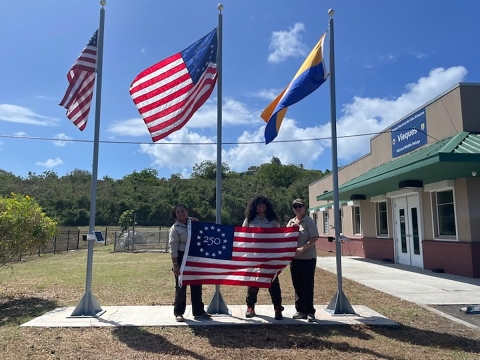
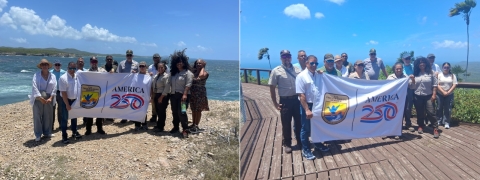
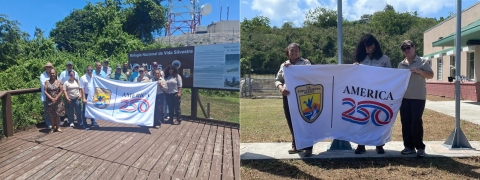
In May 2026, Flags Across America visited Vieques National Wildlife Refuge in Puerto Rico, the most ecologically diverse refuge in the Caribbean. Eleven federally protected plant and animal species occur on the refuge and its surrounding waters, including four of the six sea turtle species found in U.S. waters.

You can also see the Antillean manatee in refuge waters. It’s one of two West Indian manatee subspecies. The other is more familiar to U.S. residents: the Florida manatee. Other types of large fauna in the waters around the refuge include dolphins, sharks and whales.
And then there are the birds! About 170 bird species, both migratory and resident, have been reported on Vieques. In winter, the refuge gets more migratory species.
If it sounds like Vieques National Wildlife Refuge is a dream come true for wildlife watchers and nature photographers, you’d be right.

"Vieques National Wildlife Refuge represents one of the most powerful stories of ecological resilience, community collaboration, and natural beauty in the entire Caribbean, says Silmarie Padrón, project leader of the Caribbean Islands National Wildlife Refuge Complex. “Protecting over 17,000 acres, from pristine coastal mangroves and sea turtle nesting beaches to bioluminescent bays, it stands as a testament to what is possible when science, restoration and local partnership come together to preserve our shared natural heritage for generations to come."
There is so much more to do at Vieques National Wildlife Refuge, too.
About 800 species of fish inhabit the coastal waters around Puerto Rico, and you cantry to catch your dinner. The refuge even has a night fishing program.
The beautiful beaches are a huge draw. Besides fishing, visitors can go kayaking, snorkeling and scuba diving at the beaches and lagoons.
The refuge also borders the Puerto Mosquito Bioluminescent Bay, managed by the Puerto Rico Department of Natural Resources and the Vieques Conservation & Historical Trust. This bay, the brightest bioluminescent bay on earth, is home to millions of tiny light-producing plankton called dinoflagellates, which give it its colorful appearance.
Puerto Mosquito National Natural Landmark National Natural Landmark
The National Natural Landmarks Program preserves sites illustrating the geological and ecological character of the United States. The program aims to enhance the scientific and educational value of the preserved sites, strengthen public appreciation of natural history and foster a greater concern for the conservation of the nation’s natural heritage. The program was established in 1962 by administrative action under the authority of the Historic Sites Act of 1935. The first National Natural Landmarks were designated in 1963. Today, there are more than 600 National Natural Landmarks in 48 states, American Samoa, Guam, Puerto Rico and the U.S. Virgin Islands.
Learn more about National Natural Landmark Trail, one of Vieques National Wildlife Refuge’s trails, leads to Observation Platform with a view of the Puerto Mosquito National Natural Landmark, including the Puerto Mosquito Bioluminescent Bay.
History
At approximately 17,771 acres, Vieques National Wildlife Refuge is the largest of the nine national wildlife refuges in the Caribbean.
Beginning in the 1940s, the U.S. Navy used a large part of the island of Vieques for military exercises. In 2001 and 2003, the Navy transferred the land that became the refuge.
The refuge is on both the western and eastern sides of the island, but a major portion of the eastern side is closed to the public due to the danger of unexploded ordnance and the associated clean-up process.
Historically, the refuge’s lands had multiple owners. The refuge contains important archeological and historic resources, including artifacts of the aboriginal Taino culture and the island’s sugar cane plantation era.
A visit to Vieques National Wildlife Refuge is all but guaranteed to show you something beautiful.
Next up, we follow the flags to Sandy Point National Wildlife Refuge in the U.S. Virgin Islands, which also provides crucial nesting habitat for protected sea turtles. Stay tuned for the next chapter on this historic tour!