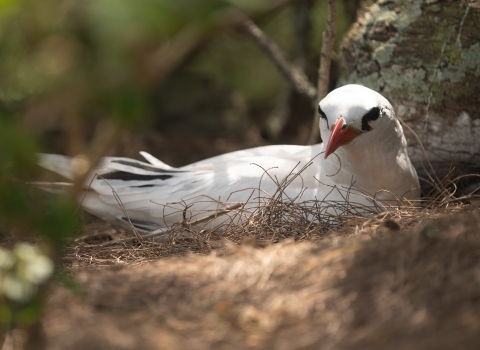
The U.S. Fish and Wildlife Service today announced the availability of the Draft Recovery Plan for the short-tailed albatross (Phoebastria albatrus) for public review and comment.
Copies of the plan are available for inspection, by appointment, during normal business hours at the following location: U.S. Fish and Wildlife Service, Anchorage Fish and Wildlife Field Office, 605 W. 4th Avenue, Anchorage, AK 99501 (telephone: 907-271-2888). Requests for copies of the draft recovery plan and written comments and materials regarding this plan should be addressed to the Field Supervisor, at the above Service address. An electronic copy of the draft recovery plan is also available at http://endangered.fws.gov/recovery/index.html#plans. Comments on the draft recovery plan must be received within 60 days if today's publication in the Federal Register.
Restoring endangered or threatened animals and plants to the point where they are again secure and self-sustaining within their ecosystems is a primary goal of the U.S. Fish and Wildlife Service's endangered species program. Recovery plans describe actions considered necessary for the conservation and recovery of the species, establish criteria for reclassifying or delisting them, and estimate time and costs for implementing the recovery measures needed.
The short-tailed albatross, the largest of the three North Pacific albatross species, is federally listed as endangered, and" TimesRoman; ; TimesRoman was likely once the most abundant albatross species in the North Pacific. Millions of these birds were harvested by feather hunters prior to and following the turn of the 20th century, resulting in the near-extirpation of the species. Presently, about 2000 short-tailed albatrosses are known to exist.
TimesRoman; ; TimesRoman
TimesRoman; ; TimesRomanThese birds are known to breed only on two remote islands in the western Pacific. Torishima Island, Japan, where the majority of short-tailed albatrosses breed, is an active volcano. The natural colony site on this is also susceptible to mud slides and erosion. A smaller colony exists in the Senkaku Islands, to the southwest of Torishima, where volcanic eruption is not a concern. However, political uncertainty and the potential for habitat alteration threaten this location.
The U.S. Fish and Wildlife Service is the principal federal agency responsible for conserving, protecting and enhancing fish, wildlife and plants and their habitats for the continuing benefit of the American people. The Service manages the 95-million-acre National Wildlife Refuge System, which encompasses 542 national wildlife refuges, thousands of small wetlands and other special management areas. It also operates 69 national fish hatcheries, 64 fishery resource offices and 81 ecological services field stations. The agency enforces federal wildlife laws, administers the Endangered Species Act, manages migratory bird populations, restores nationally significant fisheries, conserves and restores wildlife habitat such as wetlands, and helps foreign governments with their conservation efforts. It also oversees the Federal Aid Program, which distributes hundreds of millions of dollars in excise taxes on fishing and hunting equipment to state fish and wildlife agencies.
-fws-
For more information about the U.S. Fish and Wildlife Service,
visit our home page at http://www.fws.gov">