


1490 E Main Street
Ashland, OR 97520
United States
About Rebecca Kagan
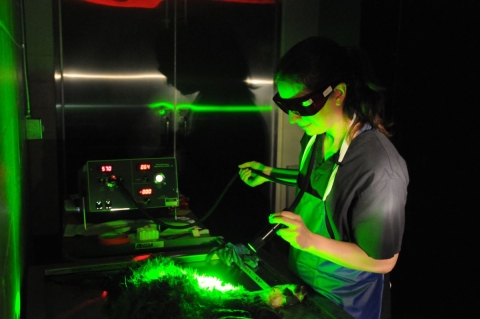
Rebecca Kagan has been a veterinary pathologist at the U.S. Fish and Wildlife Service National Fish and Wildlife Forensics Laboratory in Oregon since 2010. Before that, she was a veterinary pathology fellow with the San Diego Zoo Wildlife Alliance.
How would you describe your job to someone you just met?
“I help the U.S. Fish and Wildlife Service’s law enforcement team in their investigations by determining cause of death in suspected illegal wildlife killings, collecting any trace evidence for additional analysis (such as bullet fragments or poison samples) and serving as a fact witness in court. I’m primarily a diagnostician and my research projects are generated ‘in the moment’ to answer case-related questions. Veterinary forensic pathology is still a relatively new discipline. We do anything we can do to advance the field benefits future generations of pathologists, veterinarians, wildlife biologists, and investigators.”
What do you love about the job?
“I love mysteries, and each body we get is like a little mystery — this is my favorite part of being a pathologist. Sometimes what looks like a gunshot wound in the field turns out to be a gunshot wound. But sometimes it’s a surprise. An eagle found dead at the base of a power pole may have been electrocuted. Or it may have had a disease, or been attacked by another eagle, or been shot, or hit by a car, or something else entirely. I try to sort that out using autopsy, x-rays, microscopic examination, toxicology testing, or whatever else it may need.”
What is the most challenging part of your job?
“Because these animals are often part of vulnerable or endangered populations it’s important to keep an eye on all types of mortality, even if it’s not due to illegal activity. Unfortunately, because there is often no known history with wildlife and because the bodies may be decomposed or scavenged by the time they are found, sometimes the cause of death can never be determined. That’s part of the challenge.”
What led to your career choice?
“Like most veterinarians, I grew up reading James Herriot’s, All Creatures Great and Small books. I love animals, particularly wildlife, and my passion for physiology (the study of how bodies work) began in high school. While in college I thought I’d become a vet for cats and dogs but discovered many things a veterinarian could do I hadn’t yet considered or even been exposed to. Pathology turned out to be my favorite subject, and zoo and wildlife pathology was the perfect combination of all things I like best: the coolest animals, the most interesting diseases, and the most dedicated and awesome colleagues.”
What is your educational background?
Bachelor of science in biology from Susquehanna University
Doctor of veterinary medicine from Iowa State University
Anatomic pathology residency with University of Illinois Zoological Pathology Program
What does conservation mean to you?
“Preservation of wildlife populations is extremely important. Not only because wildlife is integral to environmental health and sustainability, but because their existence makes our lives whole. I believe, we have no future without them.”
To find available forensic scientist jobs, go to USAJobs.gov. Search “0401,” “biological sciences,” “0486,” “wildlife biologist,” or “forensic.” Filter by “U.S. Fish and Wildlife Service” or “Department of the Interior.” The job requires a bachelor’s degree in biological science with specialized study related to wildlife biology, animal ecology, zoology, botany and a range of other relevant fields. Details about education and experience requirements.