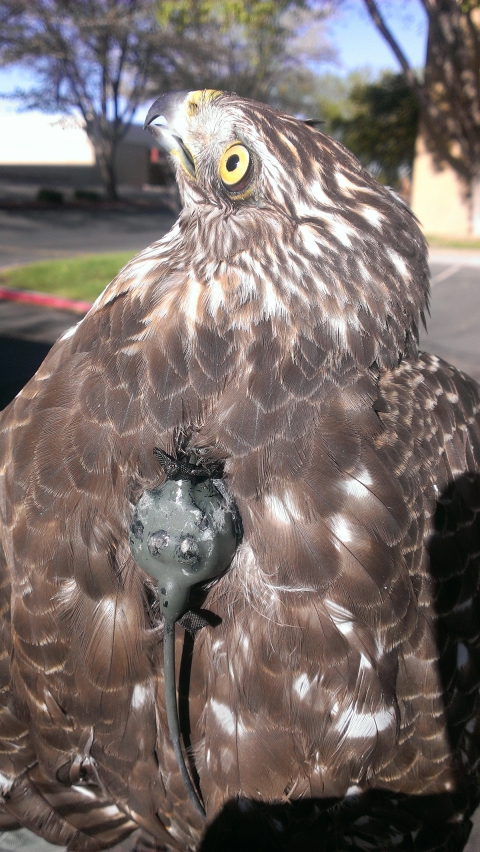
A nearly bald female Cooper’s hawk dashes about like a roadrunner, racing around the trees in Albuquerque. She lost all her flight feathers and most of her tail feathers fighting with another bird over territory. The following year, now with full plumage, she becomes a very successful breeder. Cooper’s hawks are survivors.
This female hawk was banded early in the research study by U.S. Fish and Wildlife Service’s Southwest Region Migratory Bird Chief Kristin Madden and former National Raptor Coordinator Brian Millsap. Along with then-Service wildlife biologist Robert Murphy, the team analyzed the causes of death for Cooper’s hawks in Albuquerque, New Mexico over a 10-year span. Usually, hawk remains are found when someone just happens to find them, giving a biased impression of the primary causes of death. Motivated by curiosity and conservation, Madden and her team wanted to systematically understand the causes of raptor deaths and hopefully help minimize them.
Their research is the first known study to provide a more complete picture on causes of urban Cooper’s hawk deaths. In their peer-reviewed journal article, they found that the majority of deaths were related to human factors, including collision and electrocution. They also confirmed that illegal killings continue to threaten Cooper’s hawks. The study was recently awarded Best Paper in the Journal of Raptor Research.
“Urban wildlife, such as birds, coyotes, and raccoons are finding ways to adapt as our nation becomes increasingly more and more urbanized,” said Madden. “By studying urban birds and knowing migratory pathways, we may be able to inform human actions and future urban planning in ways that are kinder to birds and other wildlife.”
What Did the Study Show?
When Madden started researching urban Cooper’s hawks in 2010, she expected to survey the entire city. It quickly became apparent there were more birds than expected and survival rates are surprisingly high. Madden and Millsap focused the current study on the northeast area. In this quadrant alone, they observed about 520 total Cooper’s hawks in 2025, including 208 adults and 312 young produced.
Since 2011, they have tracked Cooper’s hawks in a 28 square mile (72 km2) study area, monitoring their life and eventual death. The study utilized newer technology alongside traditional banding, allowing the researchers to gather information in real time.
“Our study was only possible because of the long-term support we’ve had from the U.S. Fish and Wildlife and the ability to incorporate the new GPS transmitter technology into work,” said Brian Millsap. “The study has provided the sorts of data needed to calibrate the models used by the Service and others to estimate allowable take limits for a variety of raptor species, including eagles.”

After a Cooper’s hawk was found dead, the tagged corpse was quickly retrieved to determine the cause of death via necropsy, the animal equivalent of a human autopsy. The hawk was examined with the naked eye or x-rayed to determine how it died. Its tissue and swab samples were examined under a microscope and quite a few hawks were sent to the National Wildlife Health lab for additional testing.
Most of the known causes of death of the recovered Cooper’s hawks were related to human activity, with collision being a major factor (37 birds) and intentionally killed by people (8 birds) remaining a risk. The study highlights the still too common threat of illegal and deliberate killing of birds of prey. This surprised Madden.
“What we didn’t realize was just how rampant intentional killing still is,” said Madden. “And it’s going on right in the middle of the city.”
Living with Urban Birds

Cooper’s hawks were once primarily woodland birds. Today, they often live in cities, nesting in trees and roosting on utility poles. They hunt other birds and small mammals, keeping those populations in check. Because of their diet, birds of prey have a bad rap, with some people viewing them as threats or competition to game hunting. Other people simply hunt them for sport, even though raptors are protected through the Migratory Bird Treaty Act.
A surviving adult raptor not only represents an individual, but also potential future individuals. Losing one adult, especially a breeder, doesn’t just remove that one bird from the population—it removes a significant amount of future potential offsprings over its lifetime. This cause-of-death study shows that most of Cooper’s hawk deaths are human-caused and many may be preventable by designing more bird-friendly buildings and powerlines.
Despite the study’s results, Madden and her team remain hopeful. “Something else that came out really strongly in our study is that most people care about their hawks,” said Madden. “We go around and look around people's houses with binoculars to monitor the birds. Rather than calling the police, most people come out of their homes to ask what we’re doing, and respond with ‘Cool. How can I help?’”
One way you can help is to learn about raptors and their role in supporting healthy ecosystems. If you are interested, read these tips for coexisting with urban birds of prey and learn how the Urban Bird Treaty program is helping to conserve migratory birds and their habitats across the country. Additionally, you can help reduce the number of collisions by using our Bird Friendly Toolkit.
Read the Peer-Review Journal Article
Millsap, Brian & Madden, Kristin & Murphy, Robert. (2024). Causes of Death of Female Cooper's Hawks from an Urban Setting in New Mexico, USA. Journal of Raptor Research. 58. 1-14. 10.3356/JRR-23-00022.