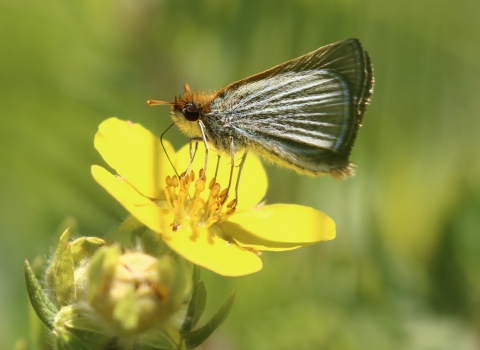
The Poweshiek skipperling is a small, big-eyed, butterfly scarcely noticed by most people. Once common across the midwest, this endangered prairie butterfly has nearly vanished from its native range and now persists only in one Michigan county and one prairie in Manitoba, Canada. We at the U.S. Fish and Wildlife Service and our partners are taking a significant step giving the Poweshiek skipperling a renewed chance at survival.
This summer our partners will release approximately 1,500 zoo-reared Poweshiek skipperlings into restored prairie fens in Michigan and Manitoba. At one site we will be taking the next step in recovery: reintroduction into a previously occupied location. This will be the first reintroduction of this species within the United States!
From common to rare
Historically at home in unplowed prairie habitats stretching from the Dakotas to Indiana, the Poweshiek skipperling has suffered dramatic declines over the past several decades. In areas where the butterfly once thrived, surveys now find only single-digit numbers, or none at all. The species was federally listed as endangered in 2014, prompting an intensive, coordinated response from agencies, zoos, universities, conservation organizations and international partners.
Breaking new ground
One of the most important parts of the recovery effort for this butterfly is captive rearing. Beginning in 2015, the Minnesota Zoo, and later Assiniboine Park Zoo and John Ball Zoo, collaborated with federal and state biologists to learn how to raise the species in human care. Breeding this rare butterfly under controlled conditions has since allowed partners to augment remaining populations and advance the species toward its recovery goals.
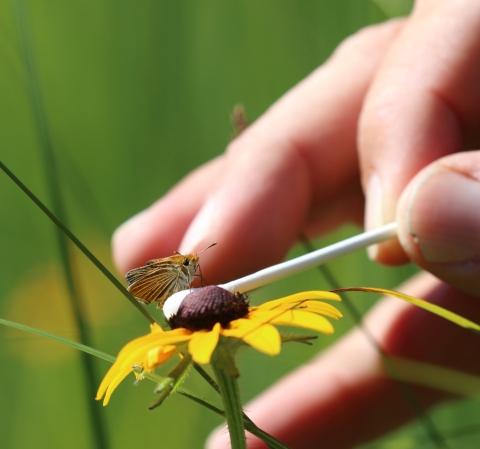
To track progress, released butterflies are marked with tiny color codes which help researchers to monitor movement, survival and breeding. Thanks to our team’s work to restore habitat in promising places, we could have a comeback for this small butterfly. Releases will continue at both new and existing sites while scientists evaluate long‑term population growth and habitat stability.
This work is supported largely by the Great Lakes Restoration Initiative Threatened and Endangered Species Template, with additional support from the Association of Zoos and Aquariums and other conservation partners. Lessons learned from this project strengthen similar pollinator recovery programs, such as those for the Dakota skipper and Mitchell’s satyr, and demonstrate how targeted collaboration can give even the smallest species a chance to rebound.
Each flutter above the prairie marks a hopeful milestone and signals new potential for a butterfly once on the brink of disappearing. But in restored prairie fen, each release brings the possibility of return: a small flash of wings above the grass, and a species once nearly lost taking flight again.