Written By

Editor's Note: This story was originally published on July 12th, 2017.
Brunswick, Georgia – Altama Plantation is perhaps the most critical, and intriguing, piece of property along the entire Altamaha River corridor.
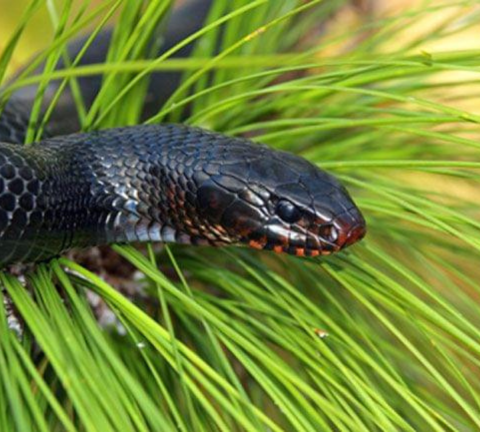
It was here in the early 1800s that plantation owner James Hamilton Couper introduced the Dutch system of tidal floodgates to grow rice. He planted sugar cane and built a refinery whose red-brick remains still stand. Couper, a noted scientist, also recorded the first eastern indigo snake, a threatened species which bears his name (Drymarchon couperi).
Altama is poised yet again to make history. It is the linchpin connecting two distinctive conservation corridors: the Altamaha; and an under-construction greenway that runs from the Okefenokee Swamp to Fort Stewart near Savannah, Georgia.
The goal, ultimately, is 1.5 million acres of protected land across the coastal plain of Georgia. Jason Lee, a Georgia Department of Natural Resources (DNR) program manager stitching the corridors together, says a long-term Southern conservation strategy depends upon huge swaths of connected lands.

“We not only have development and land-use patterns way out into the future that we’re uncertain about, but we also have a lot of obstacles that prevent species from moving about freely,” Lee said. “We’re trying to protect enough habitat so that species we’re concerned about can persist well into the future.”
The Jones family, scions of the nearby Sea Island resort, used Altama as a hunting preserve until a 2010 bankruptcy turned ownership over to a private equity firm. The Nature Conservancy bought it for $7.8 million four years later. With much help from the U.S. Fish and Wildlife Service, the U.S. Marine Corps and others, the 4,000-acre tract became a state-run wildlife management area wildlife management area
For practical purposes, a wildlife management area is synonymous with a national wildlife refuge or a game preserve. There are nine wildlife management areas and one game preserve in the National Wildlife Refuge System.
Learn more about wildlife management area .
The partners are restoring a longleaf pine forest on one-fourth of the property. Garret Andersen, a fire ecologist, recently created a fire break with backhoe and mulcher alongside a longleaf stand and blackwater creek. He burns 300 acres of pine each year creating a nutrient-rich understory of wiregrass and palmetto favored by gopher tortoises, red-cockaded woodpeckers and dozens of other species.
DNR tallied 182 gopher tortoises on Altama this spring. Lee expects the numbers to soar as the longleaf returns.
“We’re trying to preserve species before they’re listed as endangered or threatened,” he said. “If you start early enough, you preserve that genetic diversity and you’re much more likely to be successful. It’s a much better approach biologically and economically.”
Corridors, of course, offer benefits to species beyond those at-risk. Altama Plantation, outside of Brunswick and along Interstate 95, is fast becoming a recreational gem. Hunters, for years, have taken deer, boar and wild turkeys. Anglers know its riverine sweet spots. Hikers, bikers, birders and kayakers are flocking to Altama’s oak-shrouded lanes, cypress swamps and historic homes and gardens.
Corridors, as laid out in the Southeast Conservation Adaptation Strategy (SECAS), a cooperative blueprint for the region’s long-term health, defend against over-development and climate change climate change
Climate change includes both global warming driven by human-induced emissions of greenhouse gases and the resulting large-scale shifts in weather patterns. Though there have been previous periods of climatic change, since the mid-20th century humans have had an unprecedented impact on Earth's climate system and caused change on a global scale.
Learn more about climate change . The Atlantic Ocean’s minimum 3-foot rise by 2100, as predicted by NOAA and other agencies, will bring a surge of saltwater miles inland. The two corridors, though, will slow the onslaught while giving the flora and fauna time to adapt to a warming climate.
Lee has played a critical role in cobbling together the 40-mile stretch of Altamaha River. The Okefenokee-to-Fort-Stewart corridor, though, is his baby. It’s anchored by the 440,000-acre swamp to the south and the 280,000-acre Army base to the north. Altama sits squarely in the middle of the proposed 120-mile greenway. Other properties have been acquired, but large tracts must still be protected.
Combined, the two corridors will one day create an unprecedented array of protected lands across the biologically diverse Southern coastal plain.
“I am passionate about linking corridors,” Lee said. “And now is the opportune moment to really build those corridors to protect all these species well out into the future.”