Location
States
District of ColumbiaEcosystem
River/streamIntroduction

In the late 19th and 20th centuries, Europeans introduced multiple crayfish species from North America into Europe for culinary purposes, as pets, and to supplement native crayfish populations. These non-indigenous crayfish species (NICS) are now widespread in many European waterways, where they cause ecological damage and displace native species through competition for resources, direct predation, and disease transmission. Without intervention, NICS are predicted to completely overtake indigenous crayfish species (ICS) in the vast majority of European waterways in the next two decades.
Three NICS from North America are currently present in Switzerland: the spiny-cheek crayfish (Faxonius limosus), signal crayfish (Pacifastacus leniusculus), and red swamp crayfish (Procambarus clarkii). Two additional NICS are present in neighboring Germany and will likely soon appear in Switzerland. The presence of NICS poses a major threat to Switzerland’s ICS, the noble crayfish (Astacus astacus), white-clawed crayfish (Austropotamobius pallipes), Italian white-clawed crayfish (Austropotamobius italicus) and stone crayfish (Austropotamobius torrentium). The Bern Convention on the Conservation of European Wildlife and Natural Habitats defines all four ICS as internationally protected.
In 2014, in response to the threat posed by NICS, the Swiss Federal Office for the Environment formed the Swiss Coordination Office for Crayfish/Koordinationsstelle Flusskrebse Schweiz (KFKS) to coordinate the control of NICS and preservation of ICS in Switzerland by providing counsel to local governments, conducting research, informing the public, and maintaining national and international networks. Since its formation, the KFKS has evaluated data from previous control campaigns and determined containment is the most successful and cost-effective means of preventing further invasion. To guide containment efforts, the KFKS reviewed previous literature and determined key design elements for inhibiting NICS spread. The KFKS confirmed the efficacy of these design elements and provided further insight by installing and monitoring barriers in waterways across Switzerland, as well as by conducting lab tests.
Key Issues Addressed
NICS have detrimental effects on ICS. Aggressiveness, rapid growth rates, higher fecundity, and tolerance to poor water quality and environmental extremes make NICS highly successful at outcompeting ICS and other aquatic or semi-aquatic organisms. These life history traits allow NICS to spread quickly and recover rapidly from population reduction measures. NICS also act as vectors for the crayfish plague (Aphanomyces astaci), an invasive pathogen responsible for past and current mass mortalities of ICS, and the primary cause of ICS extinctions in Switzerland. Though NICS are mostly resistant, they can carry and transmit the plague to the non-resistant ICS.
NICS alter the freshwater ecosystems they invade. Due to their bottom dwelling nature, NICS increase turbidity and nutrient loads in freshwater ecosystems by disturbing sediment nutrients (Rodríguez et al., 2003). They further increase turbidity by consuming indigenous water plants which stabilize the sediment. This in turn supports the spread of non-indigenous water plants (Chucholl, 2013). The presence of NICS is also associated with decreased density and diversity of macroinvertebrates (Moorhouse et al., 2014) and amphibians (Cruz et al., 2006).
To mitigate the threats posed by NICS, managers in Switzerland have implemented control measures seeking eradication, suppression, or containment of NICS populations with varying success. Because each of these management strategies has its own limitations and side-effects, managers must make complex decisions on what strategies are most effective and practical for their circumstances. To assist natural resource managers in making these decisions, the KFKS has evaluated the success of previous control campaigns in Switzerland.
Though previous management efforts have shown containment using barriers can prevent the establishment of new NICS populations, peer-reviewed material guiding construction is limited. Many studies are theoretical, laboratory-based, short-term, or lacking sufficient monitoring protocols. Barriers may also hinder the migration of other aquatic species, causing concern for fisheries. These concerns, paired with limited documentation of construction design, create uncertainty regarding essential design elements needed to prevent NICS spread while allowing for migration of native aquatic species.
Project Goals
- Evaluate and communicate the success of past eradication, suppression, and containment efforts in Switzerland to form a basis for future NICS management strategies.
- Conduct a literature review to communicate existing knowledge on effective barrier construction and the impact of crayfish barriers on other aquatic species.
- Conduct lab and field experiments to determine necessary factors for the design and construction of maximally effective and minimally harmful physical barriers.
Project Highlights
- Control Measure Evaluation: To determine the effectiveness of previous control campaigns, the KFKS evaluated data from 40 control campaigns at 27 sites across Switzerland. Efforts to eradicate populations succeeded approximately 83% of the time, efforts to suppress populations succeeded approximately 17% of the time, and efforts to contain populations using barriers succeeded 100% of the time during the evaluation period.
- Literature Review:The KFKS reviewed 133 scientific papers to synthesize knowledge on construction of barriers to prevent the spread of NICS while minimally impacting fish migration (Krieg & Zenker, 2020). Findings affirmed the utility of barriers for NICS management.
- Barrier Construction and Passability: From 2013 to 2016, the KFKS constructed eight barriers to test their effectiveness and determine important features for maximally inhibiting the spread of NICS while minimally disrupting fish migration. The KFKS introduced marked crayfish and in one case native brown trout (Salmo trutta) and bullheads (Cottus gobio) downstream of the barriers and monitored their migration using upstream traps, cameras, and/or PIT-Tags with mixed results. Crayfish overcame one barrier by walking over land. A single crayfish passed a flow-dependent barrier due to a temporary reduction in water velocity. Brown trout passed a barrier built with a fish ladder and barrier with a free fall. Bullheads did not pass either barrier. Managers recorded multiple other species of fish passing fish ladder barriers.
- Lab Testing: To determine if crayfish could use algae on barrier materials to grip and climb barriers, the KFKS conducted lab tests using brass, copper, black glass reinforced plastic (GRP), white GRP, PVC, steel, and stainless steel. Crayfish used algal filaments to resist currents while standing on all materials but copper, steel, and black GRP. Brass and copper showed the least algal growth of all materials.
Lessons Learned
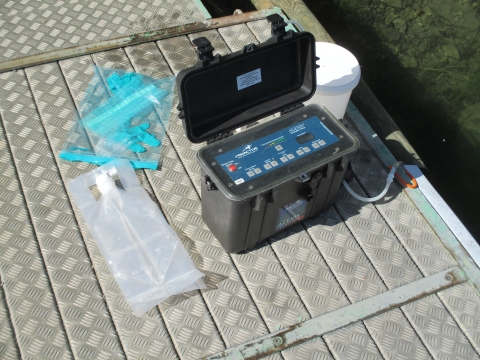
eDNA Detection: The KFKS developed assays to monitor the distribution of seven crayfish species in Switzerland using environmental DNA (eDNA) in water samples.
Containment via barrier is the most effective and economical method for preventing establishment of new NICS populations, thus preventing the need for later suppression or eradication. It is possible to eradicate populations by draining water bodies or using biocides, but these strategies are limited to small, isolated systems. Biocides may also harm the environment and other species. Suppression efforts can reduce the impacts of NICS, but can be costly, time-intensive, and often ineffective, since populations can quickly rebound once suppression stops (Krieg et al., 2020). Unlike other control measures, barriers can be implemented without negative impact to invertebrates, however, they can limit the migration of bottom-dwelling (benthic) and weak-swimming fish (Krieg et al., 2021), therefore managers should determine if this impact is of greater concern than the impact of NICS at the site.
Before barrier construction, managers should consider site characteristics including the distribution of NICS, existing structures, and water velocity. The KFKS recommends using eDNA sampling and traditional survey methods to ensure barriers are built upstream of existing NICS populations. To increase migration obstacles, barriers may be constructed directly upstream of existing structures such as walls, bridges, dams, channels and culverts. Constructing barriers as modifications to existing structures can reduce costs. It is important to extend the barrier on both banks, to prevent passing the barrier over land. To ensure functional water velocity, the KFKS recommends building fish-passable barriers in sites with constant water flow (within or downstream of hydropower plants) rather than in natural waters with fluctuating flow. A constant water velocity of at least 0.65 m/s prevents crayfish passage, in combination with smooth barrier materials which prevent crayfish from climbing. Stainless steel and GRP are recommended barrier materials since they are affordable, easy-to-use, and corrosion-resistant (Krieg & Zenker, 2020, Krieg et al., 2021).
After construction, monitoring should continue for at least one year to account for seasonal changes in crayfish migration. Barriers should be regularly cleaned and visited for maintenance.
Next Steps
- Construct approximately 30 additional barriers across Switzerland, especially in Lake Geneva, western Switzerland, where native white-clawed crayfish are threatened by signal crayfish.
- Establish breeding centers to increase indigenous crayfish numbers. Taking population genetics into account, breeding centers can produce crayfish for specific locations and conditions. Breeding centers may also selectively breed for certain adaptations enhancing crayfish resilience to climate change climate change
Climate change includes both global warming driven by human-induced emissions of greenhouse gases and the resulting large-scale shifts in weather patterns. Though there have been previous periods of climatic change, since the mid-20th century humans have had an unprecedented impact on Earth's climate system and caused change on a global scale.
Learn more about climate change . - Monitor the distribution and population densities of ICS and NICS using a combination of eDNA analysis, hand-catching, and trapping. Accurate and timely detection of populations is foundational to the success of management planning and action.
- Monitor fish-passability of barriers using internal PIT-tags.
- Maintain existing barriers and monitor long-term barrier functionality.
Funding Partners
- Swiss Federal Office for the Environment
- Industrielle Werke Basel
- Naturemade Star fund, Alpiq Hydro Aare AG
- Naturemade Star fund, EWZ
- Cantons of Aargau, Basel-Landschaft, Basel-Stadt, Geneva, Jura, Schaffhausen, St. Gallen, Tessin, Thurgau, Vaud, and Zurich
Resources
- Krieg, R. and A. Zenker. (2020). “A review of the use of physical barriers to stop the spread of non-indigenous crayfish species.” Reviews in Fish Biology and Fisheries 30: 425-535.
- Krieg, R., A. King, and A. Zenker. (2020). “Measures to Control Invasive Crayfish Species in Switzerland: A Success Story?” Frontiers in Environmental Science 8: 609129.
- Krieg, R., A. King, and A. Zenker. (2021). “Barriers against invasive crayfish species in natural waters and fish passes - Practical experience.” Global Ecology and Conservation 25: e01421.
- King, A.C., R. Krieg, A. Weston, and A.K. Zenker. (2022). “Using eDNA to simultaneously detect the distribution of native and invasive crayfish within an entire country.” Journal of Environmental Management 302(A): 113929.
- Moorhouse, T.P. et al. (2014). “Intensive removal of signal crayfish (Pacifastacus leniusculus) from rivers increases numbers and taxon richness of macroinvertebrate species.” Ecology and Evolution 4(4): 494–504.
- Chucholl, C. (2013). “Feeding ecology and ecological impact of an alien ‘warm-water’ omnivore in cold lakes.” Limnologica 43(4): 219-229.
- Rodríguez, C.F., E. Bécares and M. Fernández-Aláez. (2003). “Shift from clear to turbid phase in Lake Chozas (NW Spain) due to the introduction of American red swamp crayfish (Procambarus clarkii).” Hydrobiologia 506: 421–426.
- Cruz, M. J., Pascoal, S., Tejedo, M., and R. Rebelo. (2006). “Predation by an exotic crayfish, Procambarus clarkii, on Natterjack Toad, Bufo calamita, embryos: Its role on the exclusion of this amphibian from its breeding ponds.” Copeia, 2006(2): 274–280.
Contacts
Armin Zenker, University of Applied Sciences and Arts Northwestern Switzerland/Swiss Coordination Office for Crayfish: armin.zenker@fhnw.ch
Case Study Authors
- Blake Molenaar, CART Student Author, Florida State University
- Armin Zenker, University of Applied Sciences and Arts Northwestern Switzerland/Swiss Coordination Office for Crayfish: armin.zenker@fhnw.ch
Suggested Citation
Molenaar, B. J., and Zenker, A. K. (2023). “Determining Effective Strategies for Invasive Crayfish Management in Switzerland.” CART. Retrieved from https://www.fws.gov/project/strategies-invasive-crayfish-management.