Welcome to Nebraska Ecological Services Field Office Project Planning and Section 7 Section 7
Section 7 Consultation The Endangered Species Act (ESA) directs all Federal agencies to work to conserve endangered and threatened species and to use their authorities to further the purposes of the Act. Section 7 of the Act, called "Interagency Cooperation," is the mechanism by which Federal agencies ensure the actions they take, including those they fund or authorize, do not jeopardize the existence of any listed species.

Learn more about Section 7
Technical Assistance Website 

This page provides section 7 consultation guidance for federal agencies and their applicants and designated non-federal representatives.

To ensure that your project review packages are able to be reviewed as efficiently as possible, please include an Official Species List from the Information for Planning and Consultation (IPaC) website and all relevant project information. Every project review is important to us; we will do our very best to address project reviews in a timely fashion. Your patience is appreciated.

For emergency consultation, please see the following emergency consultation procedures handout for guidance. 

Section 7 Section 7
Section 7 Consultation The Endangered Species Act (ESA) directs all Federal agencies to work to conserve endangered and threatened species and to use their authorities to further the purposes of the Act. Section 7 of the Act, called "Interagency Cooperation," is the mechanism by which Federal agencies ensure the actions they take, including those they fund or authorize, do not jeopardize the existence of any listed species.

Learn more about Section 7
Consultation Technical Assistance Overview

Section 7(a)(2) Responsibilities 

Section 7(a)(2) of the Endangered Species Act of 1973 (Act) requires all Federal agencies to use their authorities to conserve endangered and threatened species in consultation with U.S. Fish and Wildlife Service (Service). Federal agencies must review their actions to determine whether they may affect listed species or federally designated critical habitat (50 CFR Part 402). To accomplish this, Federal agencies must determine if listed species or critical habitat are within the action area. We explain how to do that in Step 1 of this guidance. 

If listed species or critical habitat may be present in the action area, agencies must evaluate the potential effects of their action (see Step 2 and Step 3 of this guidance). If none are present or affected, no consultation is required.

Step 1. Identify Presence

Determine the presence of listed species or critical habitat in the action area action area
All areas to be affected directly or indirectly by the federal action and not merely the immediate area involved in the action.

Learn more about action area

1.A. Action Area

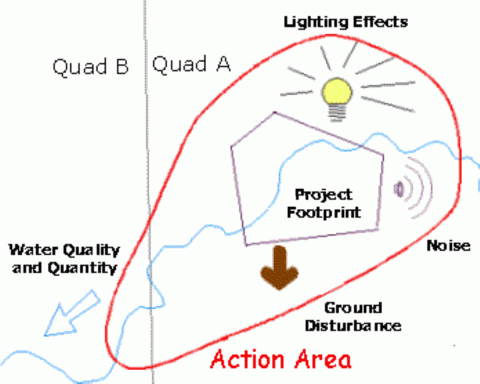
In the diagram, the project affects water quality or quantity downstream. So, the applicant should obtain a species list for both Quad A and Quad B (or County A and County B).

Action area refers to the area directly or indirectly affected by the proposed action. To identify the range of impacts, consider the effects the action may have on the environment such as:

  • Ground disturbance
  • Changes in ground or surface water quality or quantity
  • Air quality impacts
  • Lighting impacts
  • Noise disturbance

1.B. Official Species List 

An official species list is a list of federally listed species and designated critical habitats that may be in your action area. Use the Service's Information for Planning and Consultation (IPaC) system to generate an official species list.

Please note: An official species list is one piece of information our office needs to review your project. Creating an official species list is not the same as submitting a project review request. Please continue with the steps below.

1.C. Species Presence

To determine if listed species may be present in the action area, assess whether suitable habitat conditions exist by comparing species requirements with site characteristics, conduct surveys if needed, and assume presence if conditions are suitable but data is lacking.

1.D. Critical Habitat Presence

Critical habitat is an official designation under the Act that must be protected from adverse modification by federal actions. Presence of critical habitat is should be assessed by comparing physical and biological features of the critical habitat with site conditions. In Nebraska, critical habitat is designated for the Salt Creek Tiger Beetle, Topeka Shiner, and Whooping Crane.

Information on suitable conditions for species and critical habitat physical and biological features can be found on IPaC, in the official species list, or on our Nebraska Conservation Measures Document

Return to top

Step 2. Identify Effects

In step 1, you identified the presence of species and critical habitat in the action area action area
All areas to be affected directly or indirectly by the federal action and not merely the immediate area involved in the action.

Learn more about action area
. In this step, you will determine whether your project may affect a listed species or critical habitat and whether consultation is required. 

2.A. Impact overview

To describe the action and its effects, break the project into parts to identify any physical, chemical, or biological changes (stressors) that could impact species or critical habitat. Then, assess whether listed species—at any life stage—could be exposed to those stressors, even if not present during implementation. Finally, evaluate how the species or habitat might respond to that exposure.

2.B. Effect determinations

Consider the presence, stressors, exposure, and response of species and critical habitat identified above. Using this information, determine if the project actions may affect each listed species or critical habitat in the action area based on the categories listed below.

For threatened and endangered species and critical habitat:

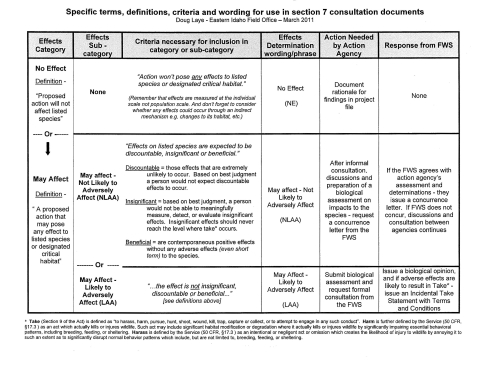
The Federal action agency must determine effects on listed species and designated critical habitat within the project area. Each species on the official list must be assigned one of three determinations: "No effect", "May affect, not likely to adversely affect", or "May affect, likely to adversely affect" (see Table 2).

  • "No effect" applies when the species is absent or no stressors are present.
  • "May affect, not likely to adversely affect" applies when impacts are possible but not adverse, especially if conservation measures (see Nebraska Conservation Measures Document) reduce effects to discountable, insignificant, or wholly beneficial.
  • "May affect, likely to adversely affect" applies when adverse effects are likely and requires formal consultation with the Service.
Note: For some species or projects, Determination Keys (DKeys) may be available in IPaC IPaC
Information for Planning and Consultation (IPaC) is a project planning tool that streamlines the USFWS environmental review process

Learn more about IPaC
to help reach an effect determination and conclude consultation.

Return to top

Table 2. Flowchart of determinations for effects of the action on listed species.

Step 3. State Coordination

In step 2, you identified effects on listed species and critical habitat. In this step, coordinate with the Nebraska Game and Parks Commission (NGPC).

All federally listed species are also protected under Nebraska law, and additional state-listed species may be present. To assess potential impacts, visit the NGPC Environmental Review webpage or contact the NGPC Environmental Review team at ngpc.envreview@nebraska.gov or (402) 471-5554.

Step 4: Package Submission

In step 3, you coordinated with NGPC. In this step, you will prepare and submit your consultation request to our office.

Once you’ve completed the previous steps and determined the effects of the project on federally protected species and critical habitat, you can submit an informal consultation request to the Nebraska Ecological Services Field Office to fulfill your ESA Section 7 Section 7
Section 7 Consultation The Endangered Species Act (ESA) directs all Federal agencies to work to conserve endangered and threatened species and to use their authorities to further the purposes of the Act. Section 7 of the Act, called "Interagency Cooperation," is the mechanism by which Federal agencies ensure the actions they take, including those they fund or authorize, do not jeopardize the existence of any listed species.

Learn more about Section 7
requirement.

Email your request to NebraskaES@fws.gov with a subject line that includes the IPaC IPaC
Information for Planning and Consultation (IPaC) is a project planning tool that streamlines the USFWS environmental review process

Learn more about IPaC
project code
, project name, and "consultation request". Include the following:

  1. IPaC generated Official Species List
  2. Any applicable DKey results or verification letters
  3. Biological assessment* that includes:
    1. Project name
    2. IPaC project code
    3. Internal agency project code (if applicable)
    4. Federal action agency / Federal nexus
    5. Project location (lat, long) a brief description and relevant maps
    6. Brief project description including all information from step 2.
    7. Request for informal consultation
    8. Effect determinations for all species and critical habitat listed in the official species list
    9. Justification for each effect determination
    10. Your contact information
  4. State Coordination NGPC outcomes or communication

*PLEASE NOTE: IPaC offers the Consultation Package Builder (step 3 in IPaC) as a tool to generate a biological assessment. Consultation Package Builder is an optional service and is not required for project review. It is intended to help guide you through organizing the information needed for consultation. The biological assessment can also be generated in a word processor including all of the information above.

Return to top