Written By

As part of the Flags Across America initiative for America’s 250th anniversary, the U.S. Fish and Wildlife Service is sharing stories from the places where our commemorative flags have traveled. From historic hatcheries to vibrant refuges, each stop celebrates conservation as an enduring American value. Join us as we highlight the lands, waters, and wildlife that connect our nation’s past, present, and future.

In March 2026, the flags visited Neosho National Fish Hatchery, the oldest continuously operational federal fish hatchery.
A little over 155 years earlier, in February 1871, the newly created U.S. Commission of Fish and Fisheries (forerunner of the U.S. Fish and Wildlife Service) began investigating a noticeable decline in fish stocks. One solution was establishing fish hatcheries across the nation to stock lakes, rivers, and streams. In 1888, the Ozark Mountain region was chosen to contribute to this broader effort, leading to the creation of Neosho National Fish Hatchery.

The southwest Missouri location appealed to the Fish Commission in part because of access to the railroad. Early on, hatcheries stored fish in milk cans or buckets and carried them by railcar (“Fish Cars!”), horseback, and wagons. A 1923 report indicates that over the previous 20 years railcars had carried over 72 billion fish across 2 million miles of railroad.
By 1890, the hatchery was raising seven fish species, and Neosho took advantage of the railcar to deliver them.
These days, Neosho National Fish Hatchery raises rainbow trout for anglers in Lake Taneycomo of Branson, Missouri. Cold water, released by Table Rock Dam, enables the production of rainbows – a fish native to North America, west of the Rocky Mountains, that has been introduced throughout the country.
The Lake Taneycomo rainbows help support a lucrative fishery for Missouri and the area economy. The Missouri Department of Conservation says rainbow trout make up about 90% of the fish caught in Lake Taneycomo. According to the U.S. Army Corps of Engineers, recreational benefits of Table Rock Dam top $60 million a year.
Neosho National Fish Hatchery also raises lake sturgeon as part of ongoing management efforts that have kept the giant fish from needing protection under the Endangered Species Act.
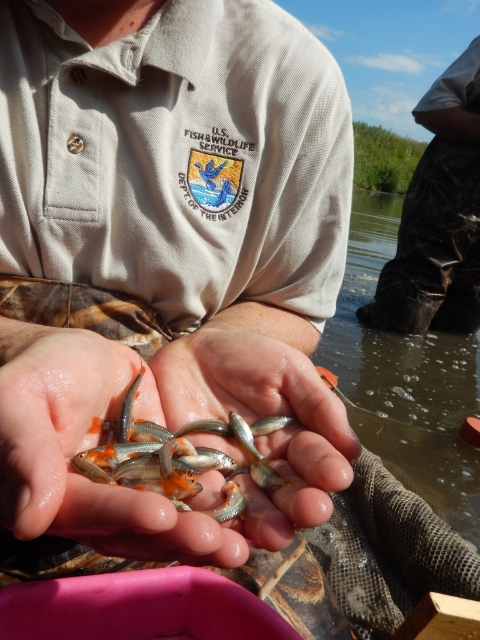
The hatchery is also working to restore the Topeka shiner, a small fish protected as endangered in 1998. Thanks to private lands partnerships that help restore oxbow lakes, hatchery-reared Topeka shiners can be reintroduced into healthy habitats.
More Than Fish
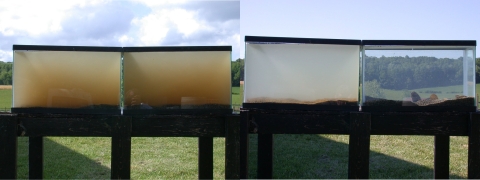
And like many hatcheries, Neosho has branched out beyond fish. Staff at Neosho are widely considered to be leading experts in the field of mussel propagation, contributing to reintroduction efforts and broadly sharing their expertise to help others restore “the livers of the river.” So-called because of their ability to filter water, freshwater mussels play an important role in aquatic habitat, but the 300 species of freshwater mussels are the most vulnerable group of animals in North America. The Endangered Species Act protects more than 90 freshwater mussels.

One mussel Neosho National Fish Hatchery produces is the endangered Neosho mucket.
The mussel life cycle is fascinating. Their larvae are called glochidia. The glochidia of most freshwater mussel species, including Neosho mucket, have a parasitic stage during which they must attach to the gills, fins, or skin of a fish to transform into a juvenile mussel. When the transformation is complete, the juvenile mussels drop from their fish host and sink to the stream bottom where they mature into adults. The fish swims on its merry way.
Neosho mucket glochidia attach to smallmouth, largemouth, and spotted bass.
Pollinator Conservation
Neosho and its Friends group are also dedicated to doing their part to advocate for pollinator conservation. They have used the visitor center and beautified the grounds with pollinator gardens to educate the community about the plight of pollinators and the important role they play in the web of life. Neosho staff recently created floating wetlands for the hatchery’s outdoor rearing ponds to serve as pollinator gardens above the water while the root systems provide structure for the fish below the surface.

On top of all of this, the hatchery’s park-like setting in the heart of Neosho serves as a primary gathering space for the community, and it hosts five popular fishing events each year.

Neosho National Fish Hatchery may be the nation’s oldest federal hatchery, but as the diverse portfolio suggests, the hatchery is not slowing down.
Next up, we follow the flags to Tishomingo National Fish Hatchery, which raises one of the oldest and largest species in the freshwater fish world, alligator gar. Stay tuned for the next chapter on this historic tour!
Written By