Chokecherry (Prunus virginiana) and Mayday trees (P. padus), also known as European bird cherry, are closely related common ornamental landscaping trees. Chokecherry is native to much of North America, while Mayday trees are native across Northern Europe and Asia. Both are small to medium deciduous trees and produce showy delicate white flowers. Noteworthy traits of each plant have yielded their common names. The flowers bloom in fragrant clusters that turn into small fruits, known as chokecherries. The raw fruits are bitter for human consumption but are eaten by wildlife and are a favorite of birds.

In Alaska, both chokecherry and Mayday trees (collectively referred to throughout as chokecherry) are invasive species invasive species
An invasive species is any plant or animal that has spread or been introduced into a new area where they are, or could, cause harm to the environment, economy, or human, animal, or plant health. Their unwelcome presence can destroy ecosystems and cost millions of dollars.
Learn more about invasive species . Theyare one of the top disruptive plants in both urban and semi-urban landscapes. Originally introduced as attractive, hardy ornamentals, to the state, chokecherries spread far beyond yards and parks. They produce abundant berries that birds tend to disperse seeds across long distances. Additionally, they spread vegetatively from suckers and extensive lateral root systems once established. As a result, chokecherry seedlings are now appearing along river corridors, forest edges, roadsides, and greenbelts—areas where they were never intentionally planted but now pose substantial ecological risks.

The problem
One of the most significant impacts of invasive chokecherry is its ability to outcompete native vegetation. In Alaska, native willows, alders, and cottonwoods provide essential forage and diverse habitat for moose, snowshoe hares, and numerous bird species. Chokecherry’s rapid growth, shade tolerance, and prolific seed production give it an advantage over native species. Over time, this can lead to shifts in forest composition, with dense patches of chokecherry reducing biodiversity and creating a complete monoculture.
Chokecherry invasions also create concerns for stream health and aquatic habitats. Native riparian riparian
Definition of riparian habitat or riparian areas.
Learn more about riparian vegetation supports diverse quantity and quality of insect communities. These insects fall into streams and are eaten by juvenile fish, including salmon. In contrast, chokecherry forms a dense monoculture with less insect biomass and diversity, potentially decreasing available food for juvenile fish. These changes threaten salmon habitat and other sensitive aquatic ecosystems, making chokecherry not only a terrestrial problem but a watershed-level issue.

In addition, chokecherry pose potential health risks to wildlife. The leaves, bark, and seeds contain cyanogenic compounds that can build up when wilted or stressed, especially during cold snaps. Although many wildlife species instinctively avoid harmful levels, the risk increases as chokecherry spreads into new habitats, especially where it replaces safer native forage. There have been multiple documented deaths of moose calvesattributed to chokecherry poisoning in Anchorage, Alaska.
The solution
Recognizing these significant ecological impacts, members from the Alaska Invasive Species Partnership collaborate to reduce the spread of chokecherry through prevention, early detection, and removal. Homer Soil and Water Conservation District and partners remove and replace chokecherry trees in communities on the Kenai Peninsula, including free removal and replacement for landowners! Anchorage Cooperative Invasive Species Management Area hosts an annual Anchorage Weed Smackdown event to engage community volunteers in removing chokecherry saplings at parks across town. They also have a landowner assistance program. Fairbanks Soil and Water Conservation District, University of Alaska Fairbanks, Friends of Creamer’s Field, and other partners have worked together in the Fairbanks area to remove and replace chokecherries.
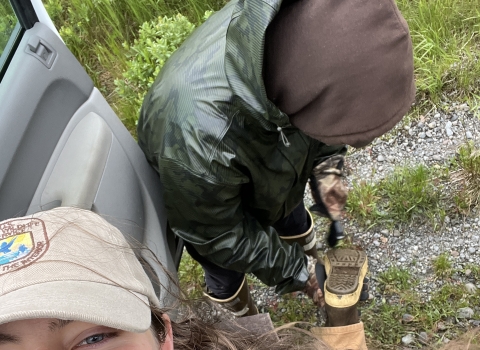
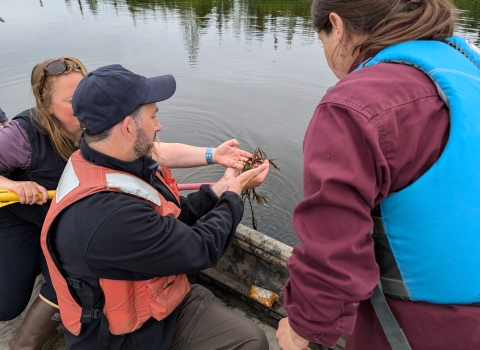
In addition to removal efforts, many partners, including U.S. Fish and Wildlife Service and Homer Soil and Water Conservation District, focus efforts on early detectionsurveys to prevent trees from spreading into wild landscapes. This prevents large infestations from establishing on National Wildlife Refuges and other wild landscapes. In 2026, Homer Soil and Water Conservation District and partners, conducted detection surveys along the Kenai River for chokecherries.
With recognition that preventing chokecherries from being planted is the most important step, in 2025, Alaska Department of Natural Resources Division of Agriculture issued a statewide quarantine on these two chokecherry species, Prunus virginiana and P. padus. This crucial management tool prevents the importation, sale, transport, and propagation of chokecherry, cutting off a primary pathway for new trees to be introduced. Because controlling chokecherries isn’t as simple as cutting them down, stopping new plantings is one of the most cost-effective long-term strategies.
Ultimately, a statewide chokecherry quarantine helps protect Alaska’s native forests, wildlife habitats, and watersheds. By preventing further spread and supporting coordinated management, it safeguards ecological integrity for future generations. It is inspiring to see how the USFWS, partners, and communities across Alaska are contributing their expertise, passion and time to respond to the challenge posed by chokecherries.


Join the cause:
Do you have chokecherries in your yard? Several organizations can help support you to remove them (often for free!).
In the Anchorage area, contact and learn more fromAnchorage Cooperative Invasive Species Management Area (CISMA).
On the Kenai Peninsula, contact and learn more from Kenai Peninsula Cooperative Invasive Species Management Area(KP-CISMA).
Have you seen chokecherries in the wild?
In the Anchorage area, use Anchorage CISMA online weed watcher reporting form. Your reports will help identify invasive species on wild lands in Anchorage.
On the Kenai Peninsula, use KP-CISMA online prunus tree reporting form. Your reports will help KP-CISMA partners locate priority trees and survey areas to support healthy habitats.
In the Fairbanks and greater Interior Alaska area, join the Fairbanks Soil and Water Conservation District (FSWCD) Chokecherry Challenge. Your reports will help FSWCD and partners document as many invasive trees as possible in interior Alaska.
Elsewhere across the state, use the Alaska Invasive Species ID App and linked reporter.